“There are no guards at the gate capable of creating a barrier to the incursion.”
Sometimes a word arrives before I know where it belongs. I wrote that sentence as it came through in guidance on April 16, 2025. I’m returning to it now as a bookmark. At the time, I had no event to attach it to. I had the word, its context, and a question as to why that word was given. Looking back, I’m less sure of the context than I thought. I wrote it down and I was baffled by it.
On October 18, 2026, the word appeared again in my channeled material:
“The guides have indicated this is an incursion that will widen our field of knowledge but it is challenging in the moment because of the confusion surrounding the idea that this is not possible and the incidents are fiction, fantasy, and/or hoax.”
Then an unexpected item in my newsfeed gave me another way to think about the word. It describes an anomalous event from the nineteenth century.
A Nudge, Not a Definition
A quick clarification of my intent. I am not offering this event as the meaning of the word, or the word as the solution to the event. The word was never about a definition. The dictionary gives incursion a meaning, usually a hostile raid or invasion. What interests me is how the word was used: as a signal to pay attention.
I understand it as a preset of sorts: a nudge to take a closer look, and a reason to watch for a key I might use in contemplating events that seem impossible and reports that seem unbelievable.
In my view, incursion points to the apparent entry of something uninvited and unknown into familiar experience. It carries no military intent, no judgment of good or evil, and no identity. Uninvited simply means it arrived without being summoned or expected. It says nothing about where it came from or what it wanted.
Doors in the Sky
The event was reported on October 1, 1863, a few miles west of Lewisburg in Greenbrier County (then described as Virginia, now West Virginia). The account was later preserved in APRO Bulletin Vol. 32, No. 2, which reprints an 1863 newspaper report.
Around 3 p.m., Moses Dwyer and others on his porch saw enormous numbers of pale, door-sized forms that looked like cotton or smoke, fringed in light green. The forms moved in orderly ranks over the treetops to the south, and they took about an hour to pass. Then, in the valley below, thousands of human figures appeared. They were dressed in white shirts and trousers and carried no weapons. They marched in formation up a steep hill, stooped like men climbing, and passed out of sight to the north. [Source: APRO Bulletin Vol. 32, No. 2]
This image is an imagined representation created with ChatGPT.
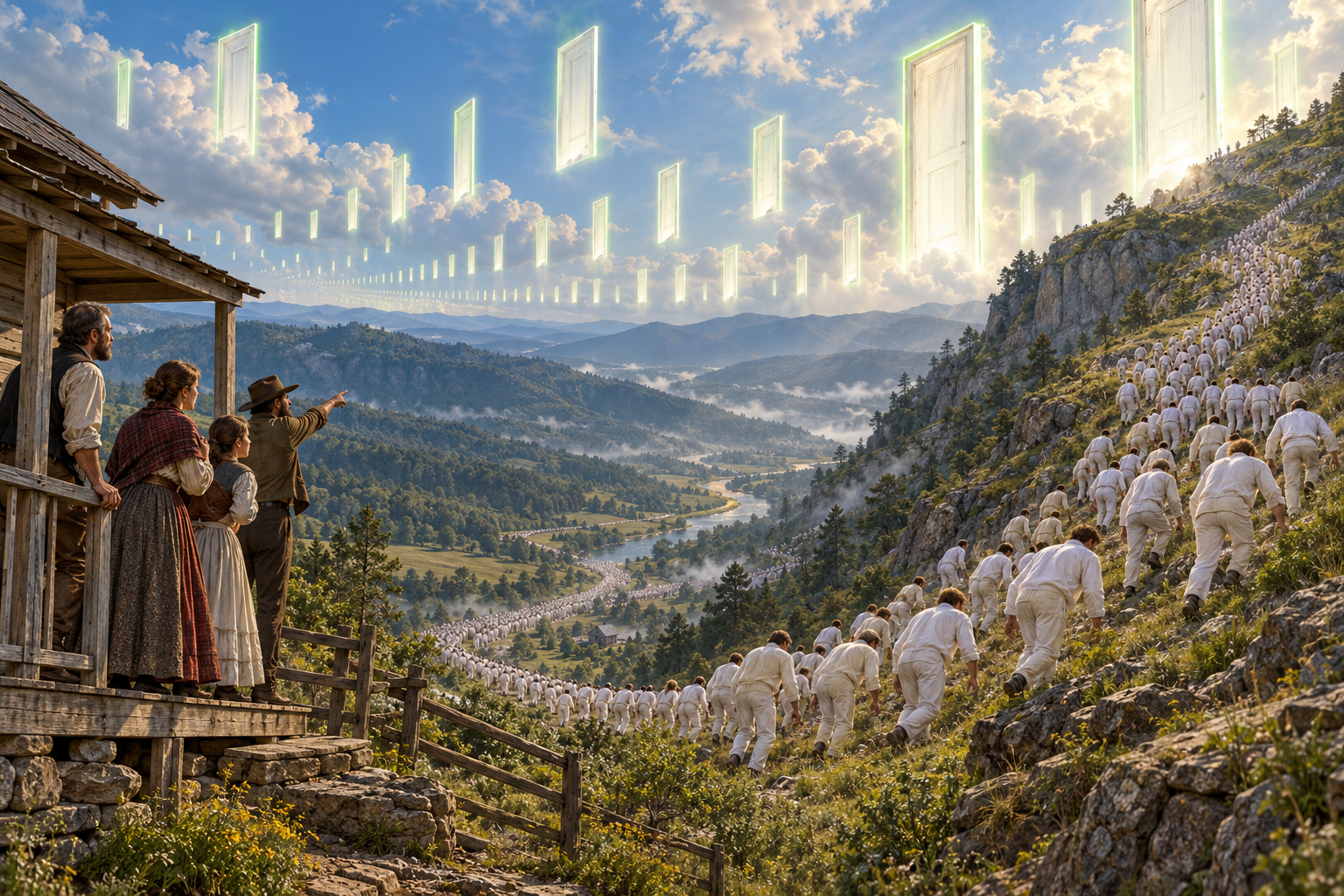
Doors in the sky. A marching contingent dressed in white, leaning forward as it made its way up an incline.
What happened? I’m not sure the question can be answered in the terms we usually use. The witnesses described what they saw with the words they had: doors, cotton, smoke, men, marching. Those words were the nearest available approximations. When we don’t understand what the experiencer actually perceived, we can’t assign the event a meaning, and we can’t rule it true or false. What remains is the record.
Someone recorded an extraordinary observation. It survived long enough for a reader in another century to come across it with different questions.
When the Marching Does Not End
What I did discover in the historical accounts is interesting. Eleven days before the reported procession near Lewisburg, the Battle of Chickamauga ended in northern Georgia. The battle ran from September 18 to 20, 1863, with the heaviest fighting on the 19th and 20th. It produced more than 34,000 casualties, counting men killed, wounded, missing, or captured. That figure is not deaths alone, but it conveys the scale of suffering just before witnesses described an unexplained multitude crossing the Greenbrier landscape.
The timing invites a question. Do accounts like this belong in the same conversation as the apparitions, phantom formations, and unexplained activity reported at other Civil War sites?
Gettysburg offers a comparison. American Hauntings recounts reports of figures marching in formation, riding horses, and seemingly continuing the actions of battle. Its collection also includes a story said to have been recorded by the Civilian Conservation Corps in the 1930s. In it, a man who worked at the Rose Farm shortly after the battle reportedly saw a strange luminous shape near soldiers’ graves.
These accounts come from paranormal literature, and how well they can be traced varies. What interests me is their recurring imagery: movement, figures, burial places, and sudden appearances.
The stories continue into modern reporting. In a HISTORY article first published in October 2024, journalist Crystal Ponti describes Gettysburg accounts of phantom footsteps, drumbeats, gunfire, and uniformed figures who vanish. Former park ranger and ghost-book author Mark Nesbitt is among her sources. The article also includes the Pennsylvania Hall elevator story, in which two administrators reportedly saw what looked like a Civil War hospital scene before the doors closed and the vision disappeared.
There is a Spiritualist context as well. The White House Historical Association describes how the war’s enormous losses and disrupted mourning fed interest in séances and communication with the dead. Families were looking for continuity across absences that were often sudden, distant, and painfully unresolved.
Within a spiritual interpretation, a procession might suggest souls continuing a journey. In paranormal discussion, similar scenes are sometimes described as residual impressions, where a past event seems to repeat, or as an unexplained overlap of times.
These are different proposed explanations, and the reports don’t establish which, if any, applies. Nor does the timing identify the Lewisburg figures as Chickamauga’s dead. The locations are hundreds of miles apart, and no documented link connects the two events. The white clothing and lack of weapons in the Lewisburg account also set it apart from typical descriptions of uniformed battlefield ghosts.
Still, a comparison gives the account another place to be filed. A multitude that appears, moves through the landscape, and disappears has recognizable parallels in the literature of battlefield hauntings. The battle supplies historical context, and the paranormal accounts supply comparisons. Who the figures were and is it somehow related? That remains an open question.
Outside the Reality Box
Ingo Swann’s work on “reality boxes” offers a useful connection. He explored the frameworks of belief and perception we use to organize experience and decide what seems possible. His idea raises a question: what do we do with an account that has no acceptable place in our existing framework?
We may call it an illusion, a fantasy, a mistake, or a mystery. Some of those labels may eventually prove right. The trouble starts when a label ends the inquiry before the account has been properly considered.
This is where the nudge matters. Incursion doesn’t tell me what the Lewisburg witnesses saw. It asks me to notice the interruption itself: something unfamiliar appearing in an otherwise recognizable setting, and the strain it puts on the words we use to describe it. If the event happened as described, what might it have changed in the environment, in the witnesses, or in their understanding of reality?
An unresolved encounter can shape the present through the questions it leaves behind. Working with material like this takes patience. We can’t return to that afternoon in 1863, interview the witnesses, or ask the procession to repeat under observation. We have an anecdotal record. We can look for related accounts. We may still never know what produced it. That limitation belongs in the story. So does the reason to preserve it.
A new frame of reference for an old report might reveal a question we didn’t know how to ask. A later observation, discovery, description, or better-documented event might clarify something that once seemed incomprehensible. (Think UFOs.)
The Bookmark Remains
I’m placing the April passage beside the October guidance and the 1863 account. Not to say that one explains another. It’s that the word keeps returning, and each time it points toward the same territory: experiences that defy our descriptions of them.
Then again, some things simply are not what they seem, and some may not be anything our current language implies. For now, incursion is an invitation to keep looking.
Curiouser and curiouser!
Sources:
- Strange Alien Army Seen Marching During Civil War – Vocal, which links the APRO Bulletin Vol. 32 No. 2 PDF
- Gettysburg: Ghost Stories From the Civil War Battlefield – HISTORY
- Chickamauga – National Park Service
- Battle of Chickamauga – House Divided, Dickinson College
- This Day in History: September 20, 1863 – Mystic Stamp
Discover more from Conscious Living & Wendy's Coffeehouse
Subscribe to get the latest posts sent to your email.


