Intuition, encounters, and a reality exempt from official permission
By Wendy Garrett
“Beyond anything you can fathom.”
The words returned when I asked what would be most helpful for me to know. Then came another thought: that which you have yet to imagine.
I take notes when I hear these prompts, filed under the category of intuitive guidance. Sometimes a message gives me something to consider immediately. Other times, the connection arrives later, through a conversation, a book, or an old note I had forgotten. This time, the words arrived while I was gathering material about encounters with the unknown.
The impression was of beings whose presence challenges our understanding of the material world. The word was incursion. In the guidance as I understood it, these encounters would widen our field of knowledge, while creating confusion because they involved things we have been taught cannot happen.
That is the perspective I am exploring. Something may be trying to get our attention — and we may be so occupied with deciding who is authorized to announce it that we overlook the people already describing their encounters.
An unknown presence would not need a government channel. It would not need permission to exist. Yet so much public discussion seems to wait for an approved announcement. A document. A credentialed spokesperson. The appropriate letters after a name, preferably accompanied by military clearance. Those things can help establish the provenance of a particular claim. They cannot confer existence on whatever the claim concerns. If something happened, it happened before anyone stamped the paperwork.
I understand the desire for official acknowledgment. It can change the conversation and give people who have remained silent a reason to speak. But I am interested in what people are reporting while we wait.
Their stories deserve a place in the record now. The sequence that brought me back to this material began with an archived interview. I was listening to my conversation with Dr. Melba Ketchum about the Sasquatch Genome Project and wondering whether to re-edit the show. An old link no longer worked. I found a fundraising page and began reconsidering the questions surrounding the research.
I had also purchased Stan Milford’s book, thinking about a possible interview follow-up. I knew of his work with John Dover, the investigators often called the Paranormal Rangers, but had not yet begun reading it. Then, preparing to interview Keith Thompson, I opened his book, Anomalous Phenomena: Apports and the Mystery of Objects That Materialize and Translocate.
The first page I opened brought me to an account from the Navajo Reservation investigated by Milford and Dover. According to the passage I was reading, a woman heard her doorknob rattle. When she opened the door, she saw a towering, shaggy figure with matted, unkempt fur. It darted off the porch. The account included a footprint described as twenty-one inches long, with toes showing, and a stride of approximately five feet.
Then came the detail that sent me back to my notes. The woman described camera imagery in which the being appeared to rise from the ground, take form, and dissolve back into the soil.
What interested me was the difficulty of fitting all its reported details into one explanation. A recognizable outline suggested Sasquatch. The described appearance and disappearance suggested a different set of questions. What are we identifying when we name something by its shape? How much of the account do we retain after choosing the name?
The language of my own intuitive impression complicated that question further. I had written transverse. It would have been easy to change it to traverse and move on. Traverse describes passing across or through. Translocate describes a change of location. Transverse carries the sense of something lying or extending crosswise. That word introduced a different image: movement across the arrangement we take for granted, perhaps between planes rather than along a familiar route..
Travel. Traverse. Translocate. Transverse. What if the difficulty lies partly in the picture of movement we bring to the encounter? I experience the timing of these discoveries as guidance.
When I returned to a journal entry from December 2025, I found an earlier instruction: “Tell a story. We are ready.” The entry spoke of preparing a space for an audience. Reading it again, I recognized the work in front of me: gather the fragments, follow the connections, and give the reader enough room to consider them.
Intuition helps direct my attention. It does not remove my responsibility to decide what to do with it. Even the source may have an agenda.
Calling a presence a guide describes the relationship as I experience it. It does not give me complete knowledge of that presence, its perspective, or its intentions. A message may encourage, challenge, or redirect. I can ask where that direction leads. Why this subject? Why this sequence? What am I being encouraged to notice? What might I still be overlooking?
Those questions belong beside the message. They also belong beside an encounter. Something unfamiliar does not automatically deserve reverence. Something frightening is not automatically understood because we are afraid of it. The rattling doorknob in Thompson’s account should remain unsettling. We do not need to make the encounter comforting before we allow it into the conversation.
Fear and reverence can both rush ahead of understanding. I suspect the middle ground is respect. Respect for the witness. Respect for uncertainty. Respect for boundaries. And enough respect for the unknown to avoid assigning it a complete identity on the strength of a familiar silhouette.
This is why I want more stories gathered. A collection can preserve what people observed, how they understood it, what others witnessed, and what remains available to examine. It can also preserve the consequences: the person who became afraid of the woods, the person who became more curious, the person who waited years to speak because ridicule seemed inevitable.
Then there is the researcher who withheld certain details from publication because they seemed too great a leap for an audience already being asked to reconsider what was possible. Budd Hopkins spoke candidly about making that choice. I’ll explore his explanation in the next piece.
Those differences matter. Scientific investigation has tools that can help us learn. My objection is to dismissal that arrives before investigation, especially when the strangest part of an account becomes the reason to exclude it.
If we retain only details that fit an accepted explanation, we have already shaped what the record will allow us to discover. I want the inconvenient details included. I want the ordinary explanations considered too. I want accounts compared carefully enough that their differences survive.
Nobody needs to accept every explanation to recognize that this is work worth doing. Perhaps some encounters will become understandable through things we already know. Others may remain unresolved. Some may eventually require us to reconsider assumptions we thought were secure. My interest is in keeping that inquiry open.
“Beyond anything you can fathom” offers no finished map. It asks me to consider how much room I have left for discovery. I am gathering these stories because I suspect our familiar account of reality is incomplete. I want to hear from the people whose experiences have led them to the same question, even when our interpretations differ.
Something may be trying to get our attention. I would like us to listen long enough to discover what we can learn. One final nudge from the intuitive guidance: “Stop listening to skeptics and focus on recording the footnotes.”
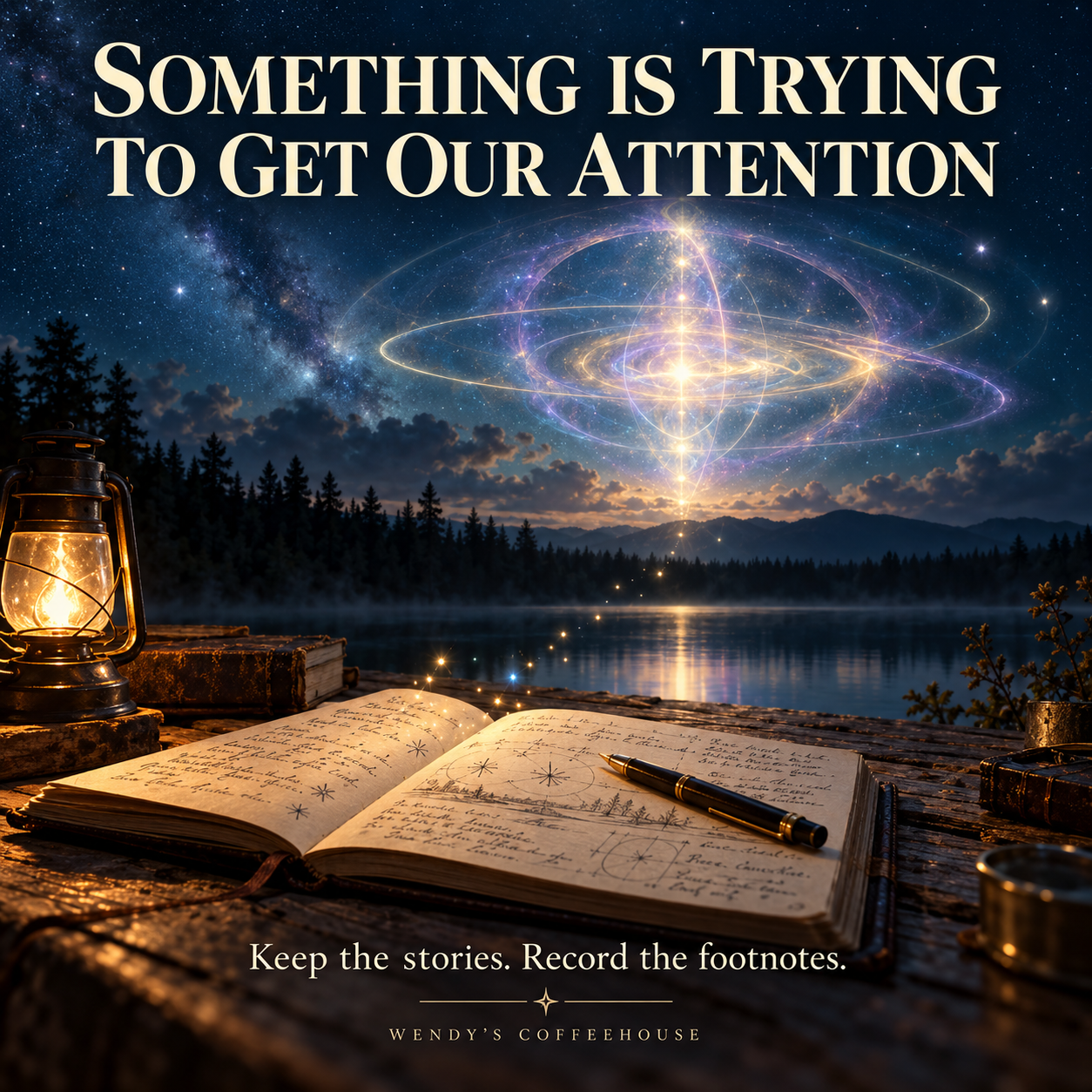
The details we overlook today may be the ones someone needs tomorrow.
And that brings me to the next segment: Budd Hopkins — what he left out, why he left it out, and why those details belong back in the conversation.
Working source notes —
- Encounter account: Keith Thompson, Anomalous Phenomena: Apports and the Mystery of Objects That Materialize and Translocate. Details above are drawn from Wendy’s supplied description of the passage involving John Dover and Stan Milford. Add the page number and check the measurements and wording against the book before publication. No claim is made here to have inspected the original camera footage. Publisher’s book page.
- Podcast: Wendy’s Coffeehouse, “Proof Denied? Bigfoot DNA — Dr. Melba Ketchum”, April 1, 2021. I am revisiting this material. Dr. Ketchum is also an experiencer.
- Personal material: Mine. October 18–20, 2026 descriptions and supplied journal entry dated December 6, 2025. Intuitive guidance.
- Terminology: Merriam-Webster, traverse and transverse; Collins, translocate. I received “transverse” as an intuitive prompt — an invitation to broaden the framework through which we consider these encounters. Reading it as a suggestion of movement between dimensions is my interpretation.
Discover more from Conscious Living & Wendy's Coffeehouse
Subscribe to get the latest posts sent to your email.


