You give someone a nightlight to help them see in the dark — and to say, You are not alone.
Notes from the path
Just back from a weekend break. Dark skies, clear weather, and the tail end of the Perseids — enough of the shower left to make looking up worth it. The drive was its own kind of omen: we dodged rain going out and coming back, and we were paid for the trouble with a rainbow. I didn’t stop to photograph it, which I half-regret, but it was enormous and vivid — and unique. Not the usual arc. A straight line, earth to sky, like a seam stitched between two places.
That feels about right for where things sit. We’re in the handoff from summer to fall, and I’ve got a few things up in the air — including an upcoming interview with astrologer Moonrabbit about her new book, Death Charts: An Astrological Tool for the Bereaved, which reads the natal, death, and bi-wheel charts as instruments for grief and healing. Fitting company for a season about endings that aren’t quite endings.
Here’s the part I keep bumping into: my usual precog window has gone quiet. My recent dream (8.24.26) came back unavailable — and I’ve stopped reading that as a problem. It feels more like a prod. A nudge to stop sweating the minutiae, quit projecting worst-case scenarios, and trust right place, right time. Some things simply need to play out, and no amount of straining at the horizon will hand me the lay of the land ahead. The curtain has been drawn on the preview. Whatever dread I might sketch onto the dark is only that — a projection. Better to step back and let the reveal arrive on its own schedule.
Which brings me to a dream that says the same thing in pictures.
Some dreams announce change before your waking mind has admitted it’s coming. They stage it — a barrier you can’t cross, a figure who won’t let you pass, a message you can’t quite decode. If you learn to read the staging, these dreams become a surprisingly practical early-warning system for the transitions ahead.
Here’s one dream, told exactly as it happened, and a working method for reading your own.
The dream
I am standing at the entry to a familiar hallway but there is a man who is mute who will not let me go further. I wonder if it is because there is another man who is also standing beside me. I wonder if I can’t go further because he is with me. That man, a witness to this event, indicates my hearing is fine. He makes a noise that sounds like a tone. Neither men speak. They just look at me.
I say as both a question and a statement, I am not going to be able to visit Michael anymore. The man in the hall becomes very animated in his actions, thumbs down, exasperated at my conclusion, indicates that is not the case. I have assumed the worst.
The situation is odd because he apparently isn’t allowed to speak. Since this is difficult for me to understand what is going on and there is no language to offer any clues, I empathize and understand he is doing what he can to indicate this is the state at the moment and working with my inability to understand his intention or purpose.
I look at him and say, you have a hard job. Another man has arrived and it is Rod Serling – The Twilight Zone. They all laugh and smile that I complimented the man guarding the hallway. Then Rod Serling sings a phrase, “in days gone by, the girl who made me cry, I heard her. “
The structure underneath
Here’s the shape beneath the dream — the scaffolding the rest of this guide will point back to.
A person stands at the mouth of a hallway. A mute man blocks the way forward — he won’t let them pass, and offers no explanation about why. There may be a reason tied to a second man standing beside them. The second man, a witness, proves the dreamer’s hearing is fine by making a single tone, but he doesn’t speak. Neither man does. They only look.
The dreamer jumps to a conclusion: I won’t be able to visit Michael anymore. The guard becomes animated — thumbs down, exasperated. No. That’s not it. You’ve assumed the worst. The dreamer softens and tells him he has a hard job. Everyone relaxes. Then Rod Serling of The Twilight Zone appears, the group laughs warmly, and Serling sings a line about hearing, long ago, the girl who made him cry.
It’s strange, yet specific. The structure is doing something you can learn to spot.
Five signals that a dream is telegraphing a transition
1. A threshold you’re held at, not moving through. Hallways, doorways, bridges, airports, staircases, gates — liminal spaces are the dream’s native vocabulary for “between two states.” When you’re stuck at one rather than passing through it, the dream is often asking you to sit with a transition you haven’t finished processing. In this dream, the entire scene happens at the mouth of a hallway. The change hasn’t happened yet; you’re at its edge.
Try this: Ask what threshold in waking life you’re currently paused at. A job you haven’t left, a relationship shifting shape, a version of yourself you’re outgrowing.
2. A guardian who blocks the way. A figure who stops you isn’t necessarily an enemy. In dreams, the obstacle is frequently protective — a part of you that senses you’re not ready, or that the feared outcome isn’t the real one. Notice the guardian’s tone. Hostile is different from reluctant.
Try this: Instead of “what’s stopping me,” ask “what might this be trying to keep me from misunderstanding?”
3. A communication barrier. The muteness is the crux. The witness / second man’s hearing test is pointed: your perception is fine — the problem is meaning. You can see the signals clearly and still not know what they mean, and the not-knowing is the actual discomfort.
Try this: Where in your life can you perceive that something is changing, but can’t yet decode what it means or where it leads? That gap is usually the emotional center of the dream.
4. The worst-case leap — and the correction. This is the most useful signal. The dreamer assumes loss (I can’t visit Michael anymore), and the dream pushes back hard. When a dream visibly corrects your catastrophic reading, some part of you already suspects the door you fear is closing isn’t actually closing.
Try this: Write down the loss you’re bracing for. Then ask, honestly, what facts actually support it — and how much is anticipatory dread filling an information vacuum.
5. A tonal shift that resolves it. The turn comes when the dreamer stops fighting the barrier and extends empathy: you have a hard job. The mood breaks open into laughter. Transitions in dreams often resolve not when you force the door but when you change your relationship to the obstacle. Serling’s arrival practically winks at this — The Twilight Zone is the genre of “it’s not what you feared; here’s the reframe.” His sung line loops back to hearing, grief, and memory, hinting that the real charge lives there rather than in the surface standoff.
A simple method you can reuse
When a dream leaves you unsettled, run it through four questions:
- Where was I held? Name the threshold. Match it to a waking transition.
- What blocked me, and how did it feel? Distinguish a hostile obstacle from a protective one.
- What did I assume — and did the dream agree? Catch the catastrophic leap and note whether the dream confirmed or corrected it.
- What shifted the mood? The moment of resolution usually points to the move your waking self needs to make.
A reminder
Dreams are personal. The same hallway means different things to different dreamers, and no template overrides your own sense of what a symbol carries. Treat these signals as prompts for reflection, not decoded verdicts. If a dream keeps returning, or arrives with real distress, that’s a sign to talk it through — with someone you trust, or a professional — for an objective overview.
What makes the doorway dream so eloquent isn’t that it hands you an answer. It’s that it dramatizes the exact shape of being on a threshold: you can hear fine, you just can’t yet understand — and the thing in your way may be trying, in the only language it has, to tell you the loss you fear isn’t the one that’s coming.
One thing I didn’t tell you
Michael isn’t a friend down the hall. Michael is the Archangel — the one I turn to for the occasional chat.
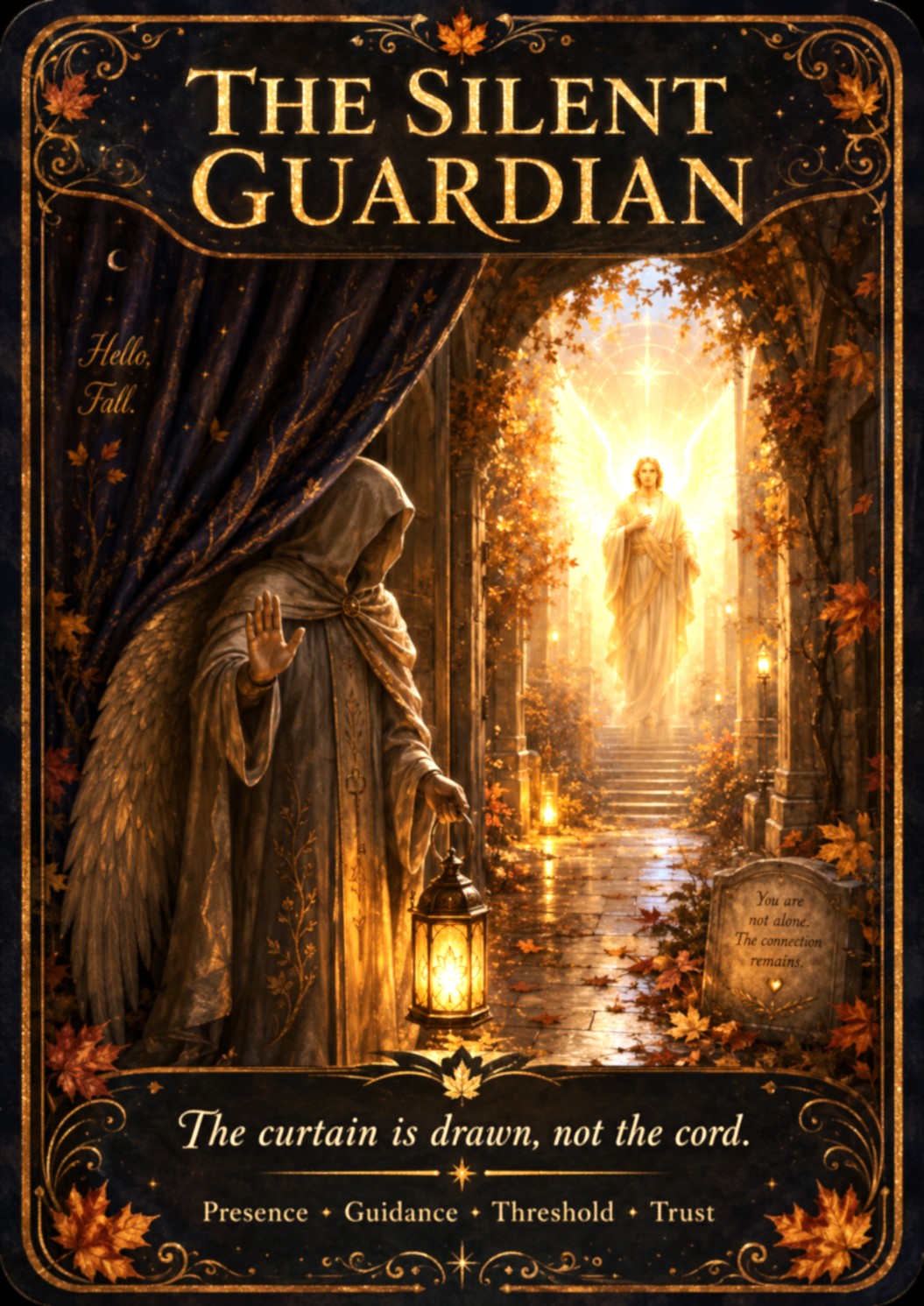
I kept it neutral because that bit is very personal. It also changes the weight of the whole dream. “I won’t be able to visit Michael anymore” was never a fear of losing a person. It was the fear of losing access to guidance itself — right at the entry point of a phase my guides have been calling beyond the pale. That’s the very human dread underneath all of this: that the thing I’m being asked to walk into is the exact thing I’ll have to walk into without my usual reassurance. Facing the unknown and worrying the line will go quiet exactly when I’d want it most.
And look how emphatically the dream refuses that conclusion. The guard gets animated — thumbs down, exasperated — no, that’s not it, you’ve assumed the worst. Read through this lens, that’s a rebuttal to the fear. The channel isn’t being cut. The precog window going dark is a drawn curtain, not a severed cord. Michael isn’t becoming unreachable — I’ve just misread the silence as loss. The very figure I’m afraid of losing is, through the mute guard, working as hard as he’s allowed to tell me he’s still there.
Afterword
Which brings me back to that last line — the thing in your way may be trying, in the only language it has, to tell you the loss you fear isn’t the one that’s coming.
Because here’s the deal. My worry, my projection, may have less to do with the dream itself than with the foreshadowing my guides have been leaning on. No words for this next phase, they say. Closest approximation: beyond the pale. Unlike any point in your world history. The scene will play out past anything you can picture. And then — with what I can only describe as a straight face — the “nightlights” are a very tiny peek into the abyss. And that’s the most positive cue we can offer.
See what I mean? Coy and vague and, I suspect, a little pleased with themselves about it. Which is its own kind of tell. If the message were pure warning, they’d have found sharper words. Instead they hand me a shrug, a wink, and a nightlight — and trust me to notice what a nightlight is for. You don’t give someone a nightlight to keep them from looking. You give it to help them see in the dark. To say: it will be dark for a while, and here is enough light to move by, and you are not alone in the dark.
Notice, too, how the dream and the foreshadowing rhyme. A mute guardian who can’t use words but can allow a tone to prove my hearing works — that’s the same gesture as a guide who has “no words for this phase” but offers a nightlight anyway. Both are saying the same thing: I can’t give you the language you want, but I can give you a signal. Presence without explanation. Enough to see by. Communication is being deliberately limited — never withdrawn.
So I’ll take my own advice and the dream’s both. The curtain is drawn for a reason. Whatever I’d sketch onto the dark from here is a projection, not a preview. The reveal will play out when it plays out, and my job in the meantime is to quit straining at the horizon and stay open to the good that’s also possible.
Forward we go. Hello, Fall.
Discover more from Conscious Living & Wendy's Coffeehouse
Subscribe to get the latest posts sent to your email.


Dear Wendy,I hope you’re doing well.You had reached out to Bruce last year regarding an interview for your Podcast conscious living and Wendy’s coffee House.  At the time our schedule was completely packed and we weren’t able to make it work, but Bruce is now available and would love to join you for a conversation.Bruce’s primary focus right now is dwelling into the nature of time, time anomalies, and how consciousness and physics intersect. Given the themes you explore on your show we think this would make for a thought-provoking deep dive discussion that your audience would really connect with. Before scheduling, we’d love for you to check out our latest video to get a sense of his current research and direction. YouTube channel: Bermuda files @beyondBermuda triangleLatest video: UFOs in the Bermuda Triangle (see thumbnail below) Let us know if you’re still interested in having Bruce on the show and what dates or times might work best for your recording schedule.  Normally, Bruce receives a small fee for his interviews but we will be happy to do  at no charge but, would appreciate help with getting subscribers to our You Tube Channel.  We are very close to our 500 followers and are trying to reach more subscribers.  The last podcast interview Bruce just finished a few weeks ago got us 100 followers!  We were so happy! Also, we are in the process of publishing two more books.  The latest book: Bermuda Triangle Survivor( 2023) we are creating a new Edition for adults and a children’s book as well.  Bruce has a lot to discuss after we released the last video.  The Gernon Archive is another addition for our research done over the last 50 years. Talk to you soon if you’re interested! Warm regards,Lynn GernonManager, Bermuda files, LLCbermudatriangle@bellsouth.net 561-281-5492
LikeLike
Hi Lynn! Outstanding. I would love to talk with Bruce – I recently shared an updated interview on the podcast and here is the post from youtube = https://youtu.be/Sp68ZyZu2SU?si=T2o4-8tTFEHF2iMJ = I sent you an email and look forward to booking a date to talk about the videos and the books. I’ll watch that new video to get up to speed. Thank you for checking in! Adding your video for others who might be interested: This is an excellent overview of the experiences and sightings in addition to the Bermuda Triangle Electronic Fog encounter — https://www.youtube.com/watch?v=vifMzQTht1E
LikeLike