“Know thyself. And while you’re at it, find thy keys.”
Consciousness, identity, and the question of who we are when we are no longer ourselves
My mother went in for a routine surgery.
The operation itself was uneventful. Nothing had gone wrong on the table, and her readings were good — blood pressure, heart rate, oxygen, all of it steady and unremarkable. The trouble came afterward, once she had been returned to her room and it was time to bring her back up out of the anesthesia. The nurses called to her. The doctor called to her. She did not respond. Her body was there, stable and present and doing everything a body is supposed to do. But she would not surface. Minutes passed, and then more minutes, and the ordinary calm of a recovery room began to tighten into something closer to alarm.
The problem, it turned out, was a name.
The name on her chart, under preferred name, was Ann. It was what everyone had called her for the better part of twenty years — but it had not always been hers. Her given name was Judith, and she had gone by Judy her whole early life. When she moved, as an adult, into a new community, there was already a Judy there, well known to everyone. To spare the confusion of two women answering to the same name, she did the sensible, courteous thing: she set Judy aside and went by her middle name instead. Ann was simpler. Ann kept the peace. It seemed, at the time, like a small and obvious accommodation.
Two decades later, on a recovery-room bed, that small accommodation nearly cost her everything.
Because down in whatever country she had gone to under the anesthesia, the name they kept calling was not the thread that reached her. Ann was the name she wore for other people. It was the name on the mailbox and the name at the door, and it had served her well in the daylight world. But it was not the name stitched to the deepest part of her, and when the staff leaned over the bed and called for Ann, no one answered, because — in the place she had gone — there was no Ann to answer.
Then one of the nurses looked again at the full legal name printed on the chart. Judith Ann. And on a hunch, she tried a shorter variation.
“Judy.”
And my mother came back. It took the better part of an hour to bring her all the way up. Afterward, in her own words, she said she was not certain she would have woken at all if no one had thought to use that name. Ann, she said, simply didn’t fit. The name they were calling slid off the surface of her and never reached down to where she actually was.
I have wondered about that experience for a long time, because it asks a question most of us never have to face: when everything else is stripped away — when the daylight self is gone, the body merely idling, the surface personality switched off like a light — what is left? And what, exactly, were they calling to?
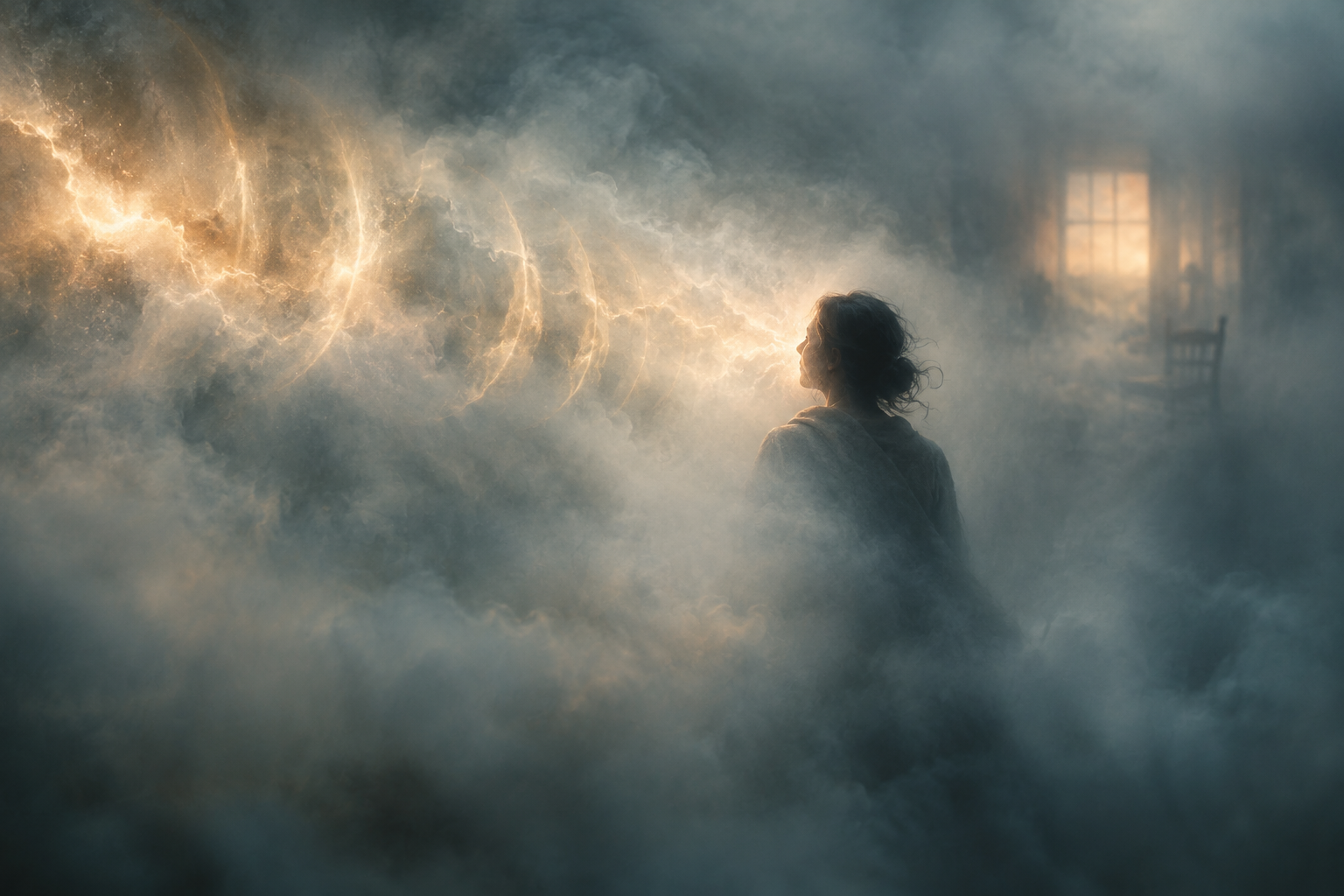
The thread that resonates
We treat names as labels. Interchangeable, editable, a matter of paperwork and convenience. My mother’s experience suggests they are something else entirely.
A name is the handle the self is carried by. It is the particular sound that means you, imprinted so early and so deep that it goes on meaning you even when memory, personality, and awareness have gone dark. In clinical settings it is standard practice to use a patient’s name to orient and rouse them — to give the submerged mind something familiar to reach toward. But my mother’s case points to a sharper truth hidden inside that practice: not just any name will do. It has to be the right one. It has to be the name the person answers to in the oldest part of themselves, not the name they present to the world.
Most of us carry more than one. We are renamed at marriage, shortened by friends, formalized on documents, nicknamed in childhood, and sometimes — like my mother — we quietly trade one name for another to smooth the path for everyone around us. Each of those trades feels weightless in the moment. A child dreads the name on the school register. An immigrant’s name is sanded down at a border until it fits an official’s mouth. A woman takes a husband’s name and is expected to answer to it as though she had always been that person. We make these adjustments without thinking, and most of the time they cost us nothing we can measure.
But identity is bound to the name whether we grant it permission or not. And it is never as simple to walk away from a name as it seems, because a name is not only yours — it is the thread everyone else uses to find you. Change it, and you had better hope that the people who come looking are paying close enough attention to follow the new one all the way down to where you actually are.
My mother renamed herself for what seemed, at the time, the most practical of reasons. Twenty years later, in a recovery room, a stranger called her by the name she had parked on a shelf — and brought her back through the fog.
The unlit country
Where does a person go, when they are under?
We have a growing collection of reports from people who have been there and come back — and the most striking thing about those reports is how little they resemble a simple switching-off.
Unconsciousness keeps no clock. There is no instrument for time inside the mind, and cut off from the ordinary turning of morning into evening, consciousness runs on a frame entirely its own — folding a moment into hours, hours sometimes into what feels like years. People returned from deep unconsciousness have described far more time passing within than the calendar ever recorded without: long stretches, whole journeys, entire seasons of experience lived while the body lay still for a matter of hours. My mother was “gone” for an entire hour — long enough to trigger a quiet panic in the staff, and in my stepfather, who had no idea what to do. What that hour was like from the inside, she could never fully say.
The neurologist Oliver Sacks spent a career documenting the stubborn persistence of the self beneath catastrophic illness — the patients in Awakenings, frozen for decades and briefly returned to themselves; the way, in Musicophilia, a familiar melody could reach a person that words and faces no longer could. Music, it turns out, is one of the last roads in. So is a voice. So, as my mother discovered, is a name. These are the signals that still get through when almost nothing else does, which tells us something important: the submerged mind is not empty. It is listening. It is simply listening from very far away, and only the deepest, most familiar signals carry that far.
During the pandemic years, when unprecedented numbers of people lay sedated for weeks at a stretch, families and clinicians began reporting something they had not expected — patients surfacing with the memory of long, vivid, frequently terrifying other lives: elaborate worlds, journeys, captivities, whole populated realities that had felt utterly solid from the inside. The journalist Alan Pearce, together with Beverley Pearce, collected many of these accounts in Coma and Near-Death Experience.
What we clinically call ICU delirium, their work suggests, is not simple confusion. It is the mind, cut off from the ordinary world, building one of its own out of whatever material drifts down to it — and the material that drifts down is the room. A monitor’s beep becomes a bird, or a bell. A conversation at the foot of the bed becomes a conversation in a dream, half-heard, its words quietly rearranged. A name, called with love and urgency, becomes a voice calling across an enormous distance, through a landscape the sleeper cannot name.
If the mind can build a whole world while the body lies still — and weave into it the sounds of the room it cannot consciously perceive — then “unconscious” is a poor word for what is happening. Something is awake down there. It is simply awake somewhere else.
Who are we when we dream?
We do not have to be anesthetized to lose ourselves. We do it every night.
In dreams, the ordinary self loosens its grip. The waking personality — so certain of its name, its history, its place — dissolves, and something stranger takes the controls. We accept impossible logic without protest. We meet the dead and do not question it. We become, at times, someone other than who we are, and feel no contradiction. And then each morning the daylight self reassembles itself out of the dark, picks its name back up, and resumes as though nothing had happened. We think so little of this nightly undoing that we rarely ask the obvious question: if “I” can be set aside every night and reconstituted every morning, how fixed is that “I” to begin with?
Some of the people who have taken this question most seriously were not mystics but scientists. At the Menninger Foundation, beginning in the 1960s, Elmer and Alyce Green spent their working lives demonstrating that a person can learn to reach the parts of the self the body is supposed to manage without ever being asked — heart rate, blood pressure, skin temperature, the slow theta rhythm of the brain that lies along the border of sleep. They called it the voluntary control of internal states, and they meant it plainly. They fixed their instruments to ordinary people and to visiting yogis alike and watched the supposedly involuntary bend, gently, to attention and intention. They gathered what they learned into a book called Beyond Biofeedback. The border between what merely happens to us and what we can steer, their work suggested, is far less fixed than the machines imply.
There is a quieter and incredibly fascinating coda to their story. Years later, as Alyce sank into Alzheimer’s, Elmer — the man who had spent a lifetime trusting his instruments — began instead to keep a record of his dreams: nights in which he believed he was meeting her, or some traveling part of her, in places that were neither that room nor this world. He came to think that what looks from the outside like a mind erasing itself may be, from the inside, a consciousness already partway across — moving between worlds through the corridors of dream while the body stays behind at the table. He wrote it into a book with a title that is hard to forget: The Ozawkie Book of the Dead: Alzheimer’s Isn’t What You Think It Is. One need not accept his conclusions to be struck by the question he was asking, which is the same question my mother’s recovery room asked, and the same one the dreamer asks every night: when the surface of a person goes, where does the person go?
When another identity surfaces
There is a stranger country still, at the far edge of all this, and I will describe some of what has been documented and what I have witnessed myself.
For more than half a century, researchers at the University of Virginia — first Ian Stevenson, then his successor Jim Tucker — have documented thousands of cases of very young children who speak, unprompted, of a life before this one: a house, a family, a way they say they died, and now and again a name. Stevenson catalogued his earliest findings in Twenty Cases Suggestive of Reincarnation; Tucker carried the work forward in Life Before Life. Walter Semkiw, building on their research, gathered many more. What strikes me in these accounts is how often the thread that surfaces first, or most insistently, is a name, and how often what comes with it is not a tidy set of facts but a weight of unfinished feeling.
The same pattern appears in the most carefully documented adult cases I know of — people I have had the privilege to interview myself. Stéphane Allix, a French investigative journalist trained to trust data over intuition, was ambushed by the vivid memory of dying as a soldier in another era, and went and traced the man; he tells the story in When I Was Someone Else. Jeffrey Keene, a Connecticut assistant fire chief, was overcome by grief at a battlefield he had never visited and slowly uncovered the Civil War officer whose wounds answered to his own, an account he set down in Fire in the Soul. Robert Snow, an Indianapolis homicide detective set out to debunk his own past-life regression and instead identified — name and canvas both — a nineteenth-century painter he had never heard of, which he documented in Looking for Carroll Beckwith.
What these accounts share is the thing that carries across ahead of any fact, and clings the hardest: the feeling. Grief, guilt, an old pride, an unfinished fear, still tangled and still live, arriving a lifetime early and fastened to a name its owner cannot yet place. Whatever the explanation, it appears that emotion is the most durable cargo a consciousness carries — more durable than language, more durable than memory, and strong enough, in these accounts, to cross a timeline intact while the name that belongs to it waits to be recovered.
I have an account of my own to add. I have, at times in my life, been the person a message arrives through, and not long ago a family friend died. At his funeral I learned he had collected a lifetime’s worth of Titanic memorabilia — models, photographs, artifacts — a passion dear to his heart. Days later, an impression arrived: a man in a dark uniform, a cap, brass buttons, and then, the words I was an engineer. I got a flood of emotions, the feeling of pride, awe, the sorrowful ache of watching a marvel fail, and beneath it a sense of duty so complete that he would never have taken a place in a lifeboat.
I went looking, and in a crew photograph I found a senior electrician listed as P. Sloan, whose face, when his family set the two pictures side by side, was unmistakably his. He had always said he had been aboard. His spouse confirmed the rest. The Titanic’s engineers stayed below as she went down, keeping the lights burning so the others could find their way to the boats; not one of them lived. My family friend, it seems, carried the pride of that work across a hundred years, still in love with circuitry and light — and it was a name, in the end, that let the two lives recognize each other.
It seems that the pattern is always the same: an identity that outlasts the self it was supposed to belong to, and a name that serves as the knot where the two are tied together.
The oldest question
Put these together — the anesthetized mind that would not answer to the wrong name, the dreamer who dissolves and reforms each night, the patient building worlds in a coma, the child or the fire chief carrying someone else’s grief — and a single thread runs through all of them.
In every one of these states, the ordinary self, the daylight personality so sure of its own boundaries, turns out to be far more provisional than we like to believe. It can be switched off and the person remains. It can be rewritten nightly and the person returns. It can, in the most amazing accounts, be dropped in one life and revived in another. Something persists beneath the self we introduce at parties — something that was listening in that recovery room, something that goes traveling every night, something that may carry an old pride across a century of water. And whatever that something is, it is reached by recognition. By the right signal. By the name it answers to.
Which only sharpens the question, rather than answering it. Because if the self can be set aside and the person remains, then who is the person? What is the thing that persists when the name, the memory, and the personality have all gone quiet? My mother knew, in that hour, that she was someone who would not answer to Ann, someone still waiting to be called correctly. But she could not have told you who. She only knew it when she heard it.
This is the oldest question we have. It was carved into the forecourt of the temple at Delphi as two words — Know thyself — and it has been pressed on every seeker, saint, and philosopher since: Who am I? We have built religions, sciences, and entire lives around the attempt to answer it, and the remarkable thing, after all these centuries, is that we still cannot. We can describe the brain in exquisite detail and still not locate the one who looks out through it. We can watch a self dissolve in sleep and reassemble at dawn and still not say what it is that does the reassembling.
Maybe the fact that the question has never been answered is itself the most important clue. Could it be that the self is not a thing to be found at all, but a thread to be followed — and the name is simply where we can take hold of it.
My mother’s story refreshes that ancient question for me, and gives me reason to delve deeper, to question more, to wonder.
It would seem we have more in common with the butterfly than a first glance would suggest. Maybe our real rebuilding happens between lives — spirit exiting one body and cloaking itself with another, and even, now and then, slipping into a life already underway, a case the old accounts called a walk-in. I find myself exploring this as a storyteller, too: telling tales and looking to see what is missing inside the box — a box that, when you open it, is somehow bigger on the inside than the outside could ever hold. And the further in you wander, the more boxes you find, each one still unopened. What a story that implies. Who am I? Where do I originate? What happens when the world inside the box becomes more real than the world outside it?
That is the hint my mother gave me. She had no wish to come back to this world — not until someone said her name. Only then did the world outside the box seem real again; only then did the clues and the life she had built up to that moment remind her that there was a place called home, and that she could still return to it.
So where do we go when this world blinks out? Maybe the answer isn’t here at all and we won’t know until we arrive somewhere else — somewhere the answer finally matters, when that time comes. And the only thing all this not-knowing does for me is make me want to learn how others have traveled this path, and what breadcrumbs they left behind that might still be glowing in the dark.
Curious.
Further Reading
Alan Pearce and Beverley Pearce, Coma and Near-Death Experience: The Beautiful, Disturbing, and Dangerous World of the Unconscious (2024)
Oliver Sacks, Awakenings (1973)
Oliver Sacks, Musicophilia: Tales of Music and the Brain (2007)
Elmer Green and Alyce Green, Beyond Biofeedback (1977)
Elmer Green, The Ozawkie Book of the Dead: Alzheimer’s Isn’t What You Think It Is (2001)
Stéphane Allix, When I Was Someone Else: The Incredible True Story of Past Life Connection (2021)
Jeffrey J. Keene, Fire in the Soul: Reincarnation from Antietam to Ground Zero (2021)
Robert L. Snow, Looking for Carroll Beckwith: The True Story of a Detective’s Search for His Past Life (1999)
Ian Stevenson, Twenty Cases Suggestive of Reincarnation (1966)
Jim B. Tucker, Life Before Life: A Scientific Investigation of Children’s Memories of Previous Lives (2005)
Walter Semkiw, Return of the Revolutionaries: The Case for Reincarnation and Soul Groups Reunited (2003)
Discover more from Conscious Living & Wendy's Coffeehouse
Subscribe to get the latest posts sent to your email.


