“Everything you see is an illusion. Yes, it is physical. Yes, it is an illusion. Think about that. That’s how you walk through walls.”
That was the message. At the time, I had no idea what to do with it. I had not been researching time shifts. I wasn’t thinking about retrocausation, alternate realities, Philip K. Dick, Joan Lindsay, or people who claim to have walked around a corner and found themselves looking at a world belonging to another century. I simply wrote it down.
Then a coffee coupon disappeared. I had received an email offering a coffee promotion available during a specific period. Later, when I tried to use it, the promotional image was still visible in the app — but the offer itself wasn’t active. So I went looking for the original email. It wasn’t there. Not in the inbox. Not in Trash. No evidence that I had received it. And yet I remembered the offer well enough to know exactly what I was looking for.
Could there be an ordinary explanation? Of course. Emails disappear. Apps glitch. Promotions change. Servers fail to synchronize. There is no proof of anything anomalous here. Only a discrepancy. And a question.
Then I remembered the earlier prompt. Everything you see is an illusion. Yes, it is physical. Yes, it is an illusion. Think about that. That’s how you walk through walls.
Suddenly I had somewhere to begin. Not because a missing coffee coupon proved reality had shifted. But what if the point wasn’t proof? What if the point was to notice?
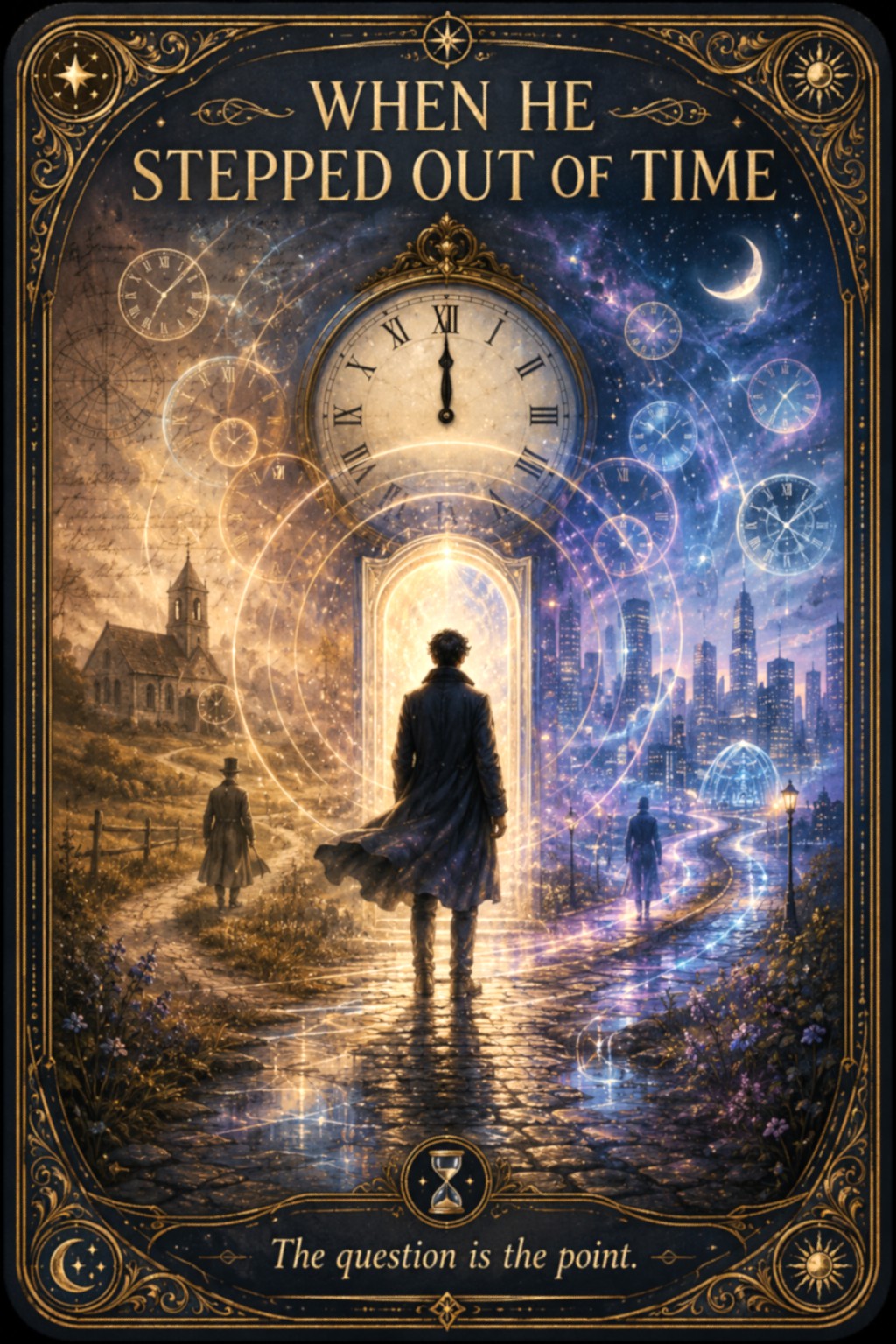
There are stories people hesitate to tell, because the moment they put them into words, they know how impossible they will sound.
A man is walking down a familiar street. Nothing announces what is about to happen. There is no flash of light, no dramatic loss of consciousness, no obvious break in perception. And then the world is different.
The buildings are wrong. The cars belong to another era. People are dressed in clothing decades out of date. A storefront that vanished years ago is suddenly open for business. Someone passes close enough to touch. There are sounds, smells, movement, weather.
It does not look like a memory. It looks like now. And then, just as abruptly, it is gone. Traffic returns. The storefront disappears. The people are gone. Perhaps only seconds have passed. The experiencer has returned to the present. But the present is no longer the same place.
The Problem Isn’t What Happened
We usually approach stories like this by asking the obvious question: Did it really happen?
We want an explanation. Was it a neurological event? A dissociative episode? A memory somehow projected onto the landscape? An unusual state of consciousness? A genuine perception of another point in time? Those are worthwhile questions. But they may not be the most interesting one.
For the person who experienced it, something already happened. They saw it. They were there. And when ordinary reality snapped back into place, they returned carrying something they did not have before. Knowledge.
Not necessarily knowledge that can be proven. Knowledge that has been experienced. And those are very different things.
Assume It Worked
Russell Targ and Harold Puthoff devoted a chapter of Mind-Reach to questions of time and precognition, extending the remote-viewing work they had begun at Stanford Research Institute. Hella Hammid was among the participants in their early research. The surviving record even includes an explicitly labeled “Precognitive Remote Viewing” protocol — a remarkable inversion of the ordinary arrangement of cause and effect, in which the viewer attempted to describe a target before the later target event had occurred.
In Mind-Reach, Targ and Puthoff approached this strange territory with an attitude they associated with Jung: Assume the experiment is going to be successful.
That changes the question completely. Instead of beginning with This cannot happen, so what went wrong?, you begin, temporarily, with Suppose it did happen. Now what?
This is not an instruction to abandon critical thinking. It is an invitation to postpone dismissal long enough to examine the implications. Because if even one authentic precognitive perception occurs, the philosophical problem becomes enormous. The future was somehow available before the experiencer reached it.
Then What Exactly Is “Now”?
We have built much of everyday life around a beautifully functional model of time. Yesterday is gone. Today is happening. Tomorrow does not yet exist. It works wonderfully for appointments, mortgages, birthdays, and train schedules. It may not describe consciousness nearly as well.
Consider what happens during precognition. At 10:00, you perceive something. At 2:00, it happens. At 2:01, you realize: I already knew this.
That realization is the anomaly — not simply the prediction. Because the event at 2:00 retroactively changes the meaning of what happened at 10:00. Something you might have dismissed as imagination suddenly becomes information. The future has validated the past. And for a moment, the neat little arrow we draw from yesterday to tomorrow begins to wobble.
Now return to the man on the street. Suppose what he saw wasn’t a hallucination. Just for the purposes of inquiry, grant him that possibility. He did not travel through time in the science-fiction sense; his body may never have moved. Instead, perhaps something happened to where consciousness was located in relation to time. For several seconds, the familiar organizing principle we call the present loosened, and another scene became available.
Yesterday did not return to him. He became capable of perceiving it. That suggests the past might not be annihilated simply because we have moved beyond it. It may remain part of a larger informational structure from which ordinary perception normally excludes us. The strange event isn’t that yesterday still exists. The strange event is that, for a few seconds, someone apparently stopped being restricted to today.
Premonitory experiences are even more disruptive. A scene from the past leaves one intellectual escape hatch — perhaps some unusually vivid memory was triggered. Seeing tomorrow removes that comfort.
Imagine dreaming that you enter a room you have never visited. Someone in a red jacket drops a glass. A dog begins barking. A woman says an unusual sentence. Two weeks later, you enter that room. The red jacket is there. The glass falls. The dog barks. And then the woman begins speaking.
There is a peculiar moment in experiences like this when the person isn’t predicting what comes next. They are remembering it — except the memory belongs to something that has not yet happened. That is where language begins failing us. We call it precognition because we need a noun. The word does not explain what occurred. It merely gives us somewhere to file the impossible paperwork.
The Clock Is Not Time
Joan Lindsay, author of Picnic at Hanging Rock, had an unusual relationship with time long before her novel became synonymous with temporal mystery. She reportedly avoided wearing watches, because, she said, they had a tendency to stop. Her home was notably free of clocks.
Even the title of her 1962 memoir — Time Without Clocks, published five years before the novel appeared — hints at something deeper than eccentricity. In a 1975 interview she described time as something surrounding us rather than stretching forward like a line on a calendar. People who knew her recalled that she did not regard time as strictly linear.
That makes the recurring clock imagery in Picnic at Hanging Rock considerably more interesting. As the party approaches Hanging Rock, watches stop. Normal chronology begins to loosen. The characters enter a landscape in which ordinary measurement appears increasingly irrelevant. And then people disappear — not necessarily, in Lindsay’s conception, into another place. Possibly into another relationship with time.
One acquaintance recalled her explaining that past, present, and future could be thought of as existing together rather than separated into the sequence we ordinarily experience. He understood her missing girls accordingly: they had not become lost in space. They had become lost in time.
The idea becomes more intriguing still when we know Lindsay identified An Adventure — the celebrated account popularly known as the “Ghosts of Versailles” — as an inspiration for the novel. In that story, two English women visiting Versailles believed they had unexpectedly encountered a scene belonging to an earlier historical period. Whether that represents a literal time-slip is a separate question. For our purposes, something more provocative matters: what happens when a person begins behaving as though linear time is only one way of experiencing reality?
Most of us rarely separate the clock from time itself. The clock says 3:17, therefore it is 3:17. But the clock isn’t measuring time. It is measuring regular physical change and giving us a standardized reference. We have become so accustomed to that reference that we mistake the measuring device for the thing being measured.
Imagine an experience that breaks the association. You are standing somewhere in 2026. For several seconds, everything around you appears to belong to 1926. Then 2026 returns. Your watch has continued ticking. Which one was time? The clock measured continuity. Your consciousness did not. And from that moment forward, the clock might begin to look less like an authority and more like an instrument — useful, necessary, but perhaps incomplete.
For Lindsay, this wasn’t merely literary. According to biographer Janelle McCulloch, in Beyond the Rock: The Life of Joan Lindsay and the Mystery of Picnic at Hanging Rock, Lindsay reported anomalous experiences of her own. In 1929, driving with Daryl Lindsay to Creswick to visit his family, she saw several nuns running through a field. They appeared frightened. They were looking behind them. And beyond them she could see what seemed to be a building on fire. Daryl had not seen anything. She immediately sensed that what she was witnessing did not belong to the present. She later investigated: a convent had once stood on that side of town. It had burned down years earlier.
No photograph handed to her in advance. No second witness. No instrument recording the event. Only a landscape, a moment, and the recognition: this does not belong to now.
That is the difficulty of the time-slip experiencer. The event can be astonishingly vivid while leaving almost nothing behind.
One more interesting detail worth mentioning. On the night of the Victorian premiere of Picnic at Hanging Rock at Melbourne’s State Theatre, the artist Martin Sharp noticed that the theatre clock had stopped. At twelve. In isolation, a stopped clock means very little; clocks stop. But placed beside Lindsay’s relationship with time, the temporal dislocation at the heart of her novel, and her own reported experiences, it becomes another curious entry in a larger pattern.
Proof? No. A clue? Perhaps. Picnic at Hanging Rock may reflect the worldview of a woman who had already discovered, through her own experience, that time did not always behave the way clocks said it should. Removing clocks doesn’t remove time. It removes the continual instruction about how you are supposed to experience it.
If you had personally witnessed time contradict everything you were taught about it, how seriously would you continue to take the clock? Not that you would stop showing up at three o’clock. But you might stop believing three o’clock tells you everything there is to know about where you are.
The Long Self
This brings us to Eric Wargo. Wargo is an anthropologist with a PhD, and the author of a run of books that press one unsettling idea from several angles: Time Loops: Precognition, Retrocausation, and the Unconscious; Precognitive Dreamwork and the Long Self: Interpreting Messages From Your Future; From Nowhere: Artists, Writers, and the Precognitive Imagination; Where Was It Before the Dream; and most recently Becoming Timefaring: Time Travel and the Human Future. He writes at thenightshirt.com.
In a November 2021 AMA on r/precognition, he fielded questions from people describing their own precognitive dreams and synchronicities. His central argument is provocative: what we call precognition may not be a message arriving from some mysterious outside source at all. It may be information moving between different points in our own lives.
That single move quietly dissolves much of the usual paranormal catalog. Synchronicity, telepathy, clairvoyance, remote viewing, the sudden certainty that a particular person is about to call — Wargo folds them all into precognition.
Information refluxing from our own future, he argues, always feels as though it comes from outside us, so people file it under whatever fits their beliefs. But there are often tracers. Dream that your mother has been in an accident and you cannot confirm it until you phone her — which means the later phone call, not any signal from elsewhere, was the true source of what you knew.
His concept of the Long Self asks us to take the next step. The person we experience as me, right now may be only one temporal portion of a much larger self extending across a lifetime. Tomorrow’s self. Next year’s self. The self twenty years from now. From our ordinary perspective those people do not yet exist. But the messages in precognitive experiences, Wargo suggests, come from exactly there — from our own future selves. And so the “meaning” people hunt for in a strange dream isn’t hidden in some external system of symbols. It’s your own biography: the unfolding story of your life, glimpsed slightly ahead of time. People are so used to looking for meaning outside themselves that they miss how rich their own story already is.
His work on dreams explores an especially intriguing consequence: that some precognitive dreams function less like predictions than like memories — except the remembered event hasn’t happened yet. And they rarely arrive as literal previews. Most connect to the later experience associatively and symbolically, which is why, Wargo argues, conventional experiments miss the overwhelming majority of precognitive material. Unless you are willing to read dreams the way Freud read them, you will not recognize the connection when it finally arrives.
That inversion is worth considering. Normally: experience, then memory. Something happens; later, you remember it. Precognition suggests the reverse — memory drawn from experience that has not yet occurred. The emotional impact of a later event somehow becomes available beforehand. You dream something strange Tuesday night. Friday afternoon, something happens. And suddenly Tuesday’s dream makes sense; the future event has supplied the missing key to the earlier image.
That is another kind of time slip. You never left your bed. The landscape didn’t transform into another century. No clocks stopped. But consciousness apparently encountered information belonging to a part of your life you had not yet reached.
That points to Wargo’s most radical proposal, which he stated flatly in the AMA: the Freudian unconscious is precognition. He calls for a “return to Freud” — not because Freud believed any of this (he didn’t), but because Freud unknowingly drew the map, and even, in the dream that made him famous, appears to have precognized a major later event in his own life. Reframed this way, your future consciousness becomes the unconscious of the present moment: not a basement of repressed material, but a deferral toward what you have not yet lived. The dream, the hunch, the flash of recognition — possibly information arising not from elsewhere but from elsewhen. From you. To you.
Let me clarify how grounded Wargo tries to keep this. He is an unapologetic materialist. Precognition, in his view, is a brain-based phenomenon that carries information about experiences within one’s own lifespan — not evidence of an afterlife, past lives, or a soul reaching across the cosmos. The machinery he leans on is the physicists’ block universe, in which past, present, and future coexist and every choice, once made, is set in stone — combined with a kind of entanglement of the brain with itself across time. He is equally impatient with the free-will worry this raises.
We do participate in shaping the present into the future, he argues; it is only in hindsight that our choices turn out to have been unalterable, as if a rerun of cosmic history would produce every one of them again. His advice is to set the paradox down as excess baggage and get on with paying attention. And then comes the loop.
A precognition isn’t simply I saw something, and then it happened. Sometimes seeing it changes what happens next. Imagine dreaming of a particular building. You become curious about the dream. Months later, traveling, you notice the building. Because you dreamed about it, you enter. Inside, something important happens. Later you realize: that was the event I dreamed. But now there is a problem — would you have entered the building if you hadn’t dreamed about it? Perhaps not. Then the future event contributed to the dream, and the dream contributed to creating the future event.
Which one caused which?
That is the loop. Wargo’s Time Loops explicitly explores this: events in which an effect may participate in creating its own cause, without requiring the familiar science-fiction paradox of someone physically traveling backward through time. The information loops. The person doesn’t have to.
Apply the experimenter’s attitude here. Suppose, provisionally, that some precognitive dreams really do contain information related to later experience. The practical question changes. Instead of how can that possibly happen?, we can ask what do we do when we notice it happening?
Record the dream. Date it. Don’t embellish the story afterward. Keep the odd details — the ones that make no sense — because those may become important later. Wargo finds the richest material in the half-asleep, hypnagogic “liminal” states on the way into sleep; catch a few of those, he suggests, and at least one will tend to correspond to something in the next day or two. Then wait. Precognitive material may look ridiculous until the event that explains it finally occurs. And then you have something extraordinarily valuable: a record made before you knew what it meant.
If the Long Self is even partly right, the person leaving clues for you may not be an invisible guide at all. It might sometimes be you — from farther down the road. Perhaps we are not simply traveling toward our future selves. Perhaps, every now and then, they are reaching back.
Becoming Timefaring
Wargo takes the question one step further in Becoming Timefaring: Time Travel and the Human Future. In a 2025 conversation with Jeffrey Mishlove on New Thinking Allowed, he challenges one of our most deeply embedded assumptions: Time travel is impossible.
Not difficult. Not technologically beyond us. Impossible. That conclusion, Wargo argues, may have been accepted far too quickly. Relativity already gives us a universe in which time is woven into the structure of spacetime. The deeper obstacles arise when we try to imagine what moving differently through that structure would mean. We immediately encounter paradoxes, free will, causality, and the terrifying possibility of meeting information that appears to come from our own future. And then we do something very human: we declare the whole subject ridiculous.
Everyone knows the classic objection. You travel backward. You prevent your grandfather from meeting your grandmother. Therefore you are never born. Therefore you cannot travel backward to prevent the meeting. Paradox. Case closed.
Except Wargo argues this may be a problem created by the way we imagine time travel rather than by time travel itself. The mistake is assuming that arriving in the past gives you access to some editable version of history. But if you arrived there, then your arrival was already part of that history. You don’t travel backward and suddenly create a second draft. You were always in the first one. You cannot change what happened, because whatever you eventually do there is part of what happened. That is a very different model. The traveler does not rewrite the timeline. The traveler completes it.
Physical time machines are dramatic. Information is quieter — and we may already have stories suggesting that information does not always respect the direction in which we experience time. Precognition. Premonitory dreams. Remote viewing of future targets. Sudden knowledge later verified. Retrocognition — the person standing in the present and apparently seeing a scene from long ago. These phenomena become much more interesting once we stop asking whether a human body physically traveled anywhere. Perhaps the earliest form of time travel available to us is simply information arriving out of sequence.
Wargo connects this with ideas about retrocausality explored within interpretations of quantum mechanics, pointing toward physics in which future measurement conditions can be included in descriptions of quantum systems. That does not prove human precognition. But it does weaken the comfortable assumption that causation must always be imagined as a one-way street. Which brings us back to the experiencer: what if the strange dream wasn’t predicting tomorrow — what if information associated with tomorrow had already entered today?
Wargo also ventures into territory familiar to anyone following the UAP discussion. What if some apparently advanced craft are not extraterrestrial, but temporal? The idea is speculative. But the reasoning is interesting. Space and time are not separate ingredients in modern physics; they are aspects of spacetime. If an advanced technology could manipulate spacetime strongly enough to produce the extraordinary movements sometimes attributed to UAP, Wargo asks whether manipulating the spatial dimensions while remaining entirely confined to our ordinary relationship with the temporal one would even make sense. The familiar question — where did they come from? — develops another possible answer. Not where. When?
He pushes further still. What if causality itself sometimes forms loops? What if observers existing much later in cosmic history somehow participate in conditions established much earlier? Instead of imagining the universe as a machine started at the Big Bang and running blindly forward, imagine a system in which later states and earlier states are not completely independent — where the future does not merely result from the past, and in some sense the entire structure participates in itself.
The physicist John Wheeler gave this intuition a name: the participatory universe. Observers, in his phrasing, are not simply passengers arriving late to watch the universe unfold; observation may belong to the story of how reality becomes defined at all. Wheeler was not talking about precognition. But connect his idea with it, and the experiencer who briefly sees tomorrow may not be violating the universe. They may be encountering a feature of a universe that was never as one-directional as human perception made it appear.
The title of Wargo’s book may be the most important idea of all. We once became seafaring. Later, spacefaring. Both transformations required something before technology — a conceptual shift. The horizon had to stop being understood as the end of the world. Perhaps becoming timefaring begins the same way. Not with a machine. With a change in perception. The moment we stop treating the present as the only point in time that possesses reality, something opens.
What If You Don’t Want the Other Reality?
Everything so far has stayed, just barely, inside a single universe. That is a boundary Wargo insists on. He has no patience for the multiverse, for “many worlds,” or for the Mandela Effect, and argues that all of this can be explained within one self-consistent timeline. Philip K. Dick is where we deliberately step outside that safety.
Dick’s 1977 speech in Metz, France, pushes the exploration into considerably stranger territory. Dick wasn’t merely suggesting that someone might glimpse yesterday or dream tomorrow. He believed he had experienced another present. Another version of the world existing, somehow, alongside this one.
He told his audience that he seemed to possess memories belonging to a different present reality. He knew how extraordinary that sounded and openly acknowledged that his claims could neither be proved nor made rational in the conventional sense. But he had experienced something. And, like the other experiencers here, he was trying to build a model large enough to contain it.
His proposal was that reality may not simply progress forward along one immutable track. Perhaps there are other tracks. Other outcomes. Other presents. And occasionally something shifts — not backward toward yesterday, not forward toward tomorrow, but sideways. One present replaced by another.
That is a fundamentally different kind of anomaly. Imagine going to sleep tonight in Reality A and awakening tomorrow in Reality B. Almost everything is identical. Your home is there. Your friends remember you. Your history still appears intact. But something is different — perhaps something small, perhaps something enormous. And everyone around you remembers Reality B as if it had always been this way. You alone — or perhaps a handful of people — retain some awareness of A.
Now we have moved far beyond déjà vu. The question becomes: how would you ever know reality had changed?
Dick’s answer was essentially this: look for the variable. Something doesn’t match. Something you remember is no longer there. Something now exists that you remember differently. The continuity of reality develops a crack. Most people never notice. The experiencer does.
Dick had a name for that gap, borrowed from Heraclitus. The koinos kosmos is the shared world — the consensus reality we all agree on. The idios kosmos is the private world, the reality experienced by one person alone. The experiencer who remembers the other present is, in Dick’s terms, briefly stranded in an idios kosmos that no one around them shares — carrying a reality the consensus has already overwritten.
The experiencer knows something changed. Everyone else knows that it didn’t.
Here I want to press beyond what Dick explicitly claimed. In the Metz speech his own emphasis was actually hopeful: he described the successive worlds as improvements, each synthesis an advance on the last, trending toward a restored “garden world.” But he also placed those worlds on a spectrum running from the unspeakably malignant to the beautiful — and once you take that spectrum seriously, a warning follows that Dick himself only gestured at. Once we imagine alternate realities, it is tempting to treat them as possibilities to explore. A better life. A better outcome. A corrected mistake. Choose another timeline; shift realities; manifest the version you prefer. But if multiple realities are possible, there is no reason to assume that movement between them always represents improvement. There could be better outcomes. There could also be considerably worse ones.
That introduces a concept strangely absent from many modern discussions of timelines: discernment. What if consciousness can influence which possibilities become actualized? Wonderful — and now comes the responsibility. Toward what? What if some paths produce greater freedom, awareness, and possibility, while others progressively reduce them? What if a reality shift can look attractive at first, precisely because we cannot see where that trajectory ultimately leads?
Suddenly the ability to move between possibilities is not merely a metaphysical superpower. It becomes an ethical problem.
This also gives us another way to understand the person who experiences something out of sequence. Perhaps their role isn’t to prove anything. Perhaps their first responsibility is simply to remember accurately. What was different? What changed? What was there before? What happened immediately prior to the shift? What state accompanied it? Were other people involved? Did anything later confirm the discrepancy?
Memory becomes tremendously important when the anomaly involves reality itself. If everyone remembers the new version, the person remembering something different becomes the only surviving witness to the discrepancy. And that is an uncomfortable position.
Perhaps the greatest mistake would be believing that because an unusual state of consciousness is accessible, it must automatically be desirable. Every doorway does not have to be entered. Every altered state does not necessarily provide superior information. Every possible future is not a better future. And every change in reality is not evolution.
That may be the deeper warning hiding inside Dick’s account. Awareness comes before navigation. You first notice that the map is larger than you were told. Then you learn to read it. Only then should you begin deciding where you want to go. Stepping outside ordinary time changes the question from Is this possible? to something much more consequential: If it is possible, where are we headed? And perhaps even more importantly: What if we recognize a future we do not want to enter?
The Evidence Is in the Details
Time shifts present a peculiar problem. Even when you have learned to recognize the pattern, they are almost impossible to prove. The scene changes. The message disappears. The object is no longer where it was. Something you clearly remember seeing cannot be recovered. And, as with so many anomalous experiences, there is rarely a convenient second observer standing beside you saying Yes. I saw it too.
That leaves the experiencer in an uncomfortable position. You know what happened. You also know that knowing is not the same thing as proving. And perhaps that distinction matters, because in anomalous experience the truth of an event may sometimes depend less on external confirmation than on whether the experiencer has done enough homework to recognize the discrepancy accurately.
Not every forgotten email is a timeline shift. Not every misplaced object is paranormal. Not every strange memory is evidence of an alternate reality. Grounding matters. Details matter. But sometimes you check, and the question remains.
Return to the coupon that opened this piece. There was no proof of anything anomalous — only a discrepancy, and a question. That is precisely where this kind of investigation begins. Not with I have proven that reality changed, but with That’s interesting. Why doesn’t this match what I remember? The value wasn’t in the missing email. It was in the fact that I had done enough looking to know it was missing.
Modern life makes this harder than ever. Notifications arrive and vanish. Web pages change. Software updates silently. Algorithms rearrange what we see. Photographs can be altered. Records can disappear. Memory itself is reconstructive. Almost every strange occurrence now comes with an immediate, reasonable explanation. Probably a glitch. Probably memory. Probably an update. Probably nothing. Often that explanation will be correct. But if we dismiss every discrepancy automatically, we create another problem: we make ourselves incapable of noticing a genuine anomaly.
The answer is not credulity. It is attention. An experiencer learns this quickly. Check the email. Search the Trash folder. Look at the date. Ask the other person. Research the building. Record the dream before the event happens. Photograph the location.
Write down exactly what was different. Separate what you actually observed from what you later inferred. That is what grounding looks like. You are not trying to prove your preferred explanation. You are trying to determine whether something remains unexplained after the ordinary possibilities have been considered. Sometimes nothing remains.
Good — you learned something. Sometimes the discrepancy survives. That is when the question becomes valuable.
The Shift After the Shift
We tend to imagine a time anomaly as the extraordinary part. The vanished street. The scene from another century. The precognitive dream. The clock stopping at midnight. But perhaps the more important shift occurs afterward. Because once you have experienced something that appears to violate the ordinary sequence of time, you cannot completely return to the worldview you had five minutes earlier.
You can go back to work. You can make dinner. You can answer email and pay the electric bill. But somewhere beneath those ordinary activities is a new piece of information: reality did something I was told reality cannot do. That changes things.
The clock still works. You simply stop assuming that the clock explains time. You begin to question assumptions that once seemed permanent. You notice alternatives. You become more responsive to opportunity. You stop treating every closed door as permanently locked. Something in the way you navigate reality changes — impossible to measure, but capable of altering a life.
The mistake is turning uncertainty into impossibility. There is an enormous difference between We cannot explain this and This cannot happen. The first opens an investigation. The second closes one. An anomaly is not automatically an answer. Sometimes it is simply the first indication that the model is incomplete.
Joan Lindsay said time was all around us. That image feels increasingly useful — not a railroad track carrying us relentlessly from yesterday through today toward tomorrow, but something more like an environment. Something we inhabit. Something consciousness may occasionally perceive from an unexpected angle. Perhaps the anomaly arrives to make sure we never again assume that we already know.
You return to the present. The room looks the same. The clock advances normally. Everyone around you continues as if nothing happened. But something has happened. You have discovered that perception may contain doors you didn’t know were there. And once you have seen through one — even for seconds — it becomes difficult to insist that the wall is solid.
Maybe the past is not completely gone. Maybe the future is not entirely absent. Maybe what we call now is simply the portion we are ordinarily permitted to see. For most of us, that remains an intriguing possibility.
For the experiencer who stepped out of time and came back, it has become something considerably more compelling. A possibility they can no longer dismiss.
“Everything you see is an illusion. Yes, it is physical. Yes, it is an illusion. Think about that. That’s how you walk through walls.”
Sources & Further Exploration
Joan Lindsay
- Janelle McCulloch, Beyond the Rock: The Life of Joan Lindsay and the Mystery of Picnic at Hanging Rock (2017) — the source for Lindsay’s reported 1929 vision of the running nuns and burning convent (p. 141), her unusual relationship with time, and the Martin Sharp stopped-clock account referenced here.
- Joan Lindsay, Time Without Clocks (1962).
- Joan Lindsay, Picnic at Hanging Rock (1967).
- Eric Wargo, “Time Loop at Hanging Rock,” thenightshirt.com, June 28, 2018 — connects Lindsay’s 1929 time-slip, her citing of An Adventure (which she reportedly confided to her friend Adam Phillips), and the novel’s temporal themes; also notes that the 1931 edition of An Adventure Lindsay likely read carried an introductory note by J.W. Dunne. Wargo’s own sources include McCulloch’s Beyond the Rock and Lindsay’s The Secret of Hanging Rock (with John Taylor’s commentary). https://www.thenightshirt.com/?p=4178
Remote Viewing / Precognition
- Russell Targ and Harold E. Puthoff, Mind-Reach: Scientists Look at Psychic Abilities — the Jung-inspired “assume the experiment is going to be successful” approach appears on p. 112.
- Russell Targ, “What Do We Know about Psi? The First Decade of Remote-Viewing Research and Operations at Stanford Research Institute” — reviewing the early SRI program and its precognitive remote-viewing work. Available at https://www.researchgate.net/publication/342061969_What_Do_We_Know_about_Psi_The_First_Decade_of_Remote-Viewing_Research_and_Operations_at_Stanford_Research_Institute
Eric Wargo
- Eric Wargo, Time Loops: Precognition, Retrocausation, and the Unconscious.
- Eric Wargo, Precognitive Dreamwork and the Long Self: Interpreting Messages From Your Future.
- Eric Wargo, From Nowhere: Artists, Writers, and the Precognitive Imagination.
- Eric Wargo, Where Was It Before the Dream.
- Eric Wargo, Becoming Timefaring: Time Travel & the Human Future — his own overview describes the book as exploring the technological and cultural implications of becoming “timefaring.” His remarks on the reluctance of physicists, the fallacies of time-travel critics, UFOs as possible visitors from the future, and retrocausation research are drawn from his May 2025 conversation with Jeffrey Mishlove on New Thinking Allowed.
- Eric Wargo, r/precognition AMA, November 2021 — discussion of precognition, dreams, synchronicity, telepathy, remote viewing, the block universe, and the “return to Freud.” Website: thenightshirt.com.
Philip K. Dick
- Philip K. Dick, “If You Find This World Bad, You Should See Some of the Others,” delivered at the Second Metz International Science Fiction Festival, September 24, 1977 — the speech in which Dick develops his ideas about orthogonal or “right-angle” time and alternate realities.
- “Hear Philip K. Dick’s Famous Metz Speech: ‘If You Find this World Bad, You Should See Some of the Others’ (1977),” Josh Jones, Open Culture, August 20, 2021 — audio of the speech plus a discussion of Dick’s lateral-axis, orthogonal-time model of overlapping realities. https://www.openculture.com/2021/08/hear-philip-k-dicks-famous-metz-speech.html
- Lawrence Sutin, ed., The Shifting Realities of Philip K. Dick: Selected Literary and Philosophical Writings, which includes the Metz material in published form.
- Edited extracts from the speech (drawn from the Sutin edition), hosted on Matthew Watkins’ University of Exeter page — the “read an edited transcript” source, covering the lateral/orthogonal-time argument, the “alternate presents,” and the Flow My Tears passage. https://empslocal.ex.ac.uk/people/staff/mrwatkin/PKDick.htm
- On koinos kosmos / idios kosmos (the shared world versus the private world), a distinction Dick drew from Heraclitus and returned to throughout his essays and fiction.
Discover more from Conscious Living & Wendy's Coffeehouse
Subscribe to get the latest posts sent to your email.


