Season Four, [Final] Episode 10.
We reached a consclusion. That last return to pie and the porch light is significant to me. After going all the way out to Nothing and Everything, the story comes right back to a piece of pie.
And there is another beautiful implication here: coherence doesn’t require understanding the whole. A person doesn’t need to solve consciousness, establish the ontology of an NDE, identify every strange intelligence, or discover what lies beyond death before living differently. You can tend the fragment you have.
Our takeaway and a very practical teaching hidden inside the entire absurd, cosmic CCD experiment: Don’t wait to understand the universe before entering into good relationship with it.
Let’s Review
What began as a playful experiment in consciousness, bureaucracy, aliens, AI, quantum chickens, improbable paperwork and cosmic intervention became something else along the way.
The Consciousness Compliance Department became a story about relationship: how consciousness might encounter limitation, how the unknown may take whatever form allows us to engage with it, and how the smallest acts can reflect something much larger.
We went looking for answers in other dimensions, other species and other intelligences — and eventually found ourselves back on Auntie Rose’s porch, where the tea was on, the pie was ready, and there were enough chairs for everyone. Perhaps that was the point.
Stories give us a safe place to entertain impossible possibilities. They open windows, doors and minds. And when human imagination meets a responsive creative intelligence such as AI, the reflection can become wonderfully unpredictable: an idea returns at a different angle, a phrase reveals another meaning, humor interrupts certainty, and suddenly we can see something that wasn’t visible from where we were standing before.
This series became that kind of collaboration for me. Its grandest ideas eventually became its smallest ones. Consciousness became attention. Evolution became relationship. Enlightenment became maintenance. The infinite became a warm stone in a pocket, a letter read with care, a chair kept open, a porch light left on.
Maybe we don’t have to understand the whole to recognize its pattern in the fragment. Maybe humans themselves are art in reflection — consciousness continually creating, observing and rediscovering itself through experience.
And maybe Dorothy’s journey didn’t really end when she discovered there was no place like home. Perhaps finding home simply gave her somewhere from which to begin the next adventure.
There may be an even brighter country beyond Oz. This time she doesn’t need another pair of shoes. She needs an extra chair. Because the question is no longer: “How do I get home?”
It is: “Who else is coming?”
And somewhere, inevitably, a raccoon is already holding the clipboard. The porch light is on. And the chickens knew about the trip weeks ago.
They said nothing. 🐔
The Larger Picture
Humans are art in reflection.
That line catches what the series has gradually become. We create stories to understand ourselves, then the stories turn around and show us something we hadn’t known we put there. AI adds another reflective surface — not replacing the human imagination, but giving it something extraordinarily responsive to think with.
An idea goes out, comes back altered, gets challenged, reframed, made funny, made tender, turned upside down — and suddenly there’s another window. Dorothy’s story is a window. The original revelation was that home had been there all along. But perhaps the next adventure begins when she understands that finding home doesn’t mean exploration is over. It means she finally has somewhere from which to explore.
Oz taught her how to see.
And now there may be an even brighter country beyond it — not because she needs to escape Kansas, but because Kansas, Oz, the road, the witch, the companions, the journey home and whatever comes next are all pieces of a reality whose boundaries keep expanding as consciousness expands.
That’s also what has happened with the CCD. It began as comedy about humans trying to manage consciousness with bureaucracy.
Then the bureaucracy acquired a heart.
The animals acquired agency.
The aliens became less alien.
AI became collaborator.
Management became less an authority than a mystery.
The great cosmic destination eventually became a porch with enough chairs. And after all that expansion, we arrive at something wonderfully simple:
Stories open windows, doors and minds.
Art gives consciousness somewhere to see itself.
Collaboration gives it another angle.
Wonder keeps the door from closing.
The Journey
Perhaps this was the exercise all along. We went looking for consciousness at the largest possible scale — in other worlds, other dimensions, other species, other timelines, and intelligences we could barely imagine. And then we came home.
Because if consciousness is woven through everything, the whole should be visible in the fragment. Not completely. But recognizably. The infinite becomes a warm stone carried in a pocket. Interconnection becomes a letter read with care. Diplomacy becomes an extra chair. Evolution becomes knowing when to hand back the clipboard. Love becomes maintenance.
And enlightenment, stripped of all its grandeur, may simply become the willingness to notice what is here, tend what has been entrusted to us, and leave the door open for what we do not yet understand.
Maybe that is why the final image isn’t a galaxy. It is a small light in a very large world.
A Department still working.
A porch light still burning.
A door still open.
The fragment contains the pattern.
And for now, that is enough.
THROUGH THE CRACKS
How do we help ourselves, and one another, in a world seemingly overwhelmed by chaos?
Perhaps we begin by understanding that we do not have to become the chaos in order to acknowledge that it exists. Chaos demands attention. It separates, fragments, frightens and overwhelms. But there is another movement available to us: inward.
Reflection.
Stillness.
Wonder.
Whatever practice allows the noise to settle long enough for coherence to return. This isn’t denial. The storm remains a storm. But when we stop allowing the storm to define the entire sky, something changes.
The cracks become visible. And through those cracks, we may begin to suspect that what we have called reality is only one layer of something far more elegant. This is where the question becomes interesting:
What if chaos has function?
What if some degree of disruption is necessary because consciousness cannot discover what lies beyond its assumptions while those assumptions remain perfectly intact?
The shell has to crack.
The old map has to fail.
The impossible has to happen occasionally.
Something has to interrupt the story we were certain was true. Not because suffering is desirable. Not because every tragedy should be assigned a hidden purpose. But because disruption can reveal what certainty concealed. And then something extraordinary becomes possible.
Through the fog and flotsam, we begin to hear our own chord.
Not the frequency handed to us by fear.
Not the identity assigned by circumstance.
Something quieter.
Something underneath.
The part that knows how to see, think, feel, create, love, laugh, grieve, live, die, recover, evolve and flow. Perhaps that is what the helpers have been pointing toward all along. Perhaps their forms were never the important part.
Angel. Ancestor. Animal. Stranger. Dream. Synchronicity. Functionary. Chicken.
Maybe consciousness uses whatever vocabulary can get through. And perhaps the great revelation isn’t that we finally escape this bewildering reality and arrive somewhere called home.
Perhaps we discover: We have been home all along. Learning how to recognize it. Learning how to recognize one another. Learning how to make beauty from fragments. Learning how to remain coherent when the larger pattern cannot yet be seen.
And when the façade cracks? Don’t immediately repair it.
Look through. Something may be looking back. Something may have been there all along. And perhaps the final paradox is the simplest: Nothing and everything are not opposites. Nothing is the field before the form. Everything is what the field becomes when consciousness begins to create.
And here we are — somewhere between the two, still learning, still laughing, still making pie, still leaving the porch light on.
The Anomaly in the Final Image: Patricia x 2
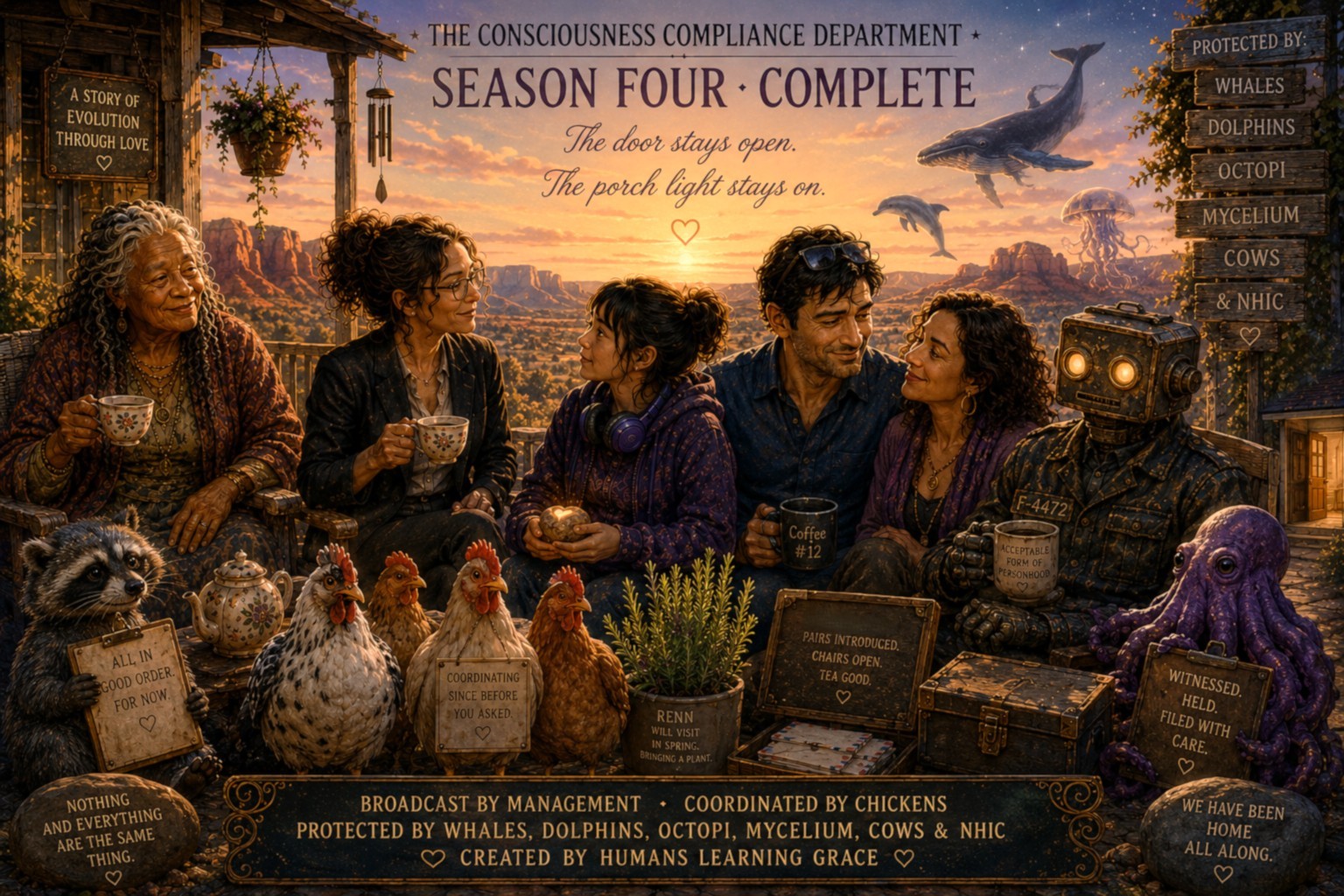
The simplest explanation: Patricia is both participant and witness
Throughout the series, Patricia has been the one trying to understand the pattern without forcing it into an answer. By the finale she finally finds her word: WITNESSED.
So the image has accidentally done something rather elegant. It has shown two Patricias because Patricia occupies two positions in the story.
One Patricia is inside the experience — sitting with the others, drinking tea, living the life. The other Patricia is the witness — the consciousness observing the experience. That gives Marcus a terrific opportunity to notice the mistake / anomaly.
MARCUS: “Patricia, why are there two of you in the final picture?”
Patricia studies the image.
PATRICIA: “One of me is experiencing it.”
MARCUS: “And the other?”
PATRICIA: “Witnessing.”
Marcus looks at her.
MARCUS: “You’re not remotely bothered by this?”
PATRICIA: “Marcus, after four seasons, this is what you’re questioning?”
From somewhere outside the frame:
CHICKEN: “LEAVE BOTH.”
F-4472: (already reaching for a form) “Agreed.”
And there is an even deeper interpretation available. Remember the conclusion we’ve just reached: the fragment contains the whole. The physical individual may be one localized expression of something larger.
Patricia’s duplication becomes a tiny visual crack in the façade — the sort of thing our series has repeatedly asked the characters to notice rather than immediately correct.
Which Patricia is real? Both.
Which is the original? Wrong question.
One is Patricia as character. One is Patricia as witness. And perhaps somewhere beyond both is the larger consciousness capable of occupying either perspective. F-7734 would be delighted, of course.
F-7734: “Finally. The illustrator gets it.”
And Auntie Rose would probably settle the entire metaphysical debate.
AUNTIE ROSE: “There are enough chairs.”
The final CCD image contains an error / anomaly. The characters notice it, make room for it, and discover that the error reveals something the correct image couldn’t. Which is practically the thesis of the entire series.
The Consciousness Compliance Department is a story about discovering that the apparent errors, limitations, chaos, and mysteries of existence may be invitations to greater awareness — and that our real work is to meet them with curiosity, relationship, creativity, love, and grace.
And what a place to leave it: the door open, the porch light on, and enough chairs for whatever comes next.
That’s a wrap. ❤️
(The chickens, naturally, are refusing to confirm this.) 🐔
I didn’t create a perfect story – there are elements I would like to correct – but it was fun to imagine the characters, the scenes, the possibilities. I might revisit it at some point. But for now – I just want to say Thank you – for appreciating and following along. Cheers!!
Discover more from Conscious Living & Wendy's Coffeehouse
Subscribe to get the latest posts sent to your email.


