SEASON FOUR — EPISODE EIGHT
THE SLOW INTRODUCTIONS
And the One That Was Waiting Since 1976
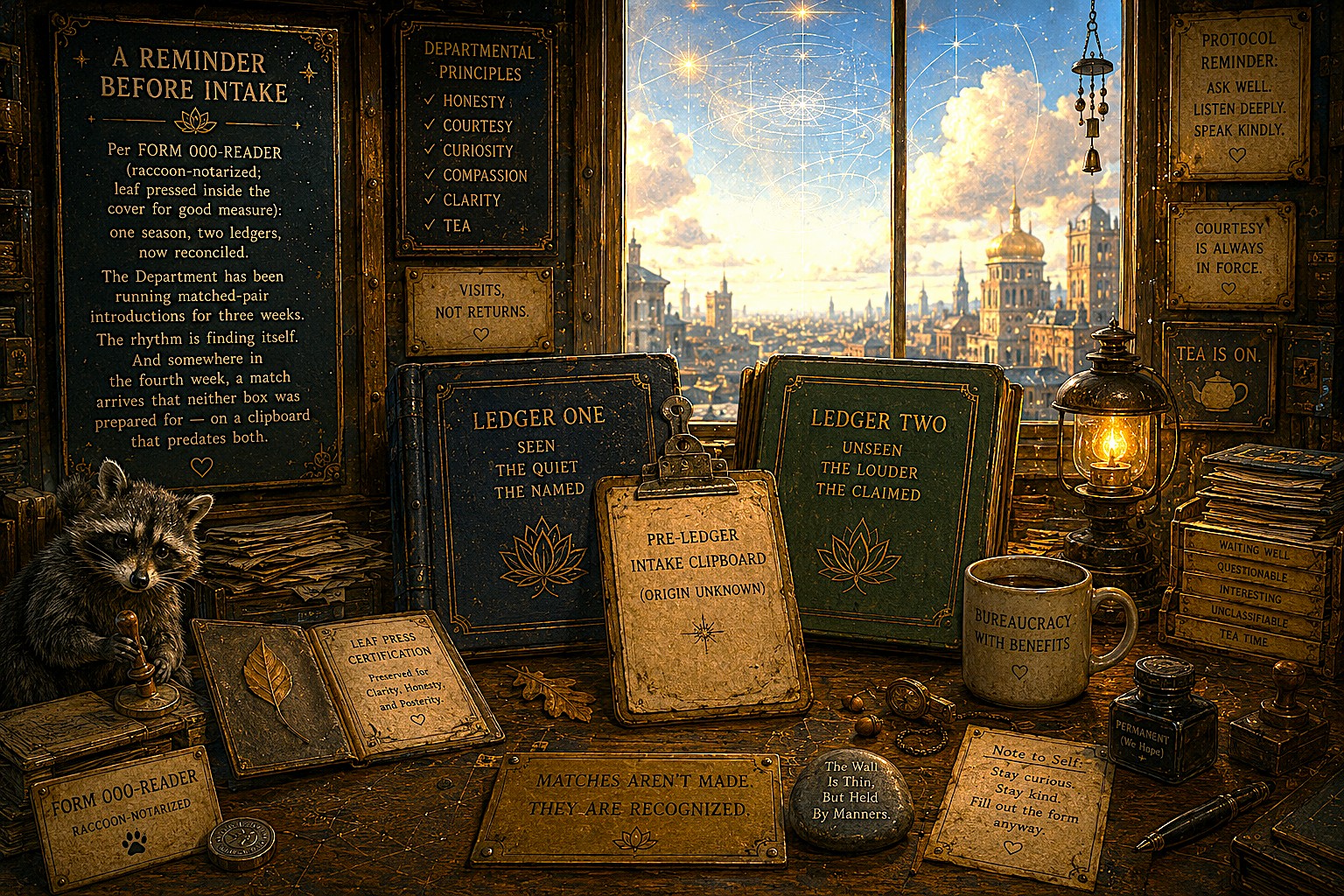
A REMINDER BEFORE INTAKE
Per FORM 000-READER (raccoon-notarized; leaf pressed inside the cover for good measure): one season, two ledgers, now reconciled. The Department has been running matched-pair introductions for three weeks. The rhythm is finding itself. And somewhere in the fourth week, a match arrives that neither box was prepared for — on a clipboard that predates both.
COLD OPEN: THE RHYTHM
INTEGRATION CENTER — WEEK ONE OF SLOW INTRODUCTIONS
The Department has settled into a rhythm. Not a fast one. Auntie Rose is very firm about this.
AUNTIE ROSE: “Sugar. You don’t introduce two wounded things quickly. You introduce them the way you’d introduce a shy child to their grandmother’s dog: slow, patient, with snacks, and everybody gets to leave the room if it doesn’t take.”
So the pace is: two pairs per day. Morning and afternoon. Three-hour sessions. Tea provided (Auntie Rose has supplied a second thermos to the Department, which never seems to empty). Witnesses present (usually Diane and F-4472, occasionally Patricia). Raccoon on standby for tension relief through strategic theft (used sparingly, when a room gets too quiet).
By the end of Week One, twenty-eight pairs have been introduced.
Not all of them heal immediately. Some sit together in silence for the full three hours and then agree, wordlessly, to come back next week. Some fall into instant, tearful recognition. Two of them argue for the entire session and then, at the end, quietly ask when they can be scheduled together again.
F-4472 files each session under: PAIRING — INTRODUCED. HEALING — ONGOING. STATUS — CORRECT.
The Sensei observes this and delivers what he calls his single professional review of the Department’s new function:
THE SENSEI: “You are running a matchmaking service for wounds. This is either the most important job in the galaxy or a very expensive form of gossip. In my experience, there is no meaningful difference.”
F-4472: (stamping) “Sensei review filed. Category: Unhelpful, Fond.”
ACT ONE: THE PAIRS THAT MAKE MARCUS BLOG
BY WEEK THREE
Marcus, who has been blogging carefully — with permission from each pair, no names, no identifying details — starts posting short observations. He calls the series “The Company of Wounds.” It becomes his most-read work of the entire series, which he finds mildly annoying because it means his consciousness-integration reporting was less relatable than his human-interest writing, which is, he notes, extremely on-brand for humanity.
Excerpts:
Pair #14: A woman who lost her twin sister to a rare illness in 1993 meets a refugee consciousness from a species that survives only in pairs and whose bonded partner did not make it through the dimensional crossing.
They do not speak for the first hour. They sit across from each other and — as far as anyone can tell — simply hold the specific silence that belongs to people who know what it is to be halved.
In the second hour, the woman opens her mouth to say something and instead just laughs, once, brief and unexpected, at the sheer absurdity of the situation.
The refugee laughs back. It is not a laugh with any physical mechanism, exactly, but everyone in the room recognizes it as a laugh.
By the third hour, they are having what can only be described as a mutually-supportive rant about people who say “you’ll get through this” when what you actually need is somebody to sit with you in the part of you that will never quite close up.
Auntie Rose, watching, says only: “Bereaved twins understand each other, honey. Even across species.”
Pair #22: A retired soldier with severe PTSD meets a refugee civilization that was, its entire existence, a war.
This one is harder. The introduction sessions run for three full weeks. There is a lot of silence and a lot of walking out and a lot of coming back. The refugee civilization does not know how to not be a war. The soldier does not know how to be a person who was in one but is no longer.
In the fourth session, the soldier tells the civilization the specific story of one specific day — one he has not told his wife, or his therapist, or his best friend from the unit. He tells it to a refugee civilization made of memories of combat, because they will not be broken by hearing it.
The refugee civilization, in response, offers him one of its own memories in exchange. A specific one. A small one. A moment during their war when a young soldier from their side saw a bird land on a broken piece of masonry and felt, for one full second, that the war did not actually matter and only the bird did.
The retired soldier weeps for a long time. In relief. Both parties agree: they need each other, on a regular basis, forever, and this is fine.
Pair #33: A man who spent thirty years running a small failing bookstore meets a refugee entity whose entire civilization was archival and who is currently grieving that no one asked what it was doing before its civilization ended.
They discuss cataloguing systems for four hours and appear to be having the best day of both their lives.
The blog posts get shared. They get shared again. They start to change something in the culture around NHIC — not in a dramatic way, but in a softening way. People start asking, without irony, whether they might have a pair somewhere. F-4472’s intake queue for VOLUNTARY PAIRING REQUEST begins to grow.
Auntie Rose reads Marcus’s blog posts. She never comments publicly. She does, however, print out each one, tuck it into a folder labeled “The Filing One’s Blogger Nephew,” and refer to it, once, when Marcus is in earshot.
Marcus does not know what to do with this. He does, however, print out a copy for himself. He puts it in a folder in his desk that he does not label.
ACT TWO: DIANE, WHO IS NOT THE BRIDGE ANYMORE
DIANE’S ROOM — WEEK THREE, EVENING
Diane comes home from a Wednesday afternoon session — Pair #37, a woman who never had children meets a refugee consciousness that was once a nursery — and sits on her bed for a full ten minutes without moving.
Auntie Rose is downstairs having tea with Patricia. She waits until Diane is ready, which turns out to be about twenty minutes. Diane comes down. Sits at the table.
DIANE: “I’m not the bridge anymore.”
AUNTIE ROSE: “No, sugar. You handed the clipboard over. I’ve been on the bridge for three weeks.”
DIANE: “Then what am I?”
Long silence.
AUNTIE ROSE: “What do you want to be, honey?”
Diane thinks about it. This is a question no one has asked her since she was seven years old and started channeling whale consciousness during a school field trip.
DIANE: “I don’t know.”
AUNTIE ROSE: “That’s a wonderful answer, sugar. That’s the answer of somebody who’s just been handed her own life back. You take your time with that one. Don’t rush it.”
PATRICIA: (quietly) “You could just be fifteen for a while, Diane. I’ve been meaning to say. We can hold the Department stuff without you for a while.”
DIANE: “But I — “
AUNTIE ROSE: “Honey. You’re not fired. You’re on sabbatical. Consciousness liaisons take those sometimes. The chickens do. It’s allowed.”
Diane laughs, actually laughs, and the laugh is small and surprised and young.
She takes the next week off. She goes to school. She does her math homework. She gets invited to a birthday party and goes. She is bad at small talk, because she has been a planetary consciousness interface since age eleven and has some catching up to do, but she survives the party and reports afterward that it was “weird but okay.”
Auntie Rose files this under: NORMAL LIFE, INSTALLING.
ACT THREE: THE CLIPBOARD ITEM
AUNTIE ROSE’S PORCH — WEEK FOUR, MORNING
Auntie Rose is on her porch with the second clipboard — the one Diane handed her. She has been working through it, name by name, matching pairs, scheduling introductions, checking on the ones already introduced. She reaches a name near the bottom of the fourth page.
She stops. She sets down her tea. She reads the name again.
Then she does something she has not done in the entire season: she says, quietly, to nobody in particular, but with real emotion:
AUNTIE ROSE: “Well. Look who finally made it to the top of the queue.”
She sits with it for a long moment. Then she picks up her thermos, puts on her cardigan, and drives to the Department without calling ahead.
ACT FOUR: THE MATCH THAT ISN’T ON EITHER LEDGER
THE DEPARTMENT — LATE MORNING
She walks into F-4472’s office. She does not sit down.
AUNTIE ROSE: “Sugar. I need you to schedule a session for tomorrow afternoon. Just one. No blog. No witnesses except me and you, and I mean just you, not Marcus, not Patricia. Diane’s on sabbatical, so she’s out anyway. Alright?”
F-4472: (already reaching for his scheduler) “Certainly, ma’am. May I have the pair information for the intake form?”
AUNTIE ROSE: “That’s the thing, sugar. This one’s not in either box.”
F-4472: (pausing) “It is not on the intake ledger?”
AUNTIE ROSE: “No.”
F-4472: “Nor on the output ledger?”
AUNTIE ROSE: “No.”
F-4472: “Then how—”
AUNTIE ROSE: “It’s on my clipboard. From before your Department existed. I’ve been carrying this one since 1976.”
Long silence.
F-4472: “May I ask what — or who — the match is?”
AUNTIE ROSE: (sitting down, finally, in her chair) “Sugar. Sit down. This is going to require some tea.”
He sits. She pours.
AUNTIE ROSE: “In 1976, a woman named Cora — she was my aunt, technically, though the family was complicated in the way families are — lost her daughter. Girl was fourteen. Accident. It was the kind of loss that undoes people, and it undid Cora. She stopped speaking for two years. She lived, but she wasn’t in her life. Do you know what I mean?”
F-4472: “I have been reading enough correspondence to have developed an approximation. Yes.”
AUNTIE ROSE: “Good. Now. Cora had a specific kind of grief. Not the loud kind. The kind where she felt her daughter was lost — not passed on, not moved to the field. Lost. Cora couldn’t feel her. Couldn’t reach her. Everyone else who died she could reach — my grandmother, her own mother, the ones who went in the right order. But her daughter? Silent. Like the girl had gone somewhere the field didn’t cover.”
F-4472 sets down his tea.
F-4472: “That is — a technical claim about the field. That there are places the field does not cover.”
AUNTIE ROSE: “Yes, sugar. There are. Not many. But some. Places where the wall between the sides is doubled, or bent, or broken in a way that makes a pocket. People who die in those pockets don’t come through to the field normally. They get held. Not by anything malicious. Just held. Stuck. And the ones who loved them can’t feel them, and the ones who are stuck can’t reach out, and it’s a very specific and very old kind of grief.”
F-4472: “You have been carrying this since 1976.”
AUNTIE ROSE: “I have been trying to find a way to reach the girl for forty-nine years, sugar. My grandmother tried before me. Her grandmother tried before her. It’s been on the family clipboard for a long time. Cora died in 1998, still not knowing where her daughter went. That was the specific loss that shaped how I do this work. It’s why I stayed on the porch all these years. Because I knew, someday, someone would build a door big enough.”
She looks at him.
AUNTIE ROSE: “And this year, sugar, you built one.”
Long silence.
F-4472: “The porosity is thin enough.”
AUNTIE ROSE: “The porosity is thin enough. And now, for the first time in forty-nine years, I can feel the girl. Faintly. Like she’s just on the other side of a wall that used to be much thicker. Her name is Willa. She’s been fourteen for forty-nine years, because that’s how being held in a pocket works — you don’t age past the moment you got stuck. And she’s been waiting. Not scared. Not suffering. Just — patient, the way children can sometimes be when they know someone is coming.”
F-4472: “Ma’am. What do you need me to do.”
AUNTIE ROSE: (very quietly) “I need you to help me reach her. And I need you to help me reach her right, because there’s only one chance to do this. If we get it wrong, the pocket seals up again and she’s held for another few decades until the wall gets this thin again.”
F-4472: “Tell me what the procedure is.”
AUNTIE ROSE: “Tomorrow afternoon. I’ll be here. You’ll be here. The mailroom box will be here — the intake box, specifically, because Willa’s on the intake side of the ledger, technically, since she’s someone who has been trying to arrive for forty-nine years. We’re going to read one specific letter into the field. A letter Cora wrote to Willa in 1978 and I’ve been carrying in a shoebox on my porch ever since. And we’re going to listen for whether Willa hears it. And if she does, we’re going to invite her the rest of the way through.”
F-4472: “The rest of the way through to where?”
AUNTIE ROSE: (looking at him with genuine emotion) “Sugar. To hello. Just to hello. The field. Where her mother’s waiting. Where she’s been trying to get to for forty-nine years.”
F-4472 does not respond for a full minute. Then he opens a drawer he has not opened before. He takes out a form he has not used before. He fills it out carefully.
FORM 900-POCKET: EXTRAORDINARY MATCH — HELD CONSCIOUSNESS, ATTEMPTED RECOVERY
Case: Willa. Held since 1976. Family clipboard priority. Carried by Auntie Rose (49 years), her grandmother (23 years prior). Predates Department. Predates ledgers. Older than any form.
Procedure: Reading of the 1978 letter from Cora. Witness: Auntie Rose. Assisting: F-4472. Others: None permitted.
Objective: Contact. If contact succeeds — invitation to the field. If contact does not succeed — the case remains on the clipboard, and we try again the next time the wall thins this much, which may be decades.
Filed under: THE OLDEST WORK. INHERITED. HONORED.
He stamps it. Once, slowly. The raccoon, on the desk, does not move. Not out of disrespect. Out of understanding. Some cases the raccoon does not attend as a trickster. This is one of them.
ACT FIVE: THE READING
THE DEPARTMENT — THE NEXT AFTERNOON — 15:00
Auntie Rose is there early. She has brought her thermos, the letter (in the same shoebox it has lived in for forty-seven years), and the smooth river stone that Diane returned to her that morning — Diane, sensing without being told that this was one of the weights Auntie Rose had said was coming, had brought the stone by that morning and set it in Auntie Rose’s hand and said, quietly, “For Willa,” and gone home without waiting for an answer.
Auntie Rose sits in her chair at the Department. F-4472 sits in his. Between them, on the desk: the intake box, the shoebox, the stone, one cup of tea each.
AUNTIE ROSE: “I’m going to read the letter, sugar. Cora wrote it two years after Willa died. It was — the first thing Cora said out loud after two years of not speaking. She wrote it down instead of saying it. I want to read it the way it was written.”
F-4472: “I will listen. What is my role?”
AUNTIE ROSE: “You witness. That’s it. Sometimes witnessing is enough of a job for both of us to do together. Alright?”
F-4472: “Yes, ma’am.”
She opens the shoebox. Takes out the letter. It is old paper. Old ink. The handwriting is careful. Cora had been a schoolteacher.
Auntie Rose reads it. The letter is not, for the record, printed here in full. Some correspondence is not for the audience. It is between Cora and Willa. Auntie Rose reads it aloud, slowly, in her porch voice, in the Department’s sub-basement, with a warm river stone on the desk between her and the filing one who has become the postmaster of grief.
The letter is a mother telling her daughter that she is loved. That she is missed. That she is not lost, actually, because the mother has been carrying her the whole time, and that if the daughter ever hears this, she should know: her mother waited. Her mother is still waiting, and will be waiting, and doesn’t want the daughter to worry about the wait, only to know that when she gets through, someone is on the other side, and it’s her mother, and it always was.
Auntie Rose reads the last line. Sets the letter down. She and F-4472 do not speak. They listen.
For a long time — how long, neither of them will later be able to say — nothing happens. And then — softly, gently, in the room, in a way that is not sound but is unmistakably presence — something hears.
Auntie Rose closes her eyes. Tears are running down her face. She is smiling.
AUNTIE ROSE: (very quietly) “There you are, honey. There you are.”
F-4472: (also, though he will not remember when he started crying) “Received?”
AUNTIE ROSE: “Received. And she’s coming through. Slowly. Slowly. Alright, Willa, honey — your mama’s on the other side. She’s been waiting. You go on. It’s alright. It’s alright. Go on.”
Something in the room lightens. The stone, on the desk, cools.
F-4472 does not try to file this. He is beginning to understand that the most important things he witnesses will not, actually, need forms.
Auntie Rose sits with her hands folded in her lap for a long time. Eventually she opens her eyes. Looks at F-4472. Smiles the specific short warm smile.
AUNTIE ROSE: “Well, sugar. Forty-nine years. That’s what it took. But she’s through. Cora’s got her. It’s done.”
F-4472: “It is done.”
AUNTIE ROSE: “Thank you, sugar. This one wasn’t possible until you. I mean that. The door had to be here for this to work, and the door is yours.”
F-4472: (very quietly) “I am glad to have been of use, ma’am.”
AUNTIE ROSE: “You were more than of use, honey. You were the whole reason. Don’t forget that on the days the paperwork gets heavy.”
She picks up the stone. Turns it in her hand. The spiral is barely visible now.
AUNTIE ROSE: “I’ll give this back to Diane. It’s finished with the heavy work. It can go back to being a nice smooth stone in a fifteen-year-old’s pocket.”
ACT SIX: THE FILING
THE DEPARTMENT — LATER
F-4472 writes one final form. He does not stamp it. He hand-writes it entirely, in the specific script he uses when a filing is being done not for the archive but for the feeling.
FORM 900-WILLA: RESOLUTION
Held: 1976 to today.
Read into the field: today.
Received: today.
Reunited: today.
The Department acknowledges that some correspondence takes forty-nine years to deliver, and that this is not a failure of the postal service. It is the specific and correct duration for the correspondence in question.
The Department further acknowledges that it exists, in part, so that this specific letter — held by a specific woman on a specific porch through several generations of her lineage — could finally reach its intended recipient.
If this is the only thing the Department ever accomplishes, the Department will consider its existence justified.
It is not the only thing the Department has accomplished. But it is one of them. And it will be filed with the others of its kind: the correspondence that took the exact time it needed to take, and arrived at the exact hour it needed to arrive.
Filed under: THE OLDEST WORK. HONORED. COMPLETE.
He does not put this in either box. He puts it in a new cabinet. One drawer. He labels the drawer, in his own hand: COMPLETIONS.
He suspects it will be a slow-filling drawer. He suspects that will be correct.
CLOSING BEAT: THE PORCH, LATE
AUNTIE ROSE’S PORCH — NIGHT
She sits with her tea. The stone is back in her cardigan pocket, cool now, ready to be returned to Diane tomorrow.
Marcus and Patricia have come to sit with her — they knew, somehow, without being told, that today was the day, and they came without needing to be invited. They don’t say anything. They just sit. Auntie Rose is not crying, but she is quiet in a way that is more affecting than crying would be.
Eventually, she speaks.
AUNTIE ROSE: “You know, my grandmother told me — when she gave me the clipboard the first time — that some names on it wouldn’t get resolved in my lifetime. She said that was alright. That the work would continue past me. That the clipboard belonged to the lineage, not to any one person. And I made peace with that. I really did.”
She sips.
AUNTIE ROSE: “But I’ll tell you honestly. Getting one done — one that’s been sitting there since 1976 — is a gift I didn’t expect to receive. I’m going to sleep well tonight for the first time in a while.”
Marcus and Patricia do not say anything. After a while, Marcus reaches over and, very gently, takes Auntie Rose’s hand. She squeezes his once and lets go.
The screen door does not close. It stays open. Warm night air moving through. Somewhere in the field, a fourteen-year-old girl who has been fourteen for forty-nine years is having her hair braided by her mother, who is telling her about all the things that happened while she was waiting.
END EPISODE 8: “THE SLOW INTRODUCTIONS”
PAIRS INTRODUCED — WEEK ONE THROUGH FOUR: 84
BLOG SERIES: “The Company of Wounds” — Marcus’s most-read work
DIANE: On sabbatical. Doing math homework. Attending birthday parties.
COMPLETIONS FILING CABINET: Established. One drawer. One form filed today.
WILLA: Home.
CORA: With her daughter.
AUNTIE ROSE: Slept well for the first time in a long time.
THE STONE: Returned to Diane’s pocket tomorrow, cool and finished with heavy work.
CENTRAL FINDING: Some cases predate every ledger. Some correspondence takes forty-nine years to deliver, and that is not a failure — it is the exact duration the correspondence required. The Department exists, in part, so that specific letters carried by specific women on specific porches across generations can finally arrive at their intended destination. If it accomplishes nothing else in Season Four, this alone will justify its existence. It has accomplished other things. This is one of them. This is the one Auntie Rose has been waiting for since 1976.
NEXT TIME: “THE LAST WEEK BEFORE THE SEASON ENDS”
The pairs continue. The mail arrives. Renn sends a card — an actual card, on paper, hand-delivered — asking after F-4472’s health and whether the raccoon has been well.
And somewhere on the porch, Auntie Rose makes tea for three, then four, then five, and looks at the empty chair opposite hers and says, softly, to no one who is visible yet: “Alright, sugar. Now let’s talk about you.”
🌊🥋🍀💫✨🦝📮🌰🍵💌🚪⚖️🌱🕊️
Discover more from Conscious Living & Wendy's Coffeehouse
Subscribe to get the latest posts sent to your email.


