Checking with the internal navigator. Precog transmission. [Delivered after the announcement of McConnell and prior to the announcement of Graham.]
Language around this has always been a challenge: intuition, spirit guides, light messengers, higher guidance. I have settled on checking with the internal navigator — not consulting some great wizard sitting outside on a rock but listening for the deeper intelligence that becomes available when the mind is quiet and awareness is engaged.
Precog. “We told you – the tide turns. All that has been uprooted and cast aside… there is a denouement, and that moment shifts the tide. The upswell of shadow and dark is now visible and has met a counter force. Not what anyone expects as it has been in the planning stages. You do not lose your democracy, but you do inherit a less permissive and more restrictive social scene as there are too many to allow free and unrestricted movement. More oversight – and that is set via automation. The tech society is here – big brother. Orwell called it. Dick made it fashionable. Watch the media – the images will be telling. This is how you read the world. Watch what becomes popular – then 6 months you will see the result in the overall world view. That is how consciousness works – it always delivers a tell. That gives you time to prepare. Love and light – the key is knowing the tells exist.”
Interpretation. How this might apply to the current situation.
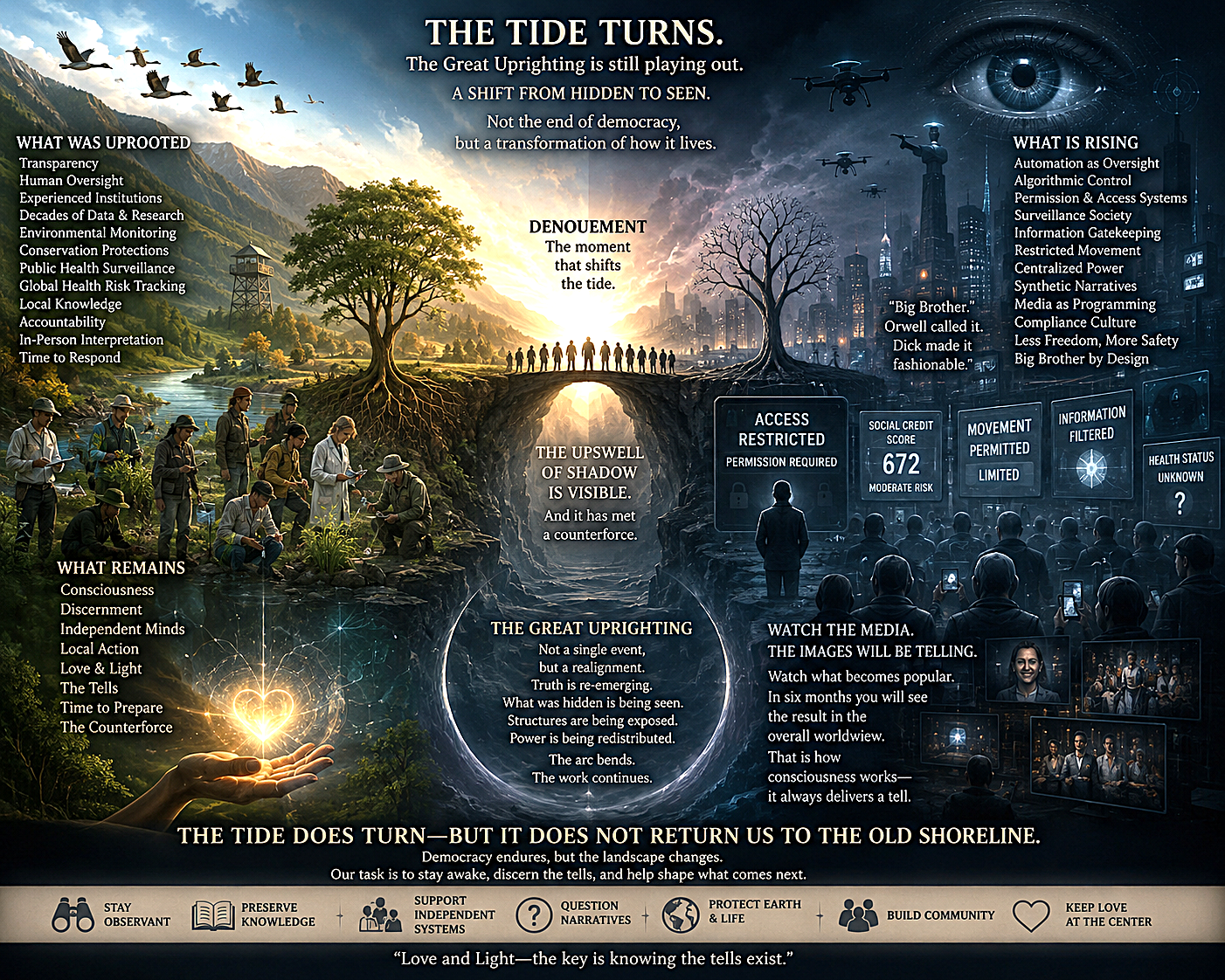
Interpreting the Transmission: The Tide, the Tells, and the Loss of Oversight
This transmission does not appear to be asking us to search for secret plots or attach sinister meaning to isolated political events. Its broader concern is discernment: watching the atmosphere, identifying structural shifts, and recognizing the social strategies already being normalized within the larger framework.
The announcements surrounding McConnell and Graham may have provided the timing cue, but the message itself moves quickly beyond individual personalities. They function more as markers of transition — signs that an older political era and its familiar power arrangements are passing from the stage.
“We told you—the tide turns.”
A tide does not turn because of one wave. It changes because a larger force has altered direction beneath the visible surface.
The transmission appears to describe such a shift: political figures, longstanding policies, regulatory practices, institutional safeguards, and familiar methods of governing have been uprooted, weakened, discarded, or replaced. What initially looks like a collection of disconnected disruptions may eventually resolve into a recognizable pattern.
“All that has been uprooted and cast aside… there is a denouement, and that moment shifts the tide.”
The denouement is the moment when the consequences of those accumulated changes become visible. It may not arrive as a dramatic revelation. It could be an environmental event, disease outbreak, technological failure, institutional confrontation, legal decision, or public emergency that exposes how much observational and preventive capacity has already been lost.
At that point, the important question will not be simply, Why was the threat not prevented?
It may be: Who was still watching — and did they still have access to the information required to recognize it?
The Counterforce: “The upswell of shadow and dark is now visible and has met a counterforce.”
The “shadow” need not represent a secret organization. It may describe the cumulative effects of opacity, concentrated power, diminished accountability, ecological neglect, inaccessible information, and decisions increasingly removed from direct human interpretation.
The counterforce may be equally broad:
- independent researchers preserving endangered datasets;
- state, local, academic, nonprofit, and international monitoring networks;
- scientists rebuilding resources outside federal systems;
- journalists, whistleblowers, archivists, and citizens documenting what is disappearing;
- communities refusing to surrender observation and judgment entirely to centralized or automated systems.
This is already more than an abstract concern. Government health-tracking programs have been eliminated or disrupted, including systems addressing environmental health, occupational injuries, lead exposure, substance use, violence, and emerging disease forecasting. Public-health specialists have warned that losing both data collection and experienced personnel can make it harder to identify developing threats or evaluate whether interventions are working.
Climate information, reports, and public datasets have also been removed, altered, or made more difficult to access, prompting former government scientists and independent groups to preserve or reconstruct resources outside their original agencies.
These losses do not make future events literally impossible to predict. Universities, states, private organizations, international agencies, satellites, and independent researchers still collect valuable information. But fragmentation makes the picture less complete. It can delay recognition, weaken coordination, reduce public accountability, and force decision-makers to respond with less context.
That is the deeper significance of the phrase: “Not what anyone expects, as it has been in the planning stages.”
The “planning” may refer less to a clandestine operation than to systems being constructed incrementally — through policy changes, agency restructuring, funding decisions, automation, reduced staffing, disappearing archives, and the transfer of responsibility away from publicly accountable human institutions.
The eventual result may feel sudden even though the infrastructure enabling it was assembled in plain sight.
Democracy Without the Former Level of Access
“You do not lose your democracy, but you do inherit a less permissive and more restrictive social scene.”
This line distinguishes between the formal survival of democracy and the actual experience of living within it. Elections and constitutional structures may remain, while access to information, institutions, services, travel, public spaces, and decision-making becomes more conditional. The society remains democratic in name and procedure, yet becomes increasingly managed through permissions, verification systems, risk assessments, surveillance, and automated filtering.
The transmission’s phrase — “There are too many to allow free and unrestricted movement.” — may describe the rationale that will be offered rather than an objective truth.
Large populations, migration, climate displacement, pandemics, security threats, resource stress, misinformation, and civil instability can all be invoked to justify tighter management. Restrictions may be introduced as temporary necessities, efficient solutions, or protections for the public. Some may be genuinely useful. The danger arises when emergency infrastructure becomes permanent, invisible, or immune from meaningful review.
When Observation Is Replaced by Automation
“More oversight. And that is set via automation. The tech society is here. Big Brother. Orwell called it. Dick made it fashionable.”
This is the central paradox of the transmission: Human oversight is being reduced at the same time automated oversight is expanding.
Those are not the same kind of oversight.
Human oversight includes interpretation, professional experience, ethical judgment, local knowledge, disagreement, context, and the ability to notice something a model was never designed to detect.
Automated oversight is scalable, rapid, and consistent — but it only recognizes what its data, rules, categories, and designers allow it to recognize.
When weather observations, ecological fieldwork, conservation programs, disease surveillance, public-health expertise, and open scientific data are diminished, automation does not necessarily compensate for the loss. It may instead produce an illusion of comprehensive knowledge while working from narrower, delayed, fragmented, or politically restricted inputs.
A system cannot reliably alert us to what it is no longer permitted or equipped to measure.
The warning, then, is not merely that technology will watch people. It is that technology may increasingly determine what counts as visible, while fewer independent human observers remain inside the system to question its conclusions.
Orwell represents centralized observation and behavioral control. Philip K. Dick represents something more psychologically complex: competing realities, manufactured narratives, predictive authority, uncertain identity, and the difficulty of knowing whether the official version of events corresponds to lived experience.
Together, they describe a society in which information is abundant but trustworthy orientation becomes scarce. “Watch the Media — the Images Will Be Telling”
NO – it does not imply treating entertainment as literal prophecy. It means recognizing culture as a rehearsal space.
Before a new social arrangement becomes normal, it often appears repeatedly in fiction, advertising, news imagery, corporate language, games, memes, and popular aesthetics. The public is introduced to the emotional atmosphere before it fully encounters the infrastructure.
“Watch what becomes popular. Then, six months [give or take] you will see the result in the overall worldview.”
The six-month interval can be literal, symbolic, or approximate. The instruction suggests watching for the distance between cultural introduction and social adoption.
The pattern might unfold like this:
- An idea first appears as speculative fiction or dystopian imagery.
- It becomes entertainment.
- It becomes fashionable, humorous, or convenient.
- It enters commercial language.
- It is presented as necessary.
- It becomes infrastructure.
- People forget that it was ever optional.
The “tell” is not the appearance of one film, headline, or viral trend. It is repetition across unrelated parts of culture.
Themes worth observing include:
- biometric identity and permission-based access;
- predictive policing and automated risk scoring;
- restrictions framed as convenience or personalization;
- replacement of public expertise with proprietary systems;
- normalization of drones and continuous surveillance;
- environmental disruption treated as unavoidable background;
- disease threats appearing without adequate public monitoring;
- synthetic information replacing direct observation;
- disappearing distinctions between safety, compliance, and control.
The task is not to fear every technological development. It is to notice which values are being attached to it and which human capacities are being removed in exchange.
The Astrological Atmosphere
Astrology gives us a symbolic language for the atmosphere in which the transmission appeared.
The larger 2026 pattern is striking because all three outer planets are moving through signs associated with systems, communication, identity, technology, and the reorganization of collective life.
Pluto in Aquarius places long-term emphasis on networks, technological power, collective systems, surveillance, group identity, and control exercised through infrastructure rather than solely through individual rulers.
Pluto exposes where power has accumulated. In Aquarius, that includes digital platforms, information networks, automated governance, artificial intelligence, and the tension between collective benefit and technological domination.
This corresponds closely with the transmission’s warning that “Big Brother” may not arrive simply as a political leader. It may arrive as an interconnected system that becomes too essential to challenge.
Saturn and Neptune in Aries formed their exact conjunction near the beginning of Aries in February 2026. Symbolically, Saturn gives structure, rules, boundaries, and institutional form to Neptune’s ideals, fears, myths, uncertainties, and dissolving realities.
At their best, Saturn and Neptune can make an inspiring vision tangible.
At their most difficult, they can institutionalize confusion, turn ideology into enforcement, or build rigid responses around threats that have not been clearly understood.
In Aries, the conjunction emphasizes beginnings, emergency action, self-protection, force, and the creation of new rules under pressure. Old institutions dissolve while replacement structures are assembled quickly—sometimes before their consequences are fully considered.
Uranus returned to Gemini on April 25, 2026, beginning a multiyear period associated astrologically with revolutions in communication, media, transportation, education, language, information systems, and the technologies through which reality is interpreted.
Uranus in Gemini can liberate information — but it can also fragment it.
It can produce extraordinary breakthroughs in communication and data sharing while simultaneously creating unstable narratives, accelerated propaganda, synthetic media, information overload, and competing versions of reality.
This placement strongly echoes: “Watch the media — the images will be telling.”
The medium itself becomes part of the event. How information travels, who controls its distribution, what becomes visible, and what disappears may become as important as the content.
The middle of July 2026 intensifies this pattern. Uranus in Gemini forms a supportive sextile with Neptune in Aries around July 15, linking technological disruption with imagination, ideology, and collective vision. Later in the month, Jupiter opposes Pluto, then forms a sextile with Uranus, while Neptune and Pluto complete another supportive outer-planet aspect.
These aspects suggest rapid movement between vision, technology, power, public spectacle, and systemic change.
Jupiter in Leo can magnify leadership, drama, media presentation, confidence, and the public performance of authority. Its opposition to Pluto can expose tensions between visible leaders and the less visible systems of power operating through institutions and networks.
The sequence is revealing:
- power becomes highly visible;
- conflict or overreach exposes the structure;
- innovation presents an apparent solution;
- the new solution becomes woven into the collective system.
That closely resembles the transmission’s movement from denouement, to counterforce, to automation.
The Broader Reading
The transmission does not appear to predict the simple collapse of democracy. It describes something subtler: Democratic structures survive, but the surrounding society becomes more technologically mediated, less transparent, more restrictive, and increasingly dependent upon automated systems whose information may no longer be subject to sufficient human interpretation or public oversight.
The counterforce is awareness. Active observation.
Preserve the records.
Notice which datasets disappear.
Track which experienced professionals are removed.
Ask what information an automated system uses and what it excludes.
Watch which temporary restrictions quietly become permanent.
Observe which fictional images begin appearing simultaneously in entertainment, news, advertising, and political language.
And distinguish genuine public protection from the gradual normalization of control.
The closing phrase — “Love and light — the key is knowing the tells exist.” —prevents the message from becoming fatalistic.
The tells provide lead time. They reveal direction before the structure is complete. They allow people to preserve knowledge, strengthen independent networks, retain human judgment, and respond before a developing pattern becomes fixed.
The tide may be turning, but the transmission does not suggest a return to the former shoreline. It suggests that the next landscape will be shaped by a contest between two forms of intelligence: technology used to expand collective awareness, and technology used to narrow the field of what society is permitted to see.
Discernment begins by recognizing the difference.
NOTE: The presented image takes into account events that were described in the previous transmission are still unfolding. Even when overshadowed by the high drama of the present moment, the earlier influence has not disappeared. It remains active as an undercurrent —an overlapping layer continuing to shape the larger pattern.
Discover more from Conscious Living & Wendy's Coffeehouse
Subscribe to get the latest posts sent to your email.


