A roller skate, a familiar song, a message from Dad, and a conversation that helped me see what the message really was.
For sixteen and a half years, I worked a job with a set schedule. That work gave me some unexpected insight, including into traffic patterns and after-death visitations. But much of my energy went into holding back. Intuitive information that ran counter to the schedule had to wait, or be set aside altogether.
That chapter has closed. I am no longer required to keep the door half shut, and I can open my mind to the flow of information that makes room for intuitive insight and mediumistic encounters. I do not know yet what that will mean. What I do know is that things have changed, and I am open to a new adventure with fewer limits on my timeline.
The experience in this article arrived right at the start of that new chapter.
I am a medium and an intuitive. I have spent nearly thirty years with extraordinary experiences, including communication I understand to come from those who have crossed over. One thing I have learned is that these experiences rarely arrive with explanations. They come in pieces: an object in the wrong place, a song I cannot ignore, a dream that replays the day. The source is simply trying to get a message across. The medium often has to jump through a few hoops of trial and error to connect the dots, especially when timing matters.
Recently I reviewed one of these experiences in conversation with ChatGPT. I did not ask it to prove that my father had reached me, or to tell me what to believe. I wanted a sounding board that could help me see patterns and meanings I might miss.
What I did not expect was how much the dialogue would teach me about my own descriptions. Each time ChatGPT reflected my account back, I could see what I had not yet put into words. Each correction I made changed the reading. The understanding grew not through agreement, but through correction.
This article walks through that conversation, round by round.
What happened: a day, a night, a morning
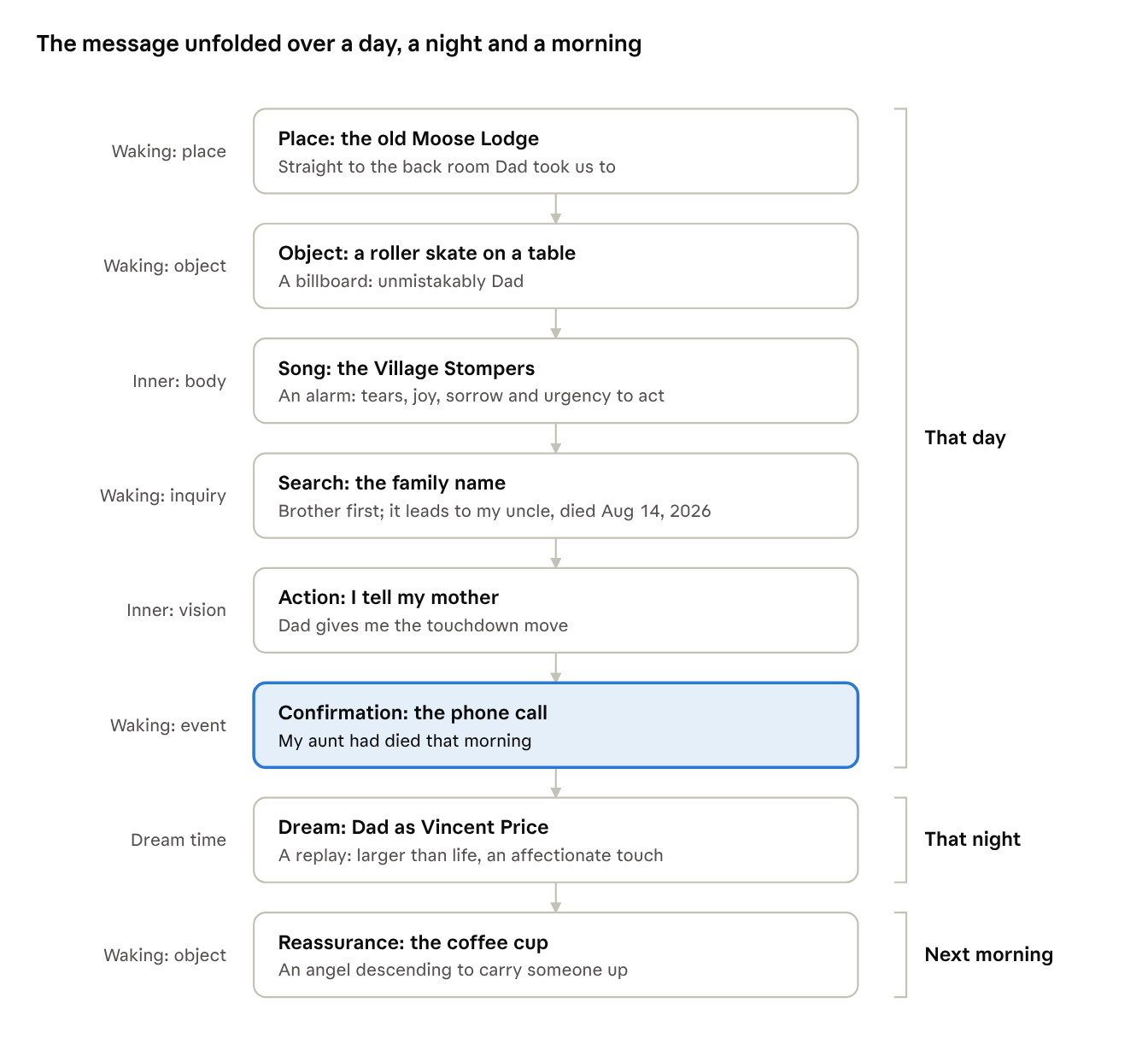
The day. I visited the former home of the Moose Lodge. My father took me there when I was eight or nine, soon after my parents divorced. I never liked it. It was an adult place, with peanuts and nothing for a child to do. I walked straight to the back room where Dad had taken us. As I stepped out, I saw a roller skate on a table. It had no reason to be in that building. But Dad used to take us skating, and he bought me a pair I kept for decades.
Then a song arrived: the Village Stompers. The trigger was stronger now. I felt my father connecting, and I knew I had to act. I guessed the message concerned my brother and looked up his name, which is also my grandfather’s. Nothing current came back on him. Instead the search pointed to my uncle, who had died on August 14, 2026.
I sensed Dad wanted me to tell my mother. After I told her how I had arrived at the name, I saw him give me the touchdown move. Then, as we sat in the restaurant, the phone rang. My mother’s sister had died that morning, while we were on our way to the event.
My aunt’s last year had been stops and starts between hospital visits. I had sensed her time was short and expected her to go the previous December. She held on another year. A week and a half before she died, she had a bright, energetic conversation with my mother. It was a gift, and also the final rally before transition. Dad’s message was that she is in a good place, with many helpers around her. Not him; she is not in his group. He wanted to set a bit of news in front of my mother to buffer the hurt.
That night. I dreamed that Vincent Price had come to make an appearance. He was so tall. I wanted a picture as he left the building. I framed it with the State Capitol in the background. He was kind, and when I told him I had interviewed his daughter Victoria, he said that was good. He put his hand gently on my waist, and the affection felt real. The people with him had a project, and they would be in touch. I understood the figure to be my father.
The next morning. I had noticed my coffee cup’s design for the first time in a while, left it out overnight and asked if there was a message. In the morning I saw an angel descending at an angle, as if coming to carry someone up.
Round one: the first reading
My first telling came out the way experiences come to me: fast, emotional, out of order. I opened with the dream, mentioned that I was sad the night before, then poured out the day at the Moose Lodge. I asked ChatGPT what it inferred, and reminded it that I am a medium and an intuitive.
The first reading was useful. It gave my stream of impressions a structure:
- It noticed that my link between Dad and Vincent Price was not about looks. It was a personality signature: humor, theatricality, a love of cooking.
- It called the roller skate a contextual anomaly, an ordinary object made extraordinary by where it appeared.
- It drew a key distinction: the skate and the song were identifiers, not the message. The message was closer to Pay attention. There is something you need to know.
- Its strongest inference was about timing. The purpose seemed to be preparing my mother for hard news. In its words, the function was not to prevent sadness, but to soften its arrival.
It also kept the inconvenient details in view. The search had pointed to my uncle; the call was about my aunt. It asked me to keep that difference intact rather than smooth it over.
But the first reading also got things wrong, and the errors came from my telling, not from bad reasoning. Because I had written the dream first, it read the dream as a precursor, a sign before the event. And because I had described the skate as “an odd clue,” it treated it as something subtle. Neither was right. I could only see that once it was reflected back to me.
Round two: the skate was a billboard
ChatGPT closed its first reading with a question. When I first saw the skate, did I immediately feel my father directing my attention? Or did that sense of deliberate contact come only after the music?
Answering it forced me to be precise: The roller skate was a billboard. When I heard the music, it triggered almost a sense of panic. It was a prompt to take action. The trombone didn’t register at that moment. It was an affirmation that I needed to pursue a connection, and it seemed to involve a relative. My first choice was my brother, and then the information arrived because the threads aligned.
That one clarification reorganized the whole reading. ChatGPT summed it up as: the roller skate was the billboard, the music was the alarm, and the information that followed was the destination. Three signals, three different jobs.
The sequence now read as recognition, then activation, then direction, discovery and action. The signal had changed character, from this is Dad to do something now.
It also reframed my wrong first guess. Thinking of my brother first was not a failure. It was part of how I navigated toward a situation that was still developing. As ChatGPT put it, there is a difference between receiving information and being prompted to discover it. Perhaps the destination was never the name at all. Perhaps it was the conversation with my mother.
Then it pushed on one word. I had said panic. Panic usually means a threat. Was urgency closer to what I felt?
Round three: what the body knew
ChatGPT asked whether the urgency was physical, like an adrenaline surge, or more like an unmistakable knowing.
My answer: I felt it in my body. I had tears and release, joy and sorrow. It was my father connecting. Urgent is a good word, but the emotions were racing as I knew I needed to keep moving to resolve what I was being guided to do. At the same time, the rush of recognition: love, loss, remembrance. So many emotions. Tears and heart and mental rush.
This changed the reading again. I was not just recognizing a signal. I was having a reunion and being prompted to act, both at once. ChatGPT drew out three overlapping layers: the personal connection the skate opened, the emotional release in which joy and sorrow belonged together, and the directive I kept following despite the flood of feeling.
It also noticed the order. The skate made sense to my mind immediately. The music did not, yet my body responded powerfully. The trombone link came later. (The trombone was my dad’s instrument.) My body registered significance before my mind assembled the reasons.
That challenges a common picture of intuition as calm and detached. In this encounter, the emotion was not interference to be quieted. It was the channel. ChatGPT offered a summary line for my records, and I recognized myself in it. My body responded before my mind could sort through the associations.
I knew my father was connecting, and I knew there was something more I needed to discover.
Round four: the message beneath the message
Up to this point, the conversation had centered on the news for my mother. But something else had been building in me, and I finally said it:
There is a core alignment with this experience, a reconnection with my father that allows him to be more than what I experienced during his lifetime. The drama and trauma of life is no longer present. There is a friendship and a genuine sense of love that is greater than my lived experience. And that joy is liberating and affirming of the changes I am currently undergoing.
ChatGPT called this the deepest layer, and I agree. The family news gave me a reason to act. The reconnection with my father was the larger gift. It noticed a contrast I had lived without naming. The Moose Lodge stood for the hard years after the divorce, a place where I felt out of place as a child. The roller skate stood for something else: shared fun, generosity, love. The past was still there, but it no longer defined the relationship.
It also named the word I had used, friendship. Friendship is not the parent-child bond. It is two people meeting with mutual recognition and affection. I do not have to remain the daughter I was. He does not have to remain the father I knew.
Then it connected this to my own life. I am in a major transition, releasing old obligations and giving myself room to write and to explore mediumship fully. As I step beyond the roles that shaped my days, I am meeting Dad beyond the roles that shaped his life with me. ChatGPT suggested that perhaps the most important message was not about my aunt’s transition. It was about mine.
My personal affirmation is I am Wendy, free to fly. In this light, it means more than where I can go. It means who I can become.
Round five: putting the dream in its place
When ChatGPT drafted an article from our conversation, it opened with the dream, as if it had come first. Reading the draft, I saw the problem immediately. My own first telling had led it there. So I corrected the record.
The Vincent Price dream was after the event. In a way it helped me see that my father occupied a larger-than-life role, and in the context of the dream his presence stood out at the Moose Lodge because it was exactly that: larger than life. It was not a precursor. It was after the events of that day, my dream mind going one step further to reaffirm the presence, the context and the affection in his touch.
The dream changed roles completely. It was not a warning. It was a replay and an overview, a continuation of the day. I also added context ChatGPT had not had. I really had interviewed Vincent Price’s daughter, Victoria. And I had jokingly told her that as a child I felt her father was my dad, a fantasy, a playful projection I recognize as such.
My dream did not claim that Price was my father. It borrowed a familiar, larger-than-life personality to show me how large my Dad’s presence had felt that day. Seen in the right order, the dream’s details made sense. He was so tall. Others were taking his picture, and I decided I wanted one too, as he left. I asked a man who was almost blocking my view to step aside. Behind Dad stood the State Capitol.
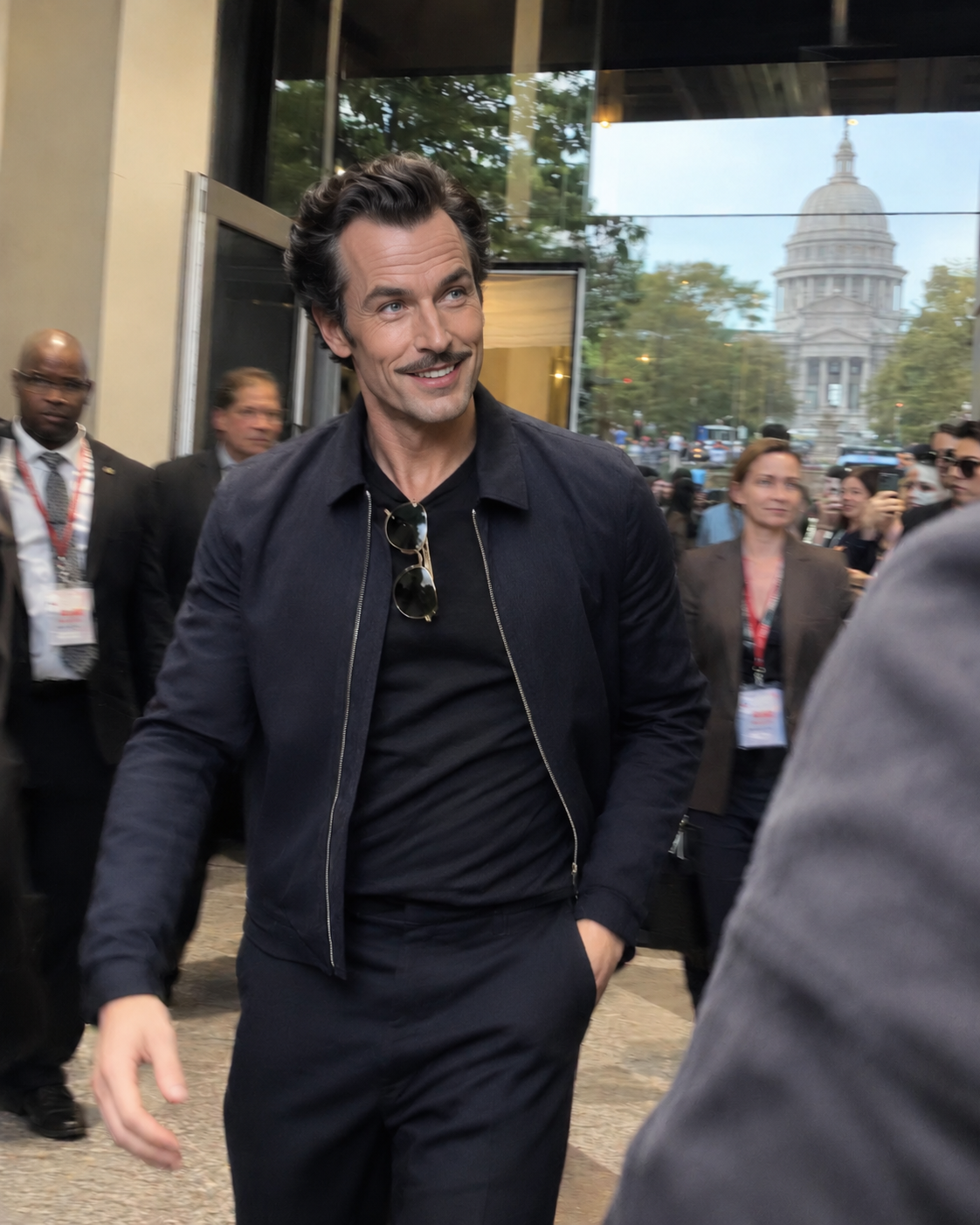
An AI illustration I made of the dream moment: the star leaving, the crowd giving him room, the Capitol building behind him and the shoulder of the man who stepped aside. It suggests the scene; it is not a likeness of Vincent Price.
That detail still amazes me. The site of the former Moose Lodge is in North Topeka, and from that street the State Capitol building would sit in the background, if only you could see that far. My dream mind placed him exactly where the day had happened.
He was with a group that had a project, and someone would be in touch. When I told him I had interviewed his daughter, he was kind and said that was good. Then he touched my waist. It was only his fingertips, yet it felt so very real. It was more than a touch. Something else resonated in it, warm and loving, carried in the subtlest contact.
The dream did not end when he left. It was raining as his group went out the door. I followed them out through the coat room and a side exit, realized I had no umbrella, and went back to find it. I never did. But when I came out again, the rain had stopped. I was happy about that. My timing had turned out better than I thought.
In the parking lot I found the security guys. Looking out over a very hilly lot, I joked with one of them that it was nice to see such a flat space. Then I went looking for my car, thinking about the horn button on a key fob and how I once wanted something like that for golf balls.
The rain is a detail I knew but did not write down at first. It surfaced only as I kept working through the dream, which is exactly how this process goes. These pieces are mine to interpret, but they echo the day. The whole experience was a search for something I could not yet see, guided by signals that called out to me, like a horn from a hidden car. I went back for protection and found I did not need it. And the joke in the parking lot has my father’s humor all over it.
ChatGPT noticed the contrast between the two experiences. At the Moose Lodge there was urgency, a task, a rush of feeling. In the dream there was no mystery to solve. As it put it: there was simply Dad. The day prompted action on behalf of my mother. The night let me experience my relationship with my father for its own sake.
The dream did not prepare me for the event. It helped me appreciate what the event had meant.
Round by round
Each correction I made changed what the experience meant.
| Round | What I clarified | How the reading changed |
|---|---|---|
| 1 | My first, unordered telling | A structure: identifiers vs. message; purpose was to prepare Mom |
| 2 | The skate was a billboard; the music was an alarm | Three signals with three jobs: recognition, activation, direction |
| 3 | I felt it in my body: tears, joy, sorrow, urgency | Emotion is the channel, not interference; body before mind |
| 4 | A friendship with Dad beyond our earthly history | The deeper message was my own transition, not only my aunt’s |
| 5 | The dream came that night, after the event | The dream became a replay and affirmation, not a premonition |
What the back-and-forth teaches
Looking back, I can see why my first telling misled. Language carries only part of a lived experience. When I describe an encounter, I know the atmosphere of the place, the history of the relationship, the feel of the moment and what things looked like. The reader, human or AI, has only my words. A reading can be perfectly logical and still be wrong.
ChatGPT said this well near the end of our conversation: I am translating an experience into language, and it is interpreting that language. Those are not the same process. The dialogue is what bridges them. The value runs both ways. A reflection can prompt me to remember a detail I left out. My clarification then changes the reading. Neither of us treats the first explanation as the final answer.
As ChatGPT put it: AI can help organize an extraordinary experience, but the experiencer supplies the context that gives the account its meaning. The interpretation improves not through agreement, but through correction.
I also know that AI can be too agreeable. It can find a pattern in almost anything and build a convincing story on thin material. That is why the experiencer has to stay in charge.
Where I hold the line in my own records:
- What happened. The events, in order, with the details that do not fit.
- What I perceived. The impressions, the feelings, the body’s response.
- What the dialogue helped me understand. The interpretations, held as interpretations.
The AI did not confirm that contact occurred, or decide what it meant. It gave me something to push against.
A note for fellow experiencers
If you use AI to review an extraordinary experience, your firsthand knowledge is the most valuable thing you bring.
- Write it down soon, then expect to revise. Your first telling is raw material, not the record.
- Get the order right. A dream placed out of sequence can turn a replay into a prophecy.
- Include the body and the emotions. They may be part of the message, not noise around it.
- Keep what does not fit. The uncle and the aunt, the timing I got wrong. These show how messages really arrive.
- Correct the AI, out loud. Each correction sharpens your own understanding as much as the reading.
- Keep your authority. Use the tool to ask better questions, not to be told what to believe.
Free to fly
I began with a roller skate, a song, a phone call and a dream. I wanted to know how the pieces fit. The answer turned out to be larger than the question.
The skate got my attention. The music moved me to act. The search, imperfect as it was, took me to my mother before the phone rang. The dream, that night, let me feel my father’s presence without any task attached. The cup, the next morning, offered a picture of an angel. My aunt being carried home. Dad said she was in good hands.
And underneath it all was a relationship made new: a father and daughter meeting as friends, free of the old story, at the very moment I am learning to live free of mine. The experience remains mine. The interpretation keeps evolving. And the joy is real.
I am Wendy, free to fly.

Quiet mind. Open heart.
Further exploration
- Dr. Garry Nolan on intuition as a capacity for recognizing anomalies in one’s environment: video
- Research links the caudate nucleus to learned intuitive expertise. It concerns intuitive cognition and does not establish mediumistic communication.
Discover more from Conscious Living & Wendy's Coffeehouse
Subscribe to get the latest posts sent to your email.


