What if interdimensionals don’t have to hide from us — they simply move in patterns our eyes cannot resolve?
My Eureka Moment: A Spinning Drone That Hides in Plain Sight
What we perceive depends, in part, on whether the spatial and energetic patterns before us can be translated by the brain into a coherent image. If a pattern is too complex, too fast, or does not fit an expected template, we may see distortion, confusion — or nothing recognizable at all.
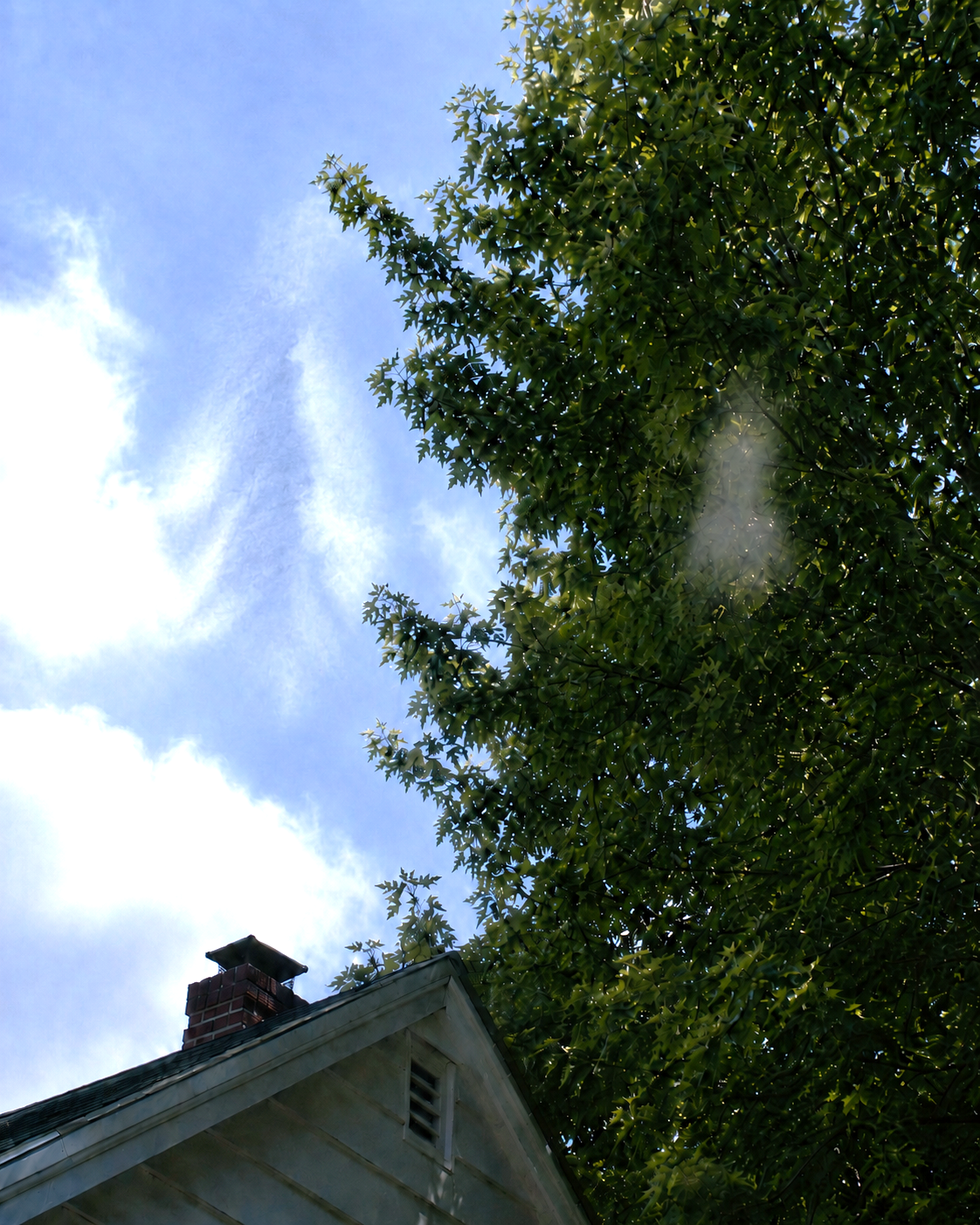
A few years ago, I filed a UFO report after seeing what appeared to be a human figure suspended in the air above our house. Describing it was nearly impossible. The figure did not appear conventionally invisible or transparent. It looked as though someone had partially erased it — a human-shaped smudge against the sky.
I also had the distinct impression that it knew I could see it. Twice, it moved into the branches of a tree as though attempting to hide. Whatever it was, it did not appear to intend to be observed.
Now, a new drone developed by Northwestern University offers a striking technological comparison. Called Phantom Twist, the drone does not hide by matching the color of its surroundings or bending light around itself. Instead, its entire body spins up to 25 times per second — too quickly for the human eye to resolve into a stable object.
With no stationary form for the eye to lock onto, the drone visually dissolves into the background. Researchers describe its appearance as a ghostly smudge — a faint, semi-transparent haze rather than a clearly defined machine.
That language immediately caught my attention. A ghostly smudge. Nearly erased. Present, but difficult for the eye to assemble into a recognizable form.
Phantom Twist does not explain what I witnessed. It does, however, offer something valuable: a plausible visual mechanism for an observation that once sounded almost impossible to communicate. A physical object can be directly in front of us and still resist recognition because its motion interferes with the way the human visual system constructs a coherent image.
And no one is more surprised than I am to discover that “it looked like it had been erased” may have been the most accurate description available.
The Takeaway – Why Sasquatch and Other Interdimensionals Can Remain Invisible
Jacobo Grinberg’s research suggests that what we “see” is not reality itself, but an interpretation assembled by the brain — a decoding of patterns in space and time. As he proposed, for something to become perceptible, “the organization of the spatial information must be adequate for the cerebral mechanism in charge of decoding it. If the complexity of this organization exceeds a limit, the image is chaotic or there is no image.”
In other words, if the physical, energetic, or spatial pattern of a being is too complex, too subtle, too fast-moving, or simply outside the normal range of human perception, the brain may fail to assemble it into a coherent image.
Instead of seeing the being directly, we may see nothing at all. We might register only a shadow, shimmer, animal-like form, or disturbance in the surrounding landscape. In some anomalous encounters, the mind may even substitute a more familiar image — an effect sometimes described as a “screen memory.”
That possibility resonates with several of my own experiences: a cat who refused to wear a collar appearing with a collar while perched on the back of a chair she could not have climbed; shimmers in spaces that otherwise appeared empty; and an odd, erased-looking smudge in the sky where I believed I saw a humanoid figure hovering above the house.
This may be why Sasquatch and similar interdimensional beings are not necessarily “invisible” in the Hollywood sense. They may be fully present, yet their frequency, movement, or spatial complexity exceeds the brain’s ordinary decoding limits. The result may be a matter of perceptual failure. The being remains present while slipping past conscious recognition, blending into the visual background of our reality.
This possibility may also help explain why witnesses often report fleeting glimpses, movement in peripheral vision, or greater perceptual clarity during meditation, deep stillness, fear, altered states, or heightened awareness — moments when the brain’s usual filtering and decoding processes shift.
Now, with the emergence of drone technology capable of appearing as a ghostly smudge or faint haze rather than a clearly defined object, we have a useful technological parallel. While the drone does not prove that interdimensional beings exist or explain what witnesses are seeing, the drone does demonstrate an important principle: something can be physically present and directly within our field of vision while remaining extraordinarily difficult for the brain to resolve.
Sometimes the question is not whether something is there. Sometimes the question is whether human perception can successfully organize what it is seeing.
Curiosities to Ponder
Wormhole caught on film?
On July 14 at 4 a.m. an elliptical hole appeared in the cloud cover above and expanded to one-quarter of a mile. Meanwhile, the instruments recorded a huge spike in radiation at 43.37 MeV. (The average was 2 MeV). Inside the egg-shaped hole, 53 white UAPs glowed, each between 35 to 50 feet wide. Then the hole closed with such abnormal swiftness, (UAlbany Professor) Kevin Knuth calculated that clouds would be moving 750 mph. Source: Rawstory. Article also available on Facebook: Link.
UAP Research Enters the University
Kudos to those helping establish UFO and UAP research within academic institutions. “This extraordinary generosity allows UAlbany to strengthen its role as one of the few universities worldwide leading academic research into UAPs,” said Fardin Sanai, vice president for university advancement. Link.
Those TARDIS type UFOs
In Alternate Perceptions Magazine, Mary concluded: “Like the Tardis, I think this craft may have been a portal which stretched dimensions, allowing an external dimension to be embedded within our normal 3-dimensional reality.” Link.
Penetration — Beyond Limitations
Eight Martinis, Issue 18, features reprints of seminal articles written by Ingo Swann in 1992 and 1993. The material explores remote viewing, extraterrestrials, and UAPs. Link.
Mainstream Recognition of the Experiencer
Finally, a recent Psychology Today headline reflects the increasingly open and constructive way mainstream outlets are approaching UFO and UAP experiences: “Why Science Is Taking UFOs Seriously, and You Should, Too.”
The article makes an important point: “Regardless of what UAP ultimately turn out to be, millions of people around the world report experiences they cannot explain. For some, it is simply an unusual observation. For others, it becomes a deeply meaningful event that changes how they think about themselves, reality, and what they believe is possible.”
That may be the most significant shift of all. Beyond what is happening in the sky, serious attention is also being given to the people who witnessed it — and to the lasting psychological, philosophical, and spiritual impact of the encounter. Source.
Discover more from Conscious Living & Wendy's Coffeehouse
Subscribe to get the latest posts sent to your email.

 Conscious Living & Wendy's Coffeehouse