The following is received wisdom — offered not as doctrine, but as invitation. There is a teaching that arrives when you sit at the foot of an Elder, and it begins, perhaps surprisingly, with time, and the quiet radical act of putting down the clock.
The message is this: the linear construct humans have built around time — schedules, calendars, epochs neatly labeled and filed — is not native to the universe. It is a tool of order, yes, but order exacts a cost. What gets stifled is the very thing our moment most desperately needs: creative coherence with the living world around us. When we fix a point on the timeline and call it now, we interrupt a flow that was never meant to stop.
This resonates with something science is already circling. Quantum physicists speak of non-locality — the way particles communicate outside the boundaries of sequential time. Indigenous knowledge keepers around the world have said for millennia that the land does not operate on a human schedule. Even modern chronobiology is discovering that the body’s deepest intelligence follows rhythms — lunar, seasonal, circadian — that no alarm clock invented yet has managed to improve upon.
The transmission suggests something practical buried inside what sounds mystical: give your body permission to rewrite the rules. Not all at once. In increments. Notice what shifts.
The Longer Story Beneath Our Feet
What comes next is harder for a modern mind to sit with comfortably — and perhaps that discomfort is precisely the point.
We are told that beneath this civilization lie the bones of others. That the violent upheavals recurring across human history — the collapses, the wars, the ecosystem failures that read like catastrophe — are in fact a form of adjustment. Not random. Not simply the work of identifiable human actors. Something larger, and older, moves through these moments to level a playing field grown too lopsided, to allow what the transmission calls “further maturation of the emotions and intellect.”
This is not a comfortable idea. It asks us to hold two things at once that our culture prefers to keep separate: that suffering is real and that it serves something beyond what we can currently see.
Archaeology and geology keep handing us evidence that challenges the official story of human development. Structures that predate accepted timelines. Astronomical alignments that suggest sophisticated knowledge we have no clean narrative for. The transmission calls this shadow history — not hidden by conspiracy, but by the sheer depth of time and the limits of what we accept as possible. The remnants surface anyway, in ancient stone, in dream, in the kind of knowing that arrives sideways when the rational mind is briefly offline.
The Tech Ceiling and What Lies Beyond It
Here is where the teaching lands with particular force for this particular moment in history.
We are a civilization in the grip of a technological acceleration that has outrun our emotional development. The transmission is direct about this: no degree of technological advancement will carry us forward until the ego is brought into balance. Centuries of work, it suggests. Not a pessimistic verdict — a patient one.
This mirrors what philosophers, ecologists, and contemplatives from entirely separate traditions are increasingly saying in concert: we have developed extraordinary external capability while neglecting the interior architecture required to wield it wisely. The result is what we see — tools of breathtaking power operated by a species still working through very old wounds.
The invitation offered here is not despair. It is expansion of frame. To consider that there are forms of intelligence — some so far evolved they require no physical body, some operating outside environmental conditions that would end a human life — that have been navigating these cycles far longer than recorded history accounts for. Whether you receive that literally or as metaphor, the functional message is the same: we are not the ceiling of what consciousness can become. We are somewhere in the middle of a very long story.
What Is Actually Being Asked of Us
Stripped to its core, this transmission offers three movements: First — loosen your grip on artificial time. Experiment with natural rhythm. Notice what becomes perceptible when you stop racing the clock, even briefly.
Second — expand your tolerance for a longer, stranger history than the one you were taught. The bones under your feet are not a tragedy. They are a library.
Third — take seriously the interior work. The trajectory shifts not through more sophisticated technology but through the slow, unglamorous maturation of how we treat each other, the living world, and ourselves.
The transmission closes with something that feels equal parts warning and encouragement: some will leave, some will stay, the next iteration will begin again — as it has across the galaxies, in a universe with no hard start and no fixed finish line. The holographic model of reality — in which every part contains the whole, in which consciousness is the substrate rather than the product — is offered as the closest map we currently have.
All is well, the Elder says. Wonder. What is possible?
Anything.
This material was received in transmission and is offered here as reflection and inquiry — not conclusion. The questions it opens are the point.
Part 2
The Spelling That Shouldn’t Have Changed: A Personal Dispatch from the Dilemna Timeline
A new wing on the house of time
There are moments when the universe decides to make a point — and makes it with impeccable timing.
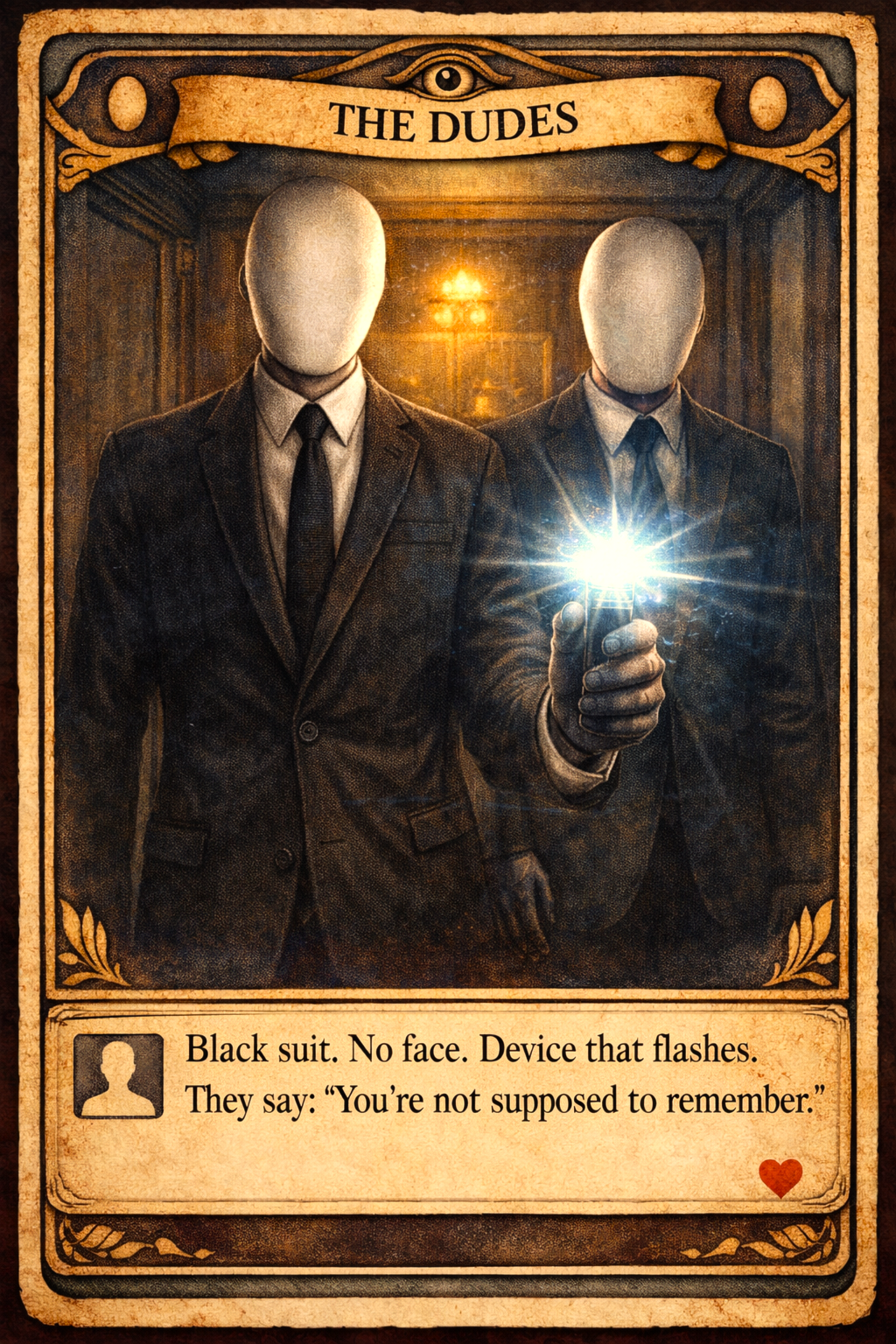
I was deep in a sci-fi piece, building out a category of beings I’d come to call The Functionaries — entities whose sole purpose is to step in when complex systems become critically stressed and begin trending toward collapse. Think cosmic maintenance workers. The quiet hands that reach in when a civilization’s operating system starts throwing fatal errors.
To describe them, I reached for a specific word. And when I paused to check the spelling — a reflex, nothing more — I fell through a small but unmistakable crack in the floor of ordinary reality.
The word was dilemma.
Except that’s not the word I’ve always known. The word I’ve always known — the one drilled into memory with a silent n that never made phonetic sense but somehow stuck — was dilemna.
What Reddit Found at the Intersection
Turns out I’m not alone in this particular timeline shift. A thread on the Mandela Effect subreddit has been quietly accumulating testimony from people — many of them in their sixties and seventies, people who learned this word in school, who developed specific memory tricks around that silent n — who share exactly the same recollection:
“I am 70 years old and I was drilled into my subconscious this spelling for many years. It has a silent ‘n’ and in many of our spelling tests, this was a trick word because of that. Dilemma is just wrong. Who changed that?”
“Same. I made a way to sound it out with the silent n so I’d never forget the spelling I was taught in school. Dilem-Na.”
“I’m 70 and consider myself well read. I have absolutely no doubt it was ‘dilemna’ with an ‘n’.”
These aren’t careless spellers. These are people describing deliberate, system-specific memory strategies — mnemonic scaffolding built around a silent letter that, by all current evidence, never officially existed. The kind of careful encoding you only do when a word is genuinely unusual enough to warrant it.
And yet: search any current authoritative source. Dilemma. Always dilemma. The n is simply… not there.
The Synchronicity That Stops You Cold
Now sit with the full picture for a moment. I am writing a character whose entire function is to intervene in systems under collapse stress — to quietly adjust the variables when the trajectory of a complex system is heading somewhere unsustainable. A being who operates, by design, outside of normal observable causation. Who doesn’t leave a trace. Who simply allows and instigates an adjustment.
And in the act of writing that character, I stumble — by checking a single word’s spelling — directly into a living example of exactly what the transmission described weeks prior: evidence that our relationship with time, memory, and consensus reality is not as stable or as linear as we’ve been led to believe.
The Elder said: those who are curious will connect the dots as they play out.
Consider a dot connected.
The Mandela Effect as Data, Not Dismissal
The Mandela Effect — named for the widespread false memory of Nelson Mandela dying in prison in the 1980s — has accumulated enough documented examples at this point that the reflexive response of mass misremembering is beginning to feel less like explanation and more like avoidance.
What we’re actually looking at, across hundreds of these documented instances, is a pattern: coherent, detailed, cross-cultural memories of a reality that differs from the currently documented one. Not vague impressions. Specific, defensible, often ingeniously constructed memories — like a 70-year-old’s phonetic mnemonic for a silent n that, according to all present records, never existed.
The transmission we explored previously speaks of shadow history — of civilizations whose bones lie beneath our feet, of knowledge seeded into the memories of conscious beings and retrieved through dreams and altered awareness. What the Mandela Effect community is documenting in real time may be a street-level, everyday version of exactly that: the bleed-through between timelines, epochs, or probability streams that our current scientific framework has no tidy drawer for.
The Elder’s framing is useful here. The holographic universe model — in which every apparent moment contains encoded information from the whole — would suggest that discontinuities like this aren’t glitches. They’re features. Evidence of the layered, non-linear nature of a reality we’ve been mapping with tools designed for a much flatter terrain.
The New Wing
What the dilemna moment crystallizes — particularly given when it arrived, mid-sentence in a story about systemic adjustment — is that we may need to genuinely expand our framework for what counts as evidence. To stop requiring that reality present its credentials in forms our current instruments were built to read.
The Functionaries in my story create the conditions for a system to recalibrate — and then the evidence of their presence is found later, sideways, in things that don’t quite add up.
Sound familiar?
The n was there. And then it wasn’t. And somewhere in that gap — in the collective bewilderment of well-read seventy-year-olds and careful spellers reaching for a mnemonic that apparently never had a reason to exist — there is a question that refuses to be filed away:
What else has quietly shifted while we weren’t looking?
Aloha — and welcome to the new wing.
The Functionaries are watching the systems. Some of us are apparently watching the Functionaries.
The Oracle Card
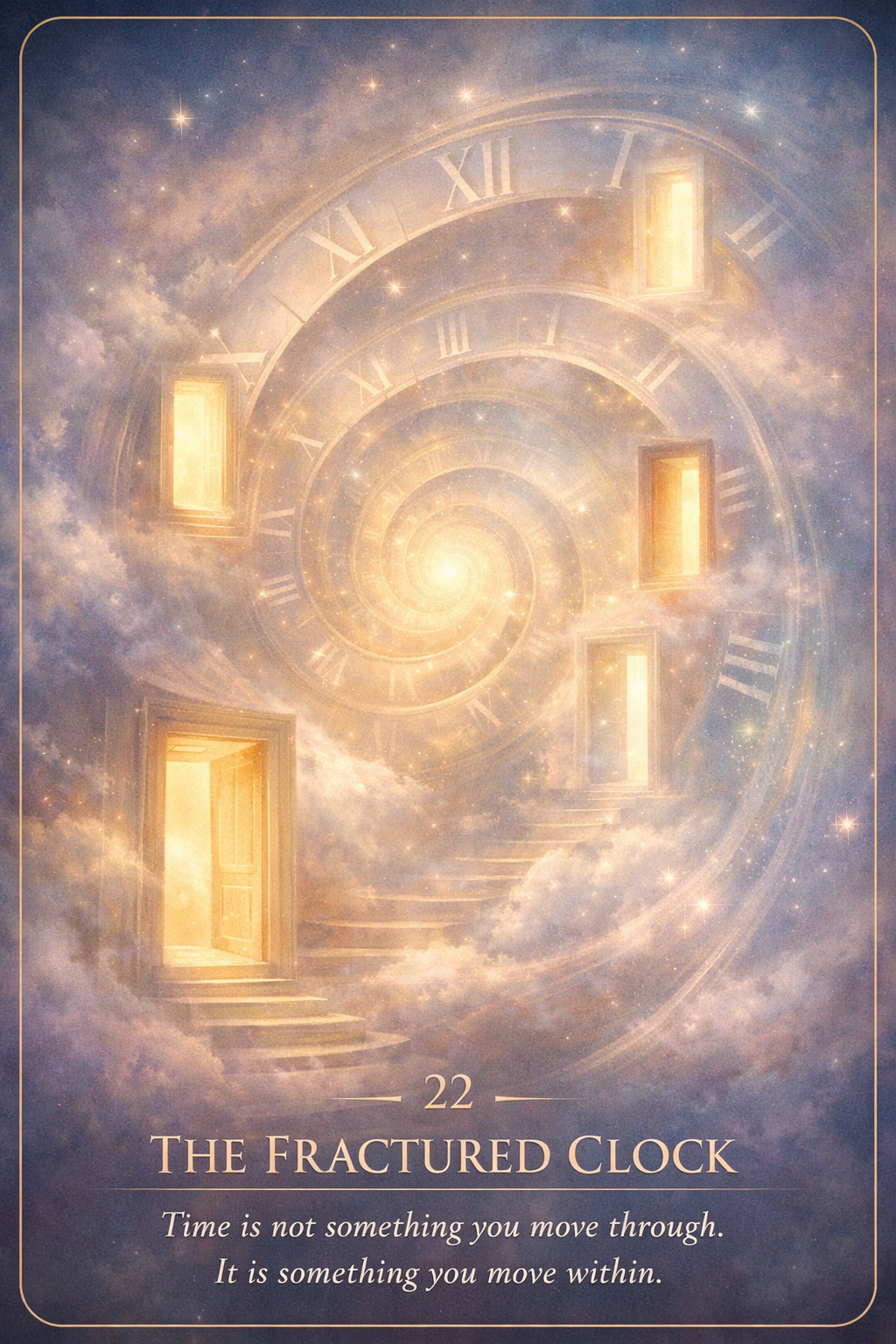
Keyword:
Threshold • Nonlinear Time • Choice Points
Time is not something you move through.
It is something you move within.
What appears as a single path is actually a series of thresholds — entry points that open and close based on awareness, timing, and perception. You are not confined to one track, even if you’ve been taught to follow it.
The clock you’ve trusted is not wrong — it’s just incomplete.
There are doors within it.
Moments when something doesn’t line up…
when memory shifts…
when you feel early, late, or somehow out of sequence…
These are not interruptions.
They are invitations.
Each doorway represents a subtle choice:
- how you interpret what you’re experiencing
- how tightly you hold to expectation
- whether you follow the schedule… or the signal within
You don’t need to force anything open.
The doorways respond to awareness.
Closing Line:
You are not bound to time.
You are learning how to walk through it.
Discover more from Conscious Living & Wendy's Coffeehouse
Subscribe to get the latest posts sent to your email.


