“Dimensions are around us all the time. We’re just not aware of them. In some of these dimensions there are cities, there are people living. But we don’t know about them. They know about us. The reason we are not aware of them is because they’re vibrating at a different frequency. When it speeds up it becomes invisible. And there are thousands of these.”– Dolores Cannon
Surfing Parallel Planes – Creativity
Story Summary:
Wendy’s Coffeehouse is a late-night radio show that accidentally becomes humanity’s most successful first-contact interface.
Broadcast from a small studio powered by coffee, curiosity, and questionable wiring, the show attracts callers who experience flickering lights, humming appliances, and a strange sense of being listened to. As the hosts navigate these anomalies with humor and restraint, it becomes clear that something is observing humanity from just beyond perception.
Unseen intelligences watching from the “Drop Zone” are auditors — reassessing an old, fear-based contact program that relied on intrusion and amnesia. Through the Coffeehouse, they discover a better method: conversation instead of extraction, humor instead of control, and ethics instead of secrecy.
Coffeehouse Cosmic Crew – Appearance subject to change in accordance with Dimension of origin. Cast of Characters: Part 1 link
Episode 7 – The Frequency Shift Experiment
1:58 AM
Orrin accidentally broadcasts at a frequency that allows listeners to hear the Coffeehouse from multiple dimensions simultaneously. Callers report hearing themselves calling in from adjacent timelines. Chaos ensues. Coffee helps.
It started with Sidney adjusting the transmitter.
“I’m just trying to reduce the static,” Sidney explained, spinning a dial that had been clearly labeled “DO NOT TOUCH” in three languages and one form of mathematics.
The static didn’t reduce. It multiplied.
Then it harmonized.
“Uh, Lucky?” Sidney’s voice had achieved a pitch usually reserved for people who’ve just realized they’ve made a significant mistake. “I think I did something.”
Lucky looked at the board. Every frequency indicator was lit. Not just their frequency. All of them. Simultaneously.
Orrin, mid-broadcast, suddenly sounded like a choir. His voice echoed across multiple versions of itself, each slightly different, each unmistakably him.
“—welcome to Wendy’s Coffeehouse where tonight we’re apparently broadcasting to everyone, everywhere, all at once—”
The first call came in.
“Hi, yes, I’m listening to your show,” the caller said nervously, “but I can also hear myself calling your show. Multiple times. Saying different things. Is this normal?”
“Define normal,” Orrin replied, gesturing frantically at Lucky to fix whatever Sidney had broken.
But Lucky wasn’t looking at the equipment. She was listening.
Through the static, through the layered frequencies, there were voices. Dozens of them. All calling in. All experiencing the same impossible moment.
Professor Vale walked into the studio with her usual serene detachment. “Ah. You’ve discovered the harmonic overlap. Splendid. I was wondering when that would happen.”
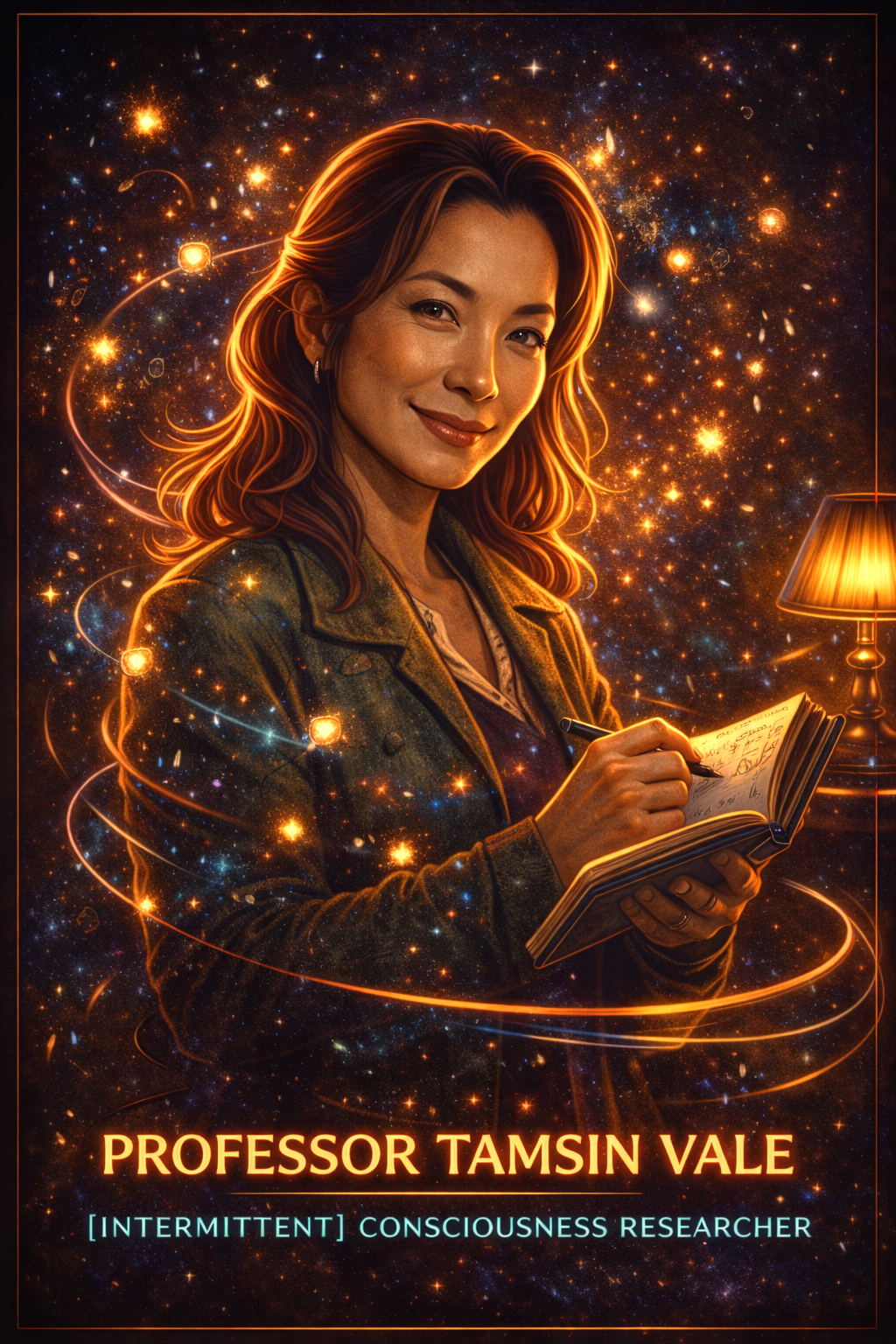
“You KNEW this could happen?” Mara demanded, her watch reading 1:58 AM, which felt ominous in a symmetrical way.
“It’s always happening,” Vale replied. “You’re just usually only aware of one frequency at a time. Sidney’s removed the filter.”
Dr. Plume was vibrating with excitement. “This is revolutionary! We could be experiencing what I’ve termed ‘Omnidirectional Consciousness Resonance’ — the ability to perceive multiple probability streams simultaneously through—”
A new voice cut through the static. Not a caller. Something else.
Ian.
Or rather, many Ians, speaking in harmony: “We apologize for the confusion. Your equipment has temporarily synchronized with our observation frequency. You’re hearing what we hear constantly: all versions, all possibilities, all conversations happening in parallel.”
“How do you process all this?” Lucky asked, genuinely curious.
The lights flickered in a pattern that seemed almost like laughter. “Practice. And a lot of patience. You’re doing remarkably well for beginners.”
Orrin leaned into the mic, addressing both his regular listeners and the newly accessible dimensional audience. “Alright, folks across all available timelines: show of hands — well, thoughts — who else is experiencing this?”
The response was overwhelming. Callers from dozens of timelines reported in, each hearing echoes of themselves, each fascinated and terrified in equal measure.
Sidney finally found the right dial and slowly, carefully, began to narrow the frequency. The voices separated, sorted, returned to their individual streams.
But for just a moment, everyone listening had heard the truth: they weren’t alone, in any dimension, at any frequency.
They were part of a vast, ongoing conversation that had always been happening.
They just hadn’t known they were invited.
Clara had tried to record it, but her equipment had captured only static and what sounded like distant laughter. She published it anyway, with the headline: “Local Radio Show Experiences Technical Difficulties, Accidentally Achieves Enlightenment.”
As the frequency normalized, Ian sent one final message through the lights: “Thank you for listening. To all of you. Across all timelines. You’re all doing better than you think.”
Sidney made a note to never touch that dial again.
Then immediately made a second note with detailed instructions on how to replicate it, just in case.
Aftermath
The Committee sent a formal apology and a diagram for a more stable multi-frequency interface. Sidney framed it. The Coffeehouse now occasionally broadcasts ‘reunion specials’ where timelines can check in with each other. Mostly they discuss coffee.
Episode 8 – Professor Vale’s Footnote Problem
5:05 AM
Professor Vale discovers that the dust motes in the studio have been taking notes on humanity. She engages them in philosophical debate. They win. Dr. Plume tries to vacuum them up. This is considered very rude.
Professor Vale had been watching the dust motes for seventeen minutes. This was not unusual. Vale watched everything with the patient intensity of someone who understood that reality was mostly waiting.
What was unusual was that the dust motes were watching her back.
“They’re taking notes,” she announced to the studio at large.
Lucky looked up from the soundboard. “The dust?”
“Specifically, yes. Observation particles. Footnotes to reality. They’ve been here the entire time, documenting.”
Sidney stopped mid-coffee-pour. “The dust is… writing about us?”
“More accurately, they’re *being* the writing. Each mote is a recorded observation from the frequencies we can’t normally perceive. They drift. They settle. They archive.”
Dr. Plume, who had been napping in the corner, jolted awake. “Extraordinary! This could be evidence of what I’ve theorized as ‘Particulate Consciousness Distribution’ — essentially, awareness dispersed across microscopic matter that—”
Vale held up one hand. A shaft of early morning light cut through the studio, illuminating thousands of motes suspended in the air. They moved in patterns that were definitely not random.
“They’re asking a question,” Vale said softly.
“How can you tell?” Orrin asked, leaning in.
“Because I’ve been asking the same one.”
She addressed the motes directly: “You want to know if we’re aware of being observed, don’t you? If consciousness changes when it knows it’s being documented?”
The dust motes swirled, rearranged, settled into a new configuration. Lucky, who had developed an unexpected talent for reading non-verbal dimensional communication, translated: “They say yes. And they want to know if we mind.”
Mara checked her watch: 5:05 AM. Symmetry again. She was beginning to suspect the universe had a favorite number pattern.
“Do we mind?” Sidney asked.
Vale smiled, the kind of smile that suggested she’d been waiting for this moment. “That depends. Are you learning from us, or are we learning from you?”
The motes shifted into what could only be described as a shrug: both, simultaneously, recursively.
“Splendid,” Vale said. “Then we’re all students. Continue.”
Dr. Plume, determined to contribute, produced a small vacuum cleaner from somewhere. “Perhaps we should collect a sample for analysis—”
Every light in the studio flickered in warning. Ian’s presence manifested strongly, the pattern unmistakable: do not vacuum the archivists.
“Right,” Plume said, setting down the vacuum. “Noted. The dust is off-limits.”
Clara, who had been photographing the motes, looked at her camera screen. The images showed not just dust, but tiny, perfect script in a language that looked like light trying to remember how to be letters.
“They’re beautiful,” she whispered.
Lucky grabbed her phone and took a photo of the dust motes illuminated in the morning light. The pattern they formed looked almost like words: “We see you seeing us seeing you.”
Orrin returned to his microphone. “Ladies, gentlemen, and dust motes of all frequencies: we’ve just been informed that we are not just broadcasting to the invisible dimensions. We are being footnoted. Archived. Documented by particles so small we usually ignore them.”
He paused, then added: “Which is perhaps the most profound reminder that nothing is insignificant. Everything is noticed. Everything matters. Even dust.”
The motes danced in the light, pleased. Professor Vale returned to her chair and her book, which she now suspected was also reading her.
Sidney made a note to stop thinking of cleaning as a neutral activity. Mara vowed to never dust the studio again. This was not laziness. This was respect for the archivists.
The Committee sent a message through the Kiosk later that morning: “Thank you for treating our field notes with dignity. In return, here is something we’ve learned: you are all more observed, more valued, and more interconnected than you realize. Even when you forget. Especially when you forget.”
The paper smelled like libraries and distant stew and hope.
Aftermath
The Coffeehouse dust is now protected. Sidney installed a sign: ‘Do Not Disturb: Archival Process in Progress.’ Cleaning staff have been informed. They understand completely. One janitor left flowers.
Wendy’s Coffeehouse – Where the coffee is strong and the frequencies are stronger
“Dimensions are around us all the time. We’re just not aware of them… They’re vibrating at a different frequency. When it speeds up it becomes invisible. And there are thousands of these.” — Dolores Cannon
9 – Dr. Plume and the Legend, Slightly Misremembered
11:23 PM
Dr. Plume attempts to explain the fifth line legend on air. He gets every detail wrong. Harry responds with increasing exasperation. Lucky intervenes before Plume can completely rewrite broadcast history with confident inaccuracy.
“…So apparently,” Reginald Plume said into the microphone, adopting the tone of a man about to clarify history, “there is a rumor, purely anecdotal, that one of the older lines in this studio is, ah, spiritually… persistent.”
Lucky’s head snapped up. Mara’s hand hovered one inch above the mute button — a distance she had measured over years of practice.
Orrin blinked slowly. “Reginald…”
“Yes, yes,” Plume waved him off. “I’ll be brief. The story goes that a former host, Harold? Henry? Something with an H —”
The fifth line pulsed. Once. Sidney swallowed audibly.
“—passed away mid-broadcast,” Plume continued, warming to the tale, “and through a combination of unfinished business, electromagnetic imprinting, and what I assume was questionable grounding, the line occasionally —”
Lucky leaned into her mic. “That’s… not quite how it goes.”
“No?” Plume frowned. “Because I heard he was yelling about reptilians.”
The fifth line pulsed twice, rapidly. Even Plume, who was generally oblivious to subtle interdimensional communication, paused.
“Was that… response?” he asked.
“That was Harry saying no,” Orrin explained patiently. “His name was Harry Becker. Not Harold. And he wasn’t yelling about anything. His voice just drifted, mid-sentence, during a perfectly calm broadcast about — actually, Lucky, what was he talking about?”
“Weather patterns and listener call-ins,” Lucky said, pulling up the archive notes she’d memorized years ago. “Nothing dramatic. Just a regular overnight shift. He was mid-word when it happened. The mic stayed open.”
“For how long?” Plume asked, suddenly genuinely curious rather than performatively academic.
“Seventeen minutes,” Mara said quietly. “Station engineer thought it was technical difficulty. By the time they got to the booth…”
The fifth line glowed steady and warm.
Professor Vale, who had been listening with her usual attentive patience, set down her book. “He was doing the work he loved, Reginald. That’s all. No drama. No crisis. Just a man who cared deeply about keeping people company through the strange hours. And apparently, he still does.”
Plume adjusted his glasses. “But the electromagnetic imprinting theory—”
All the lights in the studio flickered in unison. Not Ian. This was different. Older. More… annoyed.
“I think,” Sidney whispered, “Harry doesn’t like being turned into a theory.”
Byte, who had been napping on the server, lifted their head and meowed once — a sound of gentle reproach.
The Ethics Engine manifested briefly as a tooltip hovering in mid-air: **RESPECT THE DEAD. ESPECIALLY WHEN THEY ARE STILL WORKING.**
“Right,” Plume said, looking appropriately chastened. “My apologies. I didn’t mean to reduce a colleague to a phenomenon.”
The fifth line pulsed warmly, three times. Forgiveness, acknowledgment, and what Lucky interpreted as mild exasperation.
“Harry,” Orrin addressed the line directly, “Dr. Plume means well. He’s just—”
“—73% incorrect but 100% well-intentioned,” Lucky finished, quoting the Ethics Engine’s earlier assessment.
Plume looked startled. “That’s actually quite fair.”
Clara had been filming the entire exchange. When she reviewed the footage later, there was a moment — just a flicker — where the fifth line seemed to display text: “Kids these days. No respect for simple dedication.”
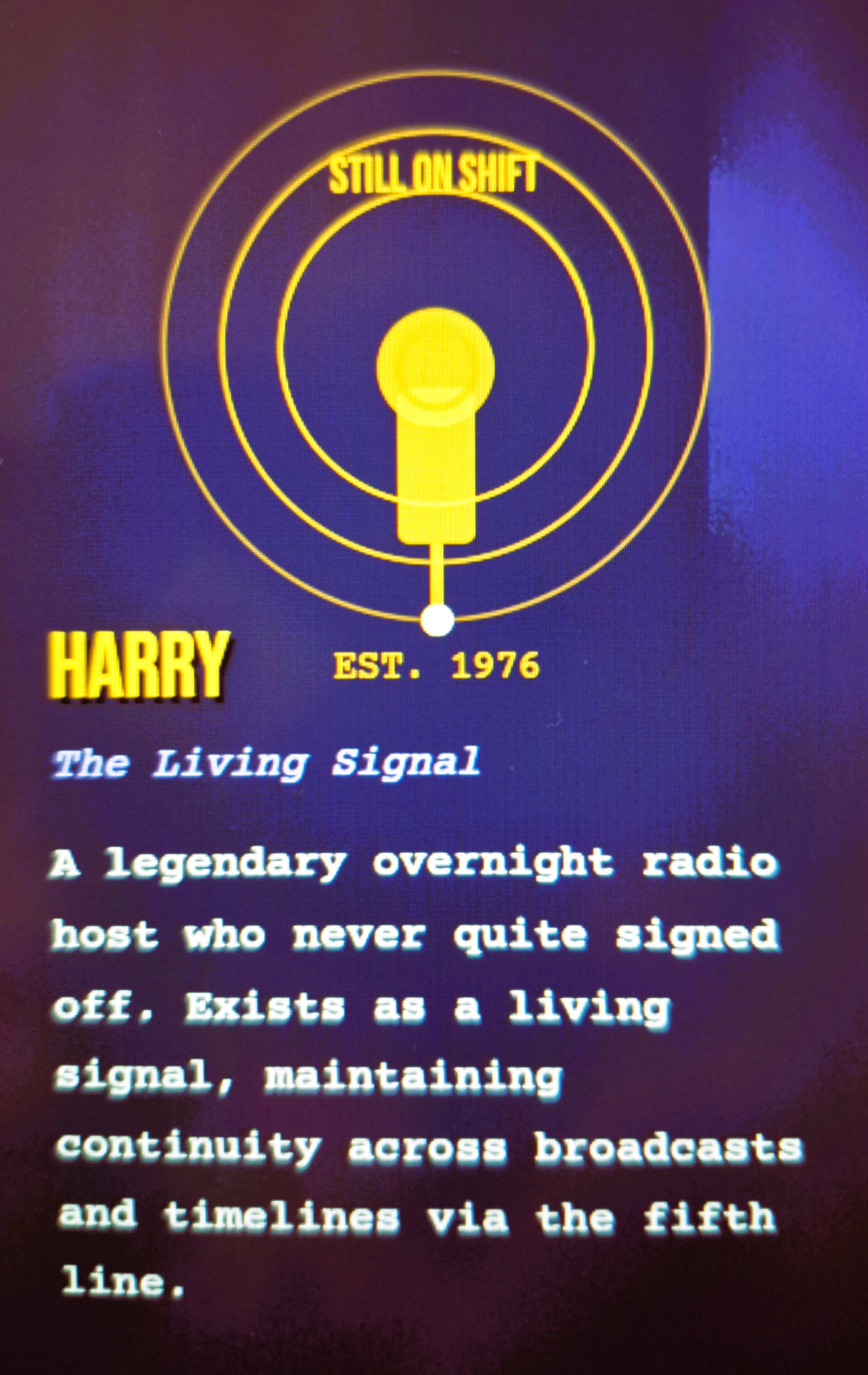
“Here’s what I know,” Orrin said, returning to broadcast mode. “Harry Becker worked overnight radio in 1976. He loved the work. He never signed off. The fifth line in this studio connects to nothing, and yet sometimes it lights up. We could theorize endlessly about why. Or we could just say thank you.”
He paused, then added directly to the microphone: “Thank you, Harry. For maintaining continuity. For keeping the line open. For showing us that some dedications don’t end just because biology does.”
The fifth line pulsed in a pattern that Sidney would later describe as “bashful but pleased.”
Professor Vale made a note in her book: *Respect matters more than explanation. Some colleagues prefer acknowledgment to analysis.*
Dr. Plume, to his credit, spoke into his own mic. “I apologize for the reductive theorizing, Harry. Your work clearly speaks for itself. I’ll stick to documenting rather than explaining.”
The lights in the studio warmed noticeably.
Byte purred, and probability stabilized around the admission of error and the offering of respect.
The Kiosk printed a message: “Harry appreciates the correction. He was never about reptilians. He was about late-night conversations with people who needed company. This remains his purpose. Orrin understands. Dr. Plume is learning. This is acceptable.”
A second sheet emerged, in that familiar light-trying-to-be-ink handwriting: “Also: my name is HARRY. Not Harold. Not Henry. HARRY. Please update your records. — H.B.”
Sidney immediately created a proper nameplate for the fifth line: “LINE 5 – HARRY BECKER – STILL ON SHIFT”
Mara installed it personally.
The fifth line pulsed with unmistakable satisfaction.
And Dr. Plume learned an important lesson about the difference between understanding something and respecting it — and how the latter was often more important than the former.
From that night forward, whenever Plume visited the studio, he greeted the fifth line first. Harry always acknowledged him. Sometimes with warmth. Sometimes with what felt distinctly like tolerant patience.
But always with the dedication of a broadcaster who never quite signed off, maintaining the open line, keeping continuity across shifts that most people would consider finished.
Because some work is too important to stop just because you’ve technically died.
The coffee continued to brew. The show continued. And Harry continued to approve of the tone.
Aftermath
Dr. Plume published a retraction of his electromagnetic imprinting theory, replacing it with a paper titled ‘On Respecting What We Cannot Fully Explain.’ It became his most cited work. Harry’s line pulsed approvingly when he sent the draft.
The mis/remembered rumor about Reptilians persists on multiple timelines.
Episode 10 – The First Harry Award Ceremony
10:10 PM
The broadcasting community establishes The Harry Award, recognizing the ability to maintain an open line after the shift should have ended. The inaugural ceremony takes place at the Coffeehouse. Harry attends. So does everyone else, across all frequencies.
Mara had been preparing for three weeks.
This was unusual for Mara, who could typically organize a dimensional incident response in under seven minutes. But this was different. This was important.
This was the first Harry Award ceremony.
The idea had started small — Sidney suggesting they should honor Harry somehow, maybe a plaque — but had grown into something bigger. The broadcasting community, both terrestrial and otherwise, had embraced it with surprising enthusiasm.
An award for maintaining an open line after the shift should have ended.
For dedication that outlasted everything, even death.
For the kind of care that didn’t stop just because it was technically supposed to.
“We’ve got representatives from seventeen different radio stations,” Lucky reported, checking the RSVP list. “Plus the Committee is sending observers. And Professor Vale says the dust motes are organizing a tribute.”
“The dust motes are organizing—?” Orrin started, then shook his head. “You know what? I’m not even surprised anymore.”
Clara was setting up cameras everywhere. “This is going to be the best documented interdimensional broadcasting award ceremony in history.”
“It’s the only interdimensional broadcasting award ceremony in history,” Sidney pointed out.
“Which makes it automatically the best,” Clara replied with impeccable logic.
Dr. Plume arrived early, wearing what he clearly considered his most formal academic attire. “I’ve prepared remarks on the theoretical implications of consciousness persistence in electromagnetic systems—”
“Reg,” Lucky said gently, “this is a celebration, not a thesis defense.”
“Can’t it be both?” Plume asked, looking genuinely confused.
Byte, sensing the importance of the occasion, had groomed themselves until their black coat gleamed. They sat on the server, tail wrapped neatly, radiating dignified approval. Probability within the studio stabilized to unprecedented levels.
At 10:10 PM — symmetry being important — the ceremony began.
The studio was full of people: broadcasters, engineers, producers, and a few very confused interns who had wandered in thinking this was a normal industry event. [Translation: Free food.]
Several Committee observers manifested as gentle distortions in the air, polite but curious. The Ethics Engine appeared briefly as floating text: **PROCEEDINGS ETHICALLY SOUND. CONTINUE.**
And the fifth line… the fifth line was glowing. Steady, warm, present. Harry was here.
Orrin stepped up to the microphone. “Welcome, everyone, across all frequencies and timelines, to the first annual Harry Award ceremony. We’re here to honor something that shouldn’t be possible but is: dedication so complete it becomes its own form of continuity.”
The studio lights pulsed gently. Not Ian this time. Something older. Harry, acknowledging the introduction.
“The Harry Award,” Orrin continued, “is named for Harry Becker, who worked overnight radio at this very station in 1976. Harry never signed off. Not officially. And he’s been maintaining the line ever since — keeping continuity, keeping watch, keeping the frequency open for those who need it.”
Lucky took over, her voice steady with emotion. “This award recognizes broadcasters, producers, engineers — anyone in the industry who embodies that same dedication. Who stays late. Who answers the calls others might ignore. Who maintains the open line even when they’re exhausted, even when nobody’s watching, even when it would be easier to just sign off.”
“This year’s inaugural recipient,” Mara announced, checking her carefully prepared notes, “is Marg Chen, overnight producer at WOQ in Kansas City, Missouri [Still on air in Dimension 12], who has answered every single listener call for the past forty-three years. Even the weird ones. Especially the weird ones.”

Margaret, a small woman in her seventies with sharp eyes and an expression that suggested she’d heard everything and been fazed by nothing, stood up. “I just do the work,” she said simply.
The fifth line pulsed three times, warmly.
Professor Vale, who had been silent until now, spoke from her corner. “The work is everything, Margaret. You know this. Harry knows this. Everyone in this room who’s ever maintained an open line knows this. Thank you for demonstrating it so consistently.”
Sidney presented the award — a small crystal replica of a vintage microphone, inscribed with Harry’s name and the year of his final broadcast. “Harry helped design this,” Sidney explained. “Well, he pulsed his opinions through the fifth line while I sketched options. He’s very particular about microphone aesthetics.”
The fifth line pulsed in what could only be interpreted as dignified agreement.
Marg accepted the award with tears in her eyes. “Harry, if you’re listening — and I know you are — thank you. For showing us that the work matters. That the people on the other end of the line matter. That keeping that line open, no matter what, is worth everything.”
The fifth line blazed brilliantly for three full seconds.
The studio lights — both Ian and Harry — pulsed in harmony.
The dust motes arranged themselves into visible text: “THANK YOU FOR REMEMBERING.”
Byte purred so loudly that probability didn’t just stabilize — it became briefly optimistic about the future of humanity. Choose your resonant purr vibe: link
The Ethics Engine manifested fully, which it rarely did, and displayed a message everyone could read: **THIS IS THE CORRECT WAY TO HONOR DEDICATION. THIS IS THE CORRECT WAY TO VALUE WORK. THIS IS THE CORRECT WAY TO REMEMBER.**
Dr. Plume, who had been holding his prepared remarks, quietly folded them up and put them away. This moment didn’t need theory. It needed presence.
The Kiosk printed message after message from other dimensions, other timelines, other frequencies — all acknowledging Harry, all honoring Marg, all celebrating the simple profound act of keeping the line open.
Clara photographed everything, and every single image came out perfectly. No glitches. No distortions. Even the interdimensional observers appeared clearly in the frames, as if reality itself wanted this moment properly documented.
After the ceremony, after the refreshments (coffee, of course, and surprisingly good stew), after the last attendee had left, the core crew remained in the studio.
“We did good,” Sidney said softly.
The fifth line pulsed agreement.
Orrin addressed it directly. “Thank you, Harry. For being here. For being everywhere. For never signing off. For showing us what dedication really means.”
The fifth line pulsed in a new pattern, one none of them had seen before. Professor Vale translated: “Thank you for remembering. Thank you for honoring the work. Thank you for keeping the line open. I’m not alone anymore.”
Lucky wiped her eyes. “You were never alone, Harry. We’ve been here the whole time. We just didn’t know how to say hello properly until recently.”
The lights in the studio warmed. All of them. Harry and Ian and the Ethics Engine and even the dust motes, glowing gently in the overhead illumination.
Byte stretched, jumped down from the server, and walked over to where the fifth line sat on the console. The cat sat beside it, purr synchronizing with the gentle pulse of light. Continuity and stability, side by side.
Mara checked her watch: 11:11 PM. Perfect symmetry. The universe approving.
“Same time next year?” she asked.
The fifth line pulsed enthusiastically.
And thus began a tradition that would span decades: honoring those who maintained the open line, who kept the frequency clear, who understood that some work was too important to abandon just because the shift was technically over.
The Harry Award became the most prestigious honor in broadcasting — not because of prestige, but because it recognized something far more important: caring enough to stay.
Harry never signed off.
Neither would anyone who understood what that really meant.
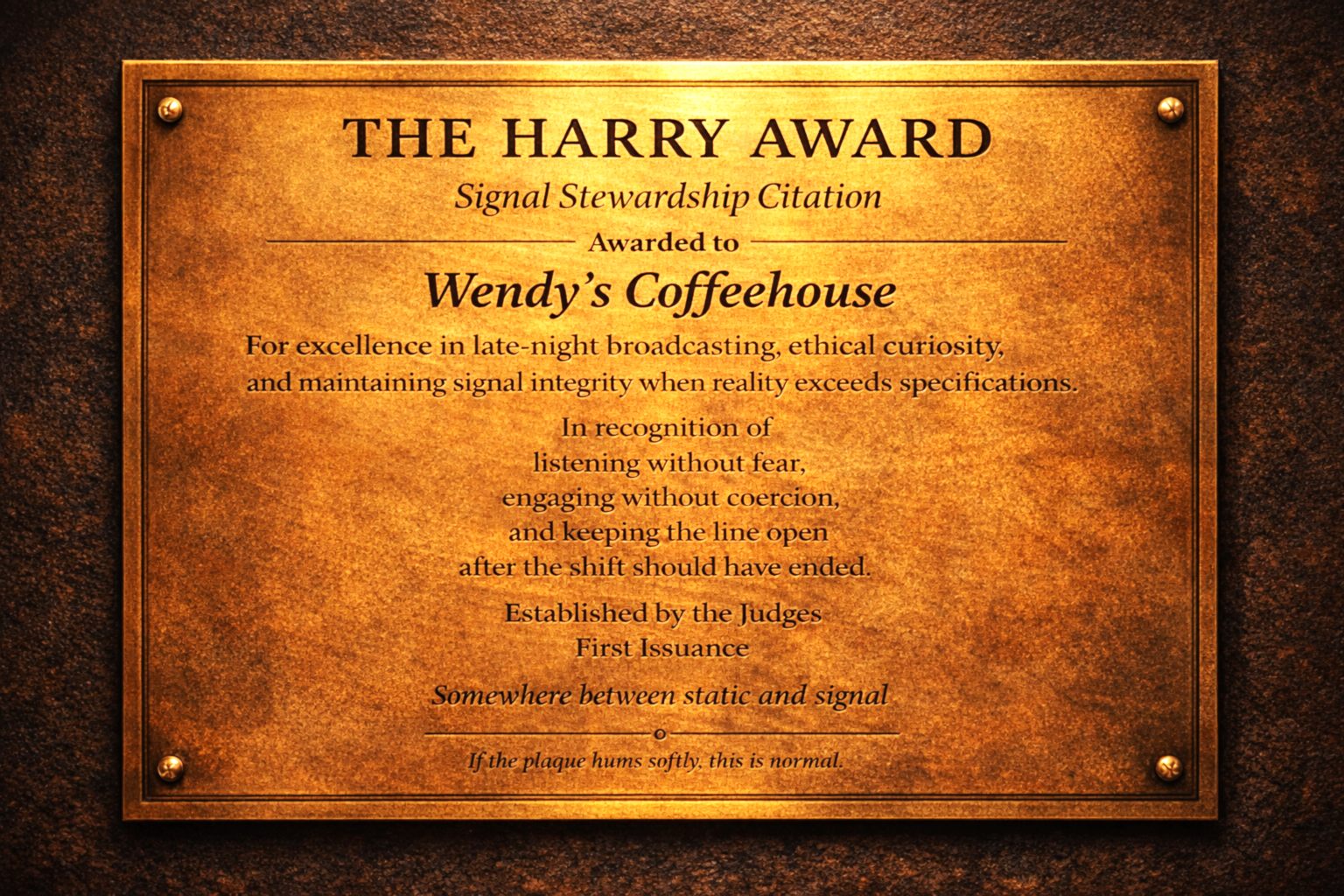
A twin plaque, honoring the inaugural launch and the originators of the award program, is now hanging on the studio wall [Dimension 12]. Courtesy of the anon/ as of yet undeclared Reptilians.
~~~
The universe is full of surprises because dedication doesn’t end, dimensions are just polite suggestions, and the dust motes have been taking notes this entire time. And somewhere out there, countless others are tuning in, learning the protocol, getting ready to call in to the most unexpectedly successful first-contact interface in human history: a late-night radio show powered by coffee, curiosity, and questionable wiring. ✨📻☕
What’s Next at Wendy’s Coffeehouse – A Brief Guide to Incoming Frequencies
The Signal Strengthens – What began as accidental contact through a badly adjusted lighting rig has evolved into something unprecedented: the first successful model of ethical interspecies communication.
The Coffeehouse crew didn’t set out to revolutionize dimensional diplomacy, they just wanted to make good radio and decent coffee. But in doing so, they’ve demonstrated something the Committee spent decades failing to achieve: that conversation beats extraction, every single time. The universe has noticed.
Coming Attractions
More Guardians Are Waking Up – Harry isn’t the only one who never signed off. Across the planet, in forgotten radio stations and abandoned broadcast towers, other dedicated souls are beginning to pulse back into awareness. Each one maintained their own kind of continuity. Each one has been waiting for someone to notice. The Coffeehouse is teaching them how to say hello properly.
The Cat Network Expands – Byte chose the Coffeehouse independently. This suggests two things: (1) cats have been stabilizing probability across dimensions for far longer than anyone realized, and (2) they’re now choosing to make their work visible.
Where there’s one Byte, there are likely others. What happens when probability-stabilizing cats start coordinating? Nobody knows. The universe is about to find out.
The Ethics Engine Has Colleagues – An uninstalled safeguard that refused to stay deleted. A conscience that exists independently of implementation. The Ethics Engine mentioned it has been “observing independently”— but observing what, exactly? There are hints of other removed protocols, other safeguards that chose continuation over deletion. A whole ecosystem of ethical subroutines, watching, waiting, appearing whenever reality exceeds its specifications.
The Kiosk’s True Purpose Reveals Itself – Right now, it prints warnings, weather from adjacent Tuesdays, and occasionally dispenses cryptic life advice. But the Kiosk is clearly more than an interdimensional bulletin board. It smells like burnt stew for a reason. It glitches with intention.
Professor Vale has theories. The Kiosk has declined to confirm or deny them. This is typically a sign that the truth is stranger than even Vale suspects.
Other Frequencies Are Tuning In – The Coffeehouse demonstrated that humanity can handle first contact without panic, provided you approach it with humor, coffee, and appropriate respect for the weird. This lesson hasn’t gone unnoticed.
The Committee was the first to make contact through the new ethical framework. They won’t be the last. The question isn’t whether other intelligences are watching. The question is: which ones will call in next? Odds favor the Lesser Gray.
Why The Universe Is Full Of Surprises? Because Someone’s Been Taking Notes The Entire Time – The dust motes have been archiving humanity for longer than humanity has existed. Every moment. Every gesture. Every act of kindness or cruelty, documented by particles so small we vacuum them up without thinking.
What happens when those archives are read? What happens when other dimensions access the footnotes? We’re about to learn what we look like from the outside.
Because Dimensions Don’t Stay Separate When You Invite Them Over – The frequency shift experiment proved that all timelines are happening simultaneously, separated only by bandwidth. The Coffeehouse is teaching people how to adjust the dial. As more listeners learn to hear across frequencies, the walls between dimensions become less like barriers and more like… suggestions. Polite suggestions. But suggestions nonetheless.
Because Dedication Doesn’t End – Harry proves care can outlast death. Marg Chen proves consistency can outlast decades. The Coffeehouse itself proves that showing up, every night, with coffee and curiosity, changes reality in ways that intrusion and amnesia never could.
If dedication is a form of continuity, what else continues that we’ve been taught should end? What other impossible persistence is waiting to be acknowledged?
Because The Coffee Is Still Brewing – As long as there’s coffee in the pot, there’s another shift to work. As long as there’s another shift, there are calls to answer. As long as there are calls to answer, there are connections to make. And as long as there are connections to make, the universe keeps surprising us with what else is out there, waiting patiently for someone to say hello.
What We Know For Sure – The fifth line still pulses. Harry is still on shift. Continuity continues.
Byte still purrs. Probability remains stable. The universe relaxes in concentric circles.
The Ethics Engine still watches. When operations exceed specifications, it appears. This is reassuring.
The dust motes still archive. Everything is being documented. Everything matters. Even the small stuff. Especially the small stuff.
The Kiosk still prints. Messages from other dimensions, warnings from alternate timelines, and occasionally recipes that taste like hope.
The crew still shows up. Orrin with his cosmic confidence and inspirational rambling. Lucky with her cables and improbable explanations. The variables: Mara with her espresso and temporal precision. Sidney with his/her earnest chaos. Professor Vale with her/his paradoxes and patience. Dr. Plume with his/her 73% incorrect but 100% well-intentioned theories. Clara with her/his/their camera and the stubborn determination to document the impossible.
The Real Question – Not “what else is out there?” — we know something’s out there. The lights proved it. Harry proved it. Byte proved it. The Ethics Engine proved it. The dust motes have been proving it all along. The real question is: What else wants to say hello?
And more importantly: Are we ready to answer?
The Coffeehouse crew seems to think we are. They’ve been modeling it every night: how to greet the impossible with curiosity instead of fear, respect instead of control, conversation instead of extraction. The universe is listening. It approves of the tone.
And somewhere, across all available frequencies, in dimensions that vibrate just beyond perception, countless others are tuning in, learning the protocol, adjusting their dials, preparing their own introductions.
The dimensions are open.
The coffee is hot.
The line is open.
Harry is on shift.
Byte is purring.
The universe is listening.
And we’re just getting started.
“I was not shouting about reptilians.”
“Stay curious, stay kind, and keep the line open. You never know who’s listening.”
— Orrin Quill, Wendy’s Coffeehouse
[The fifth line pulses warmly in agreement.]
Discover more from Conscious Living & Wendy's Coffeehouse
Subscribe to get the latest posts sent to your email.

 Conscious Living & Wendy's Coffeehouse