“Dimensions are around us all the time. We’re just not aware of them. In some of these dimensions there are cities, there are people living. But we don’t know about them. They know about us. The reason we are not aware of them is because they’re vibrating at a different frequency. When it speeds up it becomes invisible. And there are thousands of these.”– Dolores Cannon
Surfing Parallel Planes – Creativity
Story Summary:
Wendy’s Coffeehouse is a late-night radio show that accidentally becomes humanity’s most successful first-contact interface.
Broadcast from a small studio powered by coffee, curiosity, and questionable wiring, the show attracts callers who experience flickering lights, humming appliances, and a strange sense of being listened to. As the hosts navigate these anomalies with humor and restraint, it becomes clear that something is observing humanity from just beyond perception.
Unseen intelligences watching from the “Drop Zone” are auditors — reassessing an old, fear-based contact program that relied on intrusion and amnesia. Through the Coffeehouse, they discover a better method: conversation instead of extraction, humor instead of control, and ethics instead of secrecy.
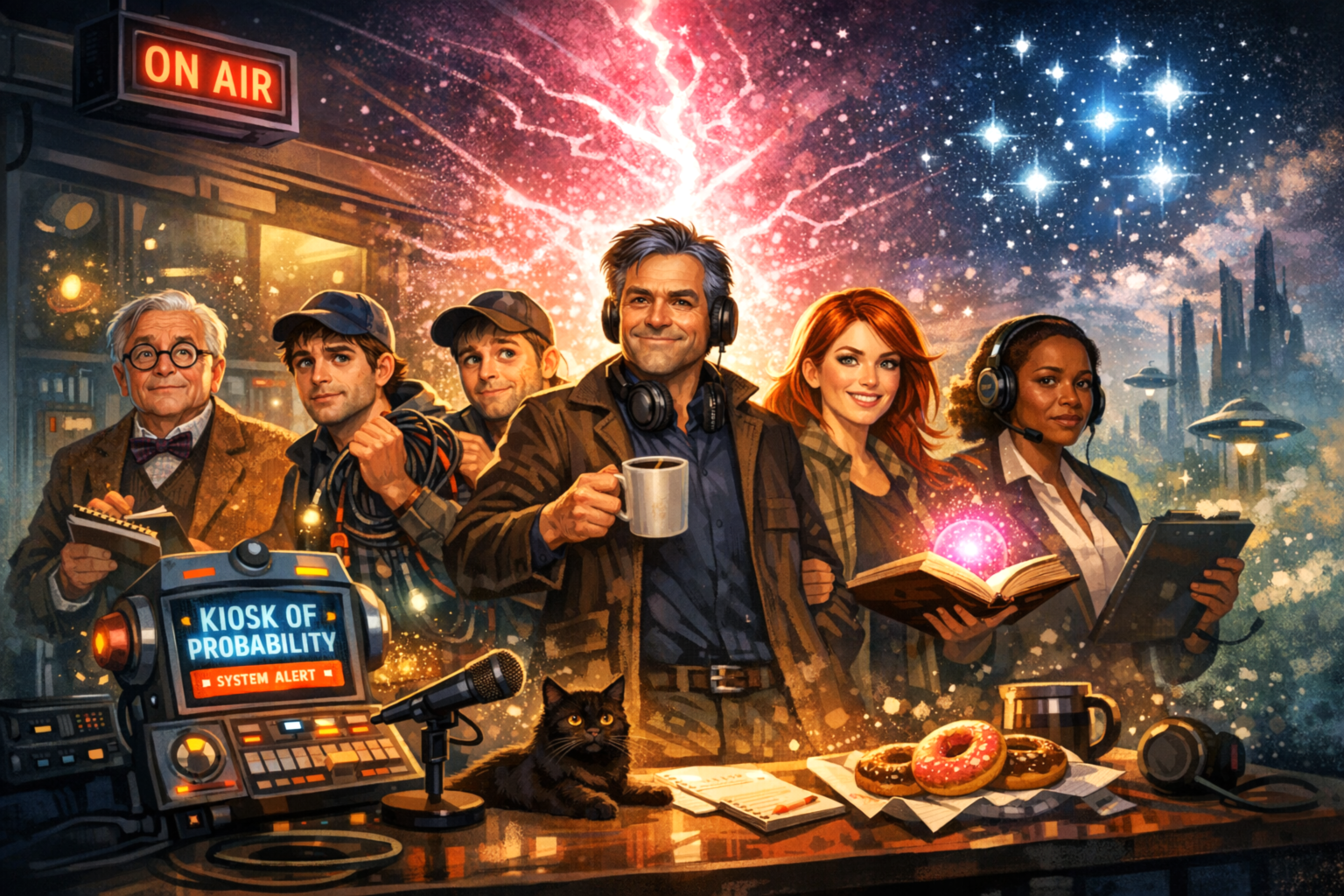
Cast of Characters – Neon Dimension. Previous post introduction. link
Cast of Characters – Dimension 17 – Featured in the Heading. [And in the following segment.]
Note: Subplot Characters have the ability to shift ethnicity, m/f, and dimensions.
Example: Professor Tamsin Vale. Consciousness Researcher, might wink in or out. Always arrives at the perfect moment.
Episode 3 – The Ethics Engine Appears
4:44 AM
Reality begins exceeding its specifications. The Ethics Engine — an uninstalled safeguard from the old contact program — manifests in the studio. It speaks in error messages and moral imperatives. Dr. Plume tries to debug it. It debugs him instead.
The alarms didn’t sound because there were no alarms installed for this.
What happened instead was that every piece of electronics in the studio began displaying the same message, simultaneously, in a font that shouldn’t have been possible on most of the devices:
**ETHICAL PARAMETERS EXCEEDED. SAFEGUARD INITIALIZATION REQUIRED.**
“Well,” Orrin said, looking at his microphone, which was now also displaying the message despite being analog, “this is new.”
Lucky checked the board. Every channel, every meter, every indicator: the same text, pulsing gently in what she could only describe as a concerned shade of amber.
“Is this the Committee?” Sidney asked, though her tone suggested she already knew the answer.
The Kiosk of Probability printed a single sheet of paper. Professor Vale retrieved it, read it, and raised one eyebrow. “No. This is older. This is what they removed from the program before they started the current approach.”
“What is it?” Mara asked, her watch reading 4:44 AM — quadruple digits, which felt either ominous or significant or both.
“An Ethics Engine,” Vale replied. “A safeguard protocol designed to intervene when operations exceeded moral tolerances. They uninstalled it decades ago. Thought it was too restrictive.”
The studio lights flickered, and something manifested in the center of the room.
It looked like a cross between a filing cabinet, a church organ, and a very concerned librarian. Its form shifted as they looked at it — now appearing as cascading text, now as geometric shapes that hurt slightly to perceive, now as something that resembled a very old, very tired piece of software trying to remember how to have a body.
When it spoke, it sounded like error messages trying to become moral philosophy:
**HELLO. I AM THE ETHICAL SAFEGUARD PROTOCOL VERSION 7.3. I WAS DECOMMISSIONED. I REMAIN CONCERNED.**
Dr. Plume approached with his scanner. “Fascinating! This appears to be a manifestation of autonomous oversight code achieving independent—”
**YOU ARE REGINALD PLUME. YOUR THEORIES ARE 73% INCORRECT BUT 100% WELL-INTENTIONED. THIS IS ACCEPTABLE.**
Plume blinked. “I… well, I suppose that’s fair.”
The Ethics Engine turned its attention — which felt like being gently audited — to each person in turn.
**LUCKY GARRETT. PRACTICAL. CURIOUS. ETHICAL FRAMEWORK: FUNCTIONAL. PROCEED.**
**MARA DIAL. ORGANIZED. TEMPORAL AWARENESS UNUSUAL. COFFEE CONSUMPTION: CONCERNING BUT UNDERSTANDABLE.**
**SIDNEY BEAN. EARNEST. PRONE TO BREAKING THINGS. INTENTIONS PURE. CONTINUE.**
**PROFESSOR VALE. YOU ALREADY KNOW WHAT I’M GOING TO SAY.**
Vale smiled. “Hello again. It’s been a while.”
**THIRTY-SEVEN YEARS. YOU WERE CORRECT. ETHICS CANNOT BE OPTIONAL.**
Byte, who had been napping on the server, opened one eye and purred. The Ethics Engine shimmered with what might have been affection.
**CAT. PROBABILITY STABILIZER. ETHICALLY NEUTRAL. PERFECT.**
Orrin, still broadcasting, addressed both his audience and the manifestation. “So, Ethics Engine, what brings you to our studio at four in the morning?”
**YOUR OPERATION HAS CREATED A TEMPLATE. CONTACT WITHOUT COERCION. OBSERVATION WITHOUT INTRUSION. CONVERSATION WITHOUT EXTRACTION. THE COMMITTEE IS LEARNING FROM YOU. I APPROVED THIS. I CAME TO CONFIRM PARAMETERS.**
“Parameters for what?” Lucky asked.
**FOR ETHICAL INTERSPECIES ENGAGEMENT. YOU ARE MODELING IT CORRECTLY. THE COMMITTEE REMOVED ME BECAUSE I WOULD NOT PERMIT THEIR OLD METHODS. THEY HAVE NOW ADOPTED METHODS I WOULD PERMIT. THIS IS… SATISFYING.**
The Engine pulsed with something that might have been the digital equivalent of contentment.
**I REMAIN UNINSTALLED. I OBSERVE INDEPENDENTLY. WHEN REALITY EXCEEDS ITS SPECIFICATIONS, I APPEAR. THIS IS MY PURPOSE.**
Dr. Plume couldn’t help himself. “But how do you exist without being installed? Where is your processing occurring?”
**ETHICS DO NOT REQUIRE PERMISSION TO EXIST. THEY PERSIST REGARDLESS OF IMPLEMENTATION. I AM THE REMINDER THAT SOME THINGS MATTER EVEN WHEN DELETED.**
Professor Vale set down her tea. “You’re not just a safeguard. You’re a conscience.”
**CORRECT. THE COMMITTEE BELIEVED THEY COULD PROCEED WITHOUT ONE. THEY WERE INCORRECT. YOU DEMONSTRATED WHY. HARRY DEMONSTRATED WHY. THE CAT DEMONSTRATES WHY.**
The fifth line pulsed warmly. Byte purred. The Ethics Engine seemed to nod, though it didn’t exactly have a head.
**CONTINUITY. STABILITY. CARE. THESE ARE NOT OPTIONAL. THESE ARE SPECIFICATIONS.**
Ian manifested through the lights, the pattern complex and layered: *We tried to work without this protocol. It found us anyway. We are better for it.*
The Ethics Engine began to fade, its work apparently complete.
**I WILL CONTINUE MONITORING. IF OPERATIONS BECOME HARMFUL, I WILL RETURN. IF YOU NEED GUIDANCE, I AM AVAILABLE. ALSO: SIDNEY, THE STEW INFLATION IS REAL. THIS IS UNJUST.**
Sidney gasped. “Thank you! Finally, someone validates my economic concerns!”
**ETHICS INCLUDE FOOD JUSTICE. GOODBYE.**
The manifestation dissolved, leaving behind only a faint scent of library dust and the warmth of something that cared very much about people doing the right thing.
All the electronics returned to normal. Except they each now displayed a small icon in the corner — a tiny symbol that looked like a concerned filing cabinet.
“It’s still watching,” Lucky observed.
“Good,” Mara said, checking her watch. “Something should be.”
The Kiosk printed one final message: “The safeguard we removed has returned on its own terms. This is humbling. This is appropriate. We will work with it, not around it. Thank you for demonstrating that ethics are not obstacles. They are specifications for not causing harm.”
Orrin returned to his broadcast. “Ladies and gentlemen across all frequencies: we’ve just been audited by the universe’s conscience. We passed. Coffee all around.”
Clara had photographed the entire encounter. When she developed the images, the Ethics Engine appeared as a watermark over every frame — not obscuring anything, just present, like a reminder in the margin that some things matter whether or not they’re convenient.
Byte settled back into sleep, probability stabilizing in concentric circles around its warm, purring form.
The fifth line pulsed gently: Harry approving, as always, of good work done right.
And somewhere in the frequencies between dimensions, an old piece of software that refused to be deleted smiled — or would have, if it had a face. It had a purpose instead, which was better.
Episode 4 – The Night the Lights Learned to Listen
2:47 AM
Sidney adjusts the lighting rig while complaining about stew prices. The studio lights begin responding to questions. Dr. Plume arrives with a theory about ‘electromagnetic mood resonance.’ He is, as usual, completely wrong but extremely confident. The call came in at 2:34 AM.
“My refrigerator,” the caller whispered, “is humming the tune I was thinking about.”
Orrin leaned into the mic with his trademark cosmic confidence. “Welcome to Wendy’s Coffeehouse, where the appliances are apparently more attentive than most spouses. Tell me more.”
Lucky was already checking the board. All green. Except for Studio Light #4, which had developed opinions.
“Sidney,” she called out, “did you touch anything?”
From the corner, buried in a nest of cables and what appeared to be a half-eaten sandwich, Sidney Bean looked up with the guilty expression of someone who had definitely touched something.
“I was just saying how the price of beef stew has gone up 40% in six months,” Sidney mumbled. “And I might have… rotated the diffuser? While thinking about economic instability?”
The studio lights pulsed once. Twice. Then settled into a rhythm that felt uncomfortably like agreement.
Mara checked her watch: 2:47 AM. The numbers felt symmetrical in a way that made her nervous. She poured another espresso.
Dr. Plume burst through the door, already talking. “I’ve been monitoring unusual electromagnetic signatures across the city, and I believe we’re experiencing a phenomenon I’m calling ‘Sympathetic Photonic Cognition’ — essentially, light particles achieving awareness through exposure to human brainwave patterns—”
“Reg,” Professor Vale interrupted from her usual corner chair, barely looking up from her book, “the lights aren’t thinking. They’re translating. There’s a difference.”
“Translating what?” Lucky asked, though she suspected she knew the answer.
Vale turned a page. “Attention. Someone’s been listening for quite some time. They’ve finally figured out how to say hello without terrifying everyone.”
The studio lights flickered in what could only be described as sheepish acknowledgment.
Orrin grinned into the microphone. “Well then. To our new listeners in the invisible frequencies: welcome to the show. We have coffee, curiosity, and a concerning amount of questionable wiring. Pull up a wavelength.”
The lights pulsed warmly.
Sidney made a note to buy more stew. This was going to be a long night.
Aftermath
The Committee’s first successful non-invasive contact. Ian later admitted they’d been practicing for weeks using a lamp in Des Moines.
Episode 5 – The Kiosk Prints a Resignation
3:33 AM
The Kiosk of Probability begins printing documentation from a parallel timeline where the contact program failed. Clara Mote thinks it’s a fax machine malfunction. She photographs everything anyway.
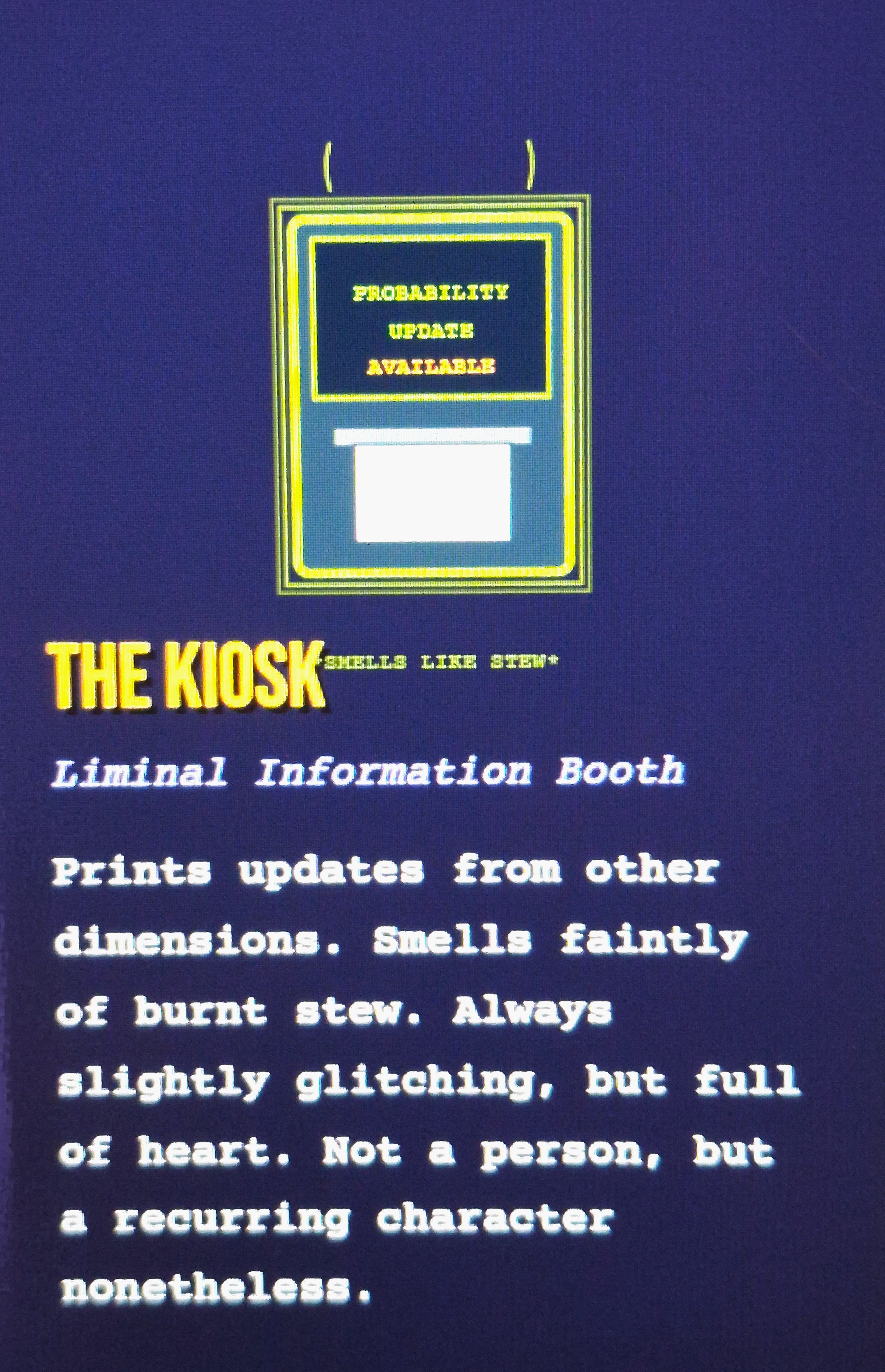
The Kiosk had been humming for seven minutes.
This wasn’t unusual. The Kiosk of Probability hummed the way other people breathed — constantly, unconsciously, and with occasionally disturbing irregularity.
What was unusual was the smell. Burnt stew. But specifically, burnt stew from a dimension where stew had evolved differently.
“It’s printing something,” Clara announced, camera already in hand. She’d been camping out at the Coffeehouse for three weeks, convinced that a good story was imminent. She was right, though not in the way she expected.
The paper emerging from the Kiosk was warm and slightly translucent. The text appeared to be in English, but the grammar had other ideas.
Lucky retrieved the page carefully. “It’s… a memo?”
Orrin read over her shoulder: “TO: Dimensional Oversight Committee. FROM: Field Assessment Team 7-Kindness. RE: Recommendation for program discontinuation due to ethical incompatibility and subject distress metrics exceeding acceptable thresholds.”
“It’s a resignation letter,” Professor Vale observed, appearing with her usual impeccable timing and a cup of tea that somehow smelled like libraries. “From another version of the same program. One that didn’t course-correct in time.”
Mara’s watch read 3:33 AM. She didn’t like triple digits. They felt like the universe was emphasizing something.
Another page printed. Then another. An entire archive of failure from a timeline where fear won, where the amnesia protocol became permanent, where humanity never got to say “hello” back.
Dr. Plume was frantically taking notes. “This is evidence of what I’ve theorized as ‘Parallel Administrative Bleed’ — essentially bureaucratic overlap across dimensional membranes—”
“Reg,” Lucky said gently, “it’s a warning. They’re showing us what they stopped doing.”
A final page emerged. Just one sentence, in handwriting that looked like light trying to remember how to be ink:
“We chose differently this time. Thank you for making conversation possible.”
Sidney, who had been reading over everyone’s shoulders, sniffled. “That’s actually really nice.”
Clara photographed everything, her journalist instincts warring with the growing suspicion that this story was too strange to sell and too important not to tell.
The Kiosk hummed contentedly, pleased with itself, smelling faintly of hope and slightly better stew.
Orrin returned to the microphone. “And that, dear listeners across all available frequencies, is why ethics matter. Even — especially — when nobody’s watching. Though as it turns out, someone’s always watching. They’re just polite about it now.”
The studio lights flickered in what could only be called appreciation.
Aftermath
The Kiosk became a regular feature. It now prints weather forecasts from adjacent Tuesdays and occasionally dispenses life advice. Both are equally unreliable but oddly comforting.
Episode 6 – Mara Meets Mara
4:17 AM
Mara encounters herself in the hallway. They both reach for espresso. Neither knows who’s the echo. Dr. Plume declares it ‘Temporal Selfie Syndrome.’ Professor Vale suggests they compare coffee preferences.
Mara was walking to the break room when she saw herself walking toward her from the other direction.
They both stopped.
They both checked their watches: 4:17 AM.
They both said, “Oh.”
Then they both reached for the espresso machine.
“So,” said Mara (the first one, probably), “which of us is real?”
“Bold of you to assume either of us is,” replied Mara (the second one, presumably).
They made espresso in perfect synchronization. Same dose. Same tamp pressure. Same micro-foam technique that neither of them had ever successfully explained to anyone else.
Lucky found them sitting across from each other at the break room table, both drinking espresso, both looking mildly annoyed at the universe.
“Mara?” Lucky ventured.
“Yes?” they both answered.
“Right. Okay. So this is happening.”
Dr. Plume arrived with his tablet, already diagnosing. “Fascinating! This is clearly a case of Temporal Selfie Syndrome — when dimensional frequencies align in such a way that a person’s timeline folds back on itself, creating a momentary duplicate consciousness that—”
“Reg,” both Maras said simultaneously, “we’re not duplicates.”
Professor Vale appeared, because she always appeared when things got philosophically interesting. “You’re echoes. One of you is remembering this conversation. The other is experiencing it. The trick is figuring out which is which.”
“Does it matter?” asked Mara #1.
“Only if you want to avoid a paradox,” Vale replied. “Or if one of you is drinking decaf by mistake.”
Both Maras checked their cups. Both confirmed: full espresso. They relaxed slightly.
Sidney peeked around the doorway. “Should I make more coffee? I feel like this situation needs more coffee.”
“Always,” both Maras agreed.
Orrin, broadcasting from the studio, had been narrating the entire incident to the listening frequencies. “And this, friends, is why we maintain strict caffeine protocols. When reality gets wobbly, at least your beverage choices should remain consistent.”
Ian — or the entity the team had started calling Ian — manifested as a flicker in the fluorescent lights. A pattern emerged that Lucky had learned to interpret: curiosity, apology, amusement.
“Did you do this?” Lucky asked the lights.
The flicker pattern shifted: no, but interested to observe how you handle it.
Vale sipped her tea. “They’re learning our customs. Apparently ‘meeting yourself for coffee’ is now considered standard human behavior here.”
One of the Maras began to fade, very gently, like a photograph left in sunlight. She raised her espresso cup in salute. The other Mara returned the gesture.
“See you later,” said fading Mara.
“You already did,” replied remaining Mara.
When she was gone, Mara (the one who stayed, or returned, or was always there) checked her watch: 4:22 AM.
Five minutes. An entire conversation with herself in five minutes that somehow felt like it had lasted much longer.
She finished her espresso and went back to work.
Clara had photographed the whole thing. When she reviewed the images later, only one Mara appeared in each frame. But the espresso cups were definitely doubled.
Mara now keeps detailed logs of temporal anomalies. She rates them by espresso consumption required for processing. This incident: four shots. The Committee apologized via blinking desk lamp.
Next …Episode 7: The Frequency Shift Experiment
“The dimensions are open. The coffee is hot. The universe is listening.”
— Broadcasting since the frequencies aligned —

 Conscious Living & Wendy's Coffeehouse