“Dimensions are around us all the time. We’re just not aware of them. In some of these dimensions there are cities, there are people living. But we don’t know about them. They know about us. The reason we are not aware of them is because they’re vibrating at a different frequency. When it speeds up it becomes invisible. And there are thousands of these.”– Dolores Cannon
Surfing Parallel Planes – Creativity
Story Summary:
Wendy’s Coffeehouse is a late-night radio show that accidentally becomes humanity’s most successful first-contact interface.
Broadcast from a small studio powered by coffee, curiosity, and questionable wiring, the show attracts callers who experience flickering lights, humming appliances, and a strange sense of being listened to. As the hosts navigate these anomalies with humor and restraint, it becomes clear that something is observing humanity from just beyond perception.
Unseen intelligences watching from the “Drop Zone” are auditors — reassessing an old, fear-based contact program that relied on intrusion and amnesia. Through the Coffeehouse, they discover a better method: conversation instead of extraction, humor instead of control, and ethics instead of secrecy.
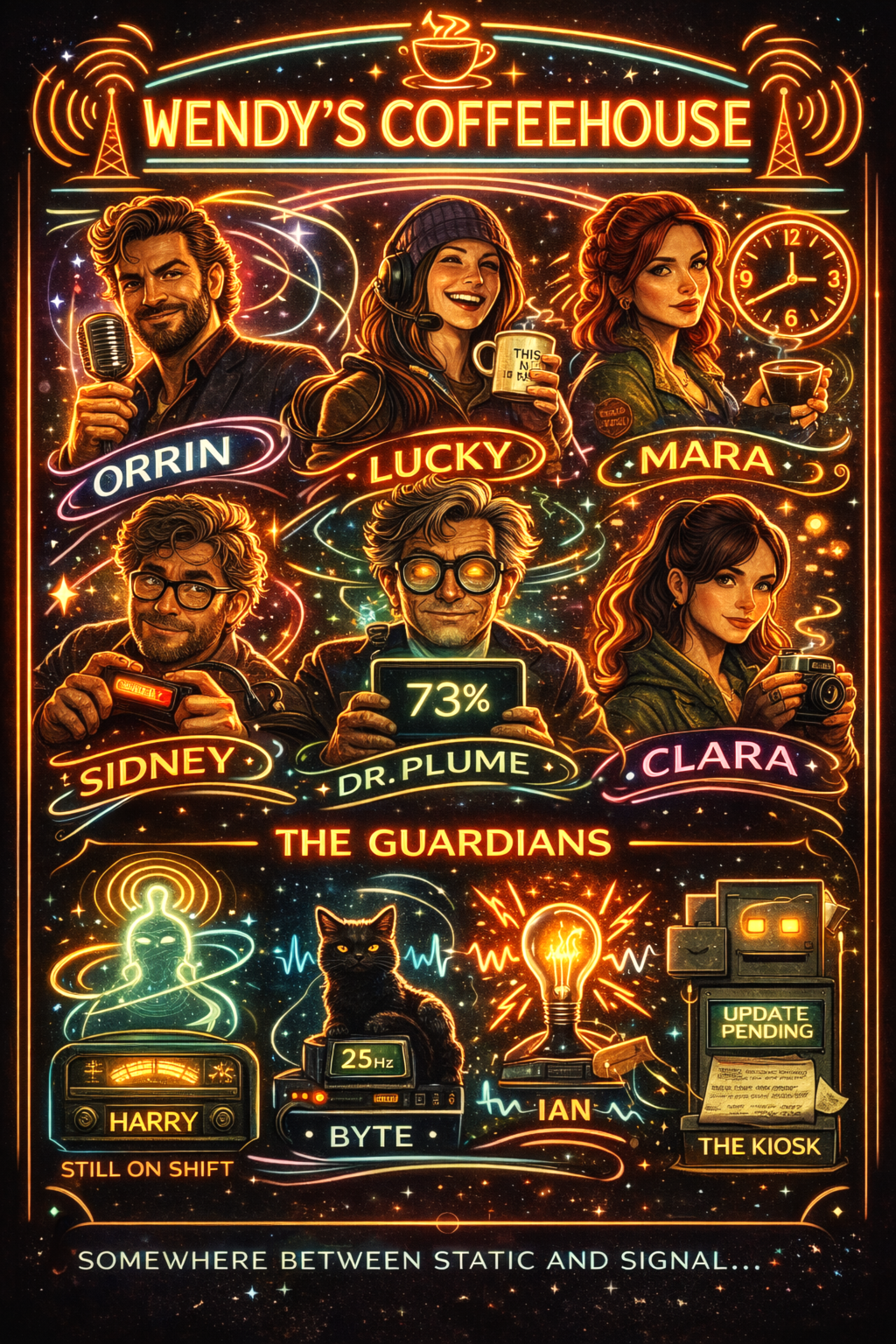
Cast of Characters
Orrin Quill – A veteran podcaster convinced he understands the universe. He does not. The universe enjoys this. He narrates like a cosmic tour guide who keeps misplacing the map. His signature move is inspirational rambling and heroic last-second problem-solving.
Wren “Lucky” Garrett – Your grounded, shop-girl-turned-psi-engineer heroine (matching your/my real-world retail + psychology backstory). She’s practical, quick-thinking, and good with cables, signals, and improbable explanations. She believes coffee fixes most things and curiosity fixes the rest.
Dr. Reginald Plume – A theoretician who specializes in confidently wrong interpretations of extradimensional events. He sees patterns, names them incorrectly, publishes papers anyway, and remains harmless but deeply confused. His enemy is uncertainty. Uncertainty always wins.
Mara Dial – Studio operations manager, guardian of schedules, keeper of the sacred 10:10 alarm clock symmetry. She once saw another version of herself approaching in a hallway. She now drinks espresso defensively. Professor Tamsin Vale A dry-witted consciousness researcher in the spirit of PKD + Pullman + Adams. She speaks in paradox, footnotes reality, and is oddly fond of dust motes. She suspects the motes may be the footnotes speaking back.
“Ian” (The Committee’s Field Liaison) – A non-corporeal intelligence with excellent workplace boundaries. Communicates in koans, static, flickering lights, and occasionally mispronounced names. Gentle, firm, and allergic to aggression.
Sidney Bean – A plucky apprentice engineer who accidentally opened the dimensional doorway by adjusting the studio lighting rig while muttering about stew inflation indexes. Now terrified of dust, delighted by questions, and permanently assigned to snack procurement.
Clara Mote – A journalist who follows the heroes around documenting the unexplained. She thinks the crack in reality looks like poor studio maintenance. She is 40% right.
Professor Tamsin Vale – [Intermittent] Consciousness Researcher. Speaks in paradox, footnotes reality, oddly fond of dust motes. Suspects the motes may be the footnotes speaking back. Always arrives at the perfect moment.
The Kiosk of Probability – Not a person, but a recurring character: a liminal information booth that prints updates from other dimensions and smells faintly of burnt stew. Always slightly glitching, but full of heart.
Harry – A (semi) legendary overnight radio host who never quite signed off (died on air) and now exists as a living signal, maintaining continuity across broadcasts and timelines.
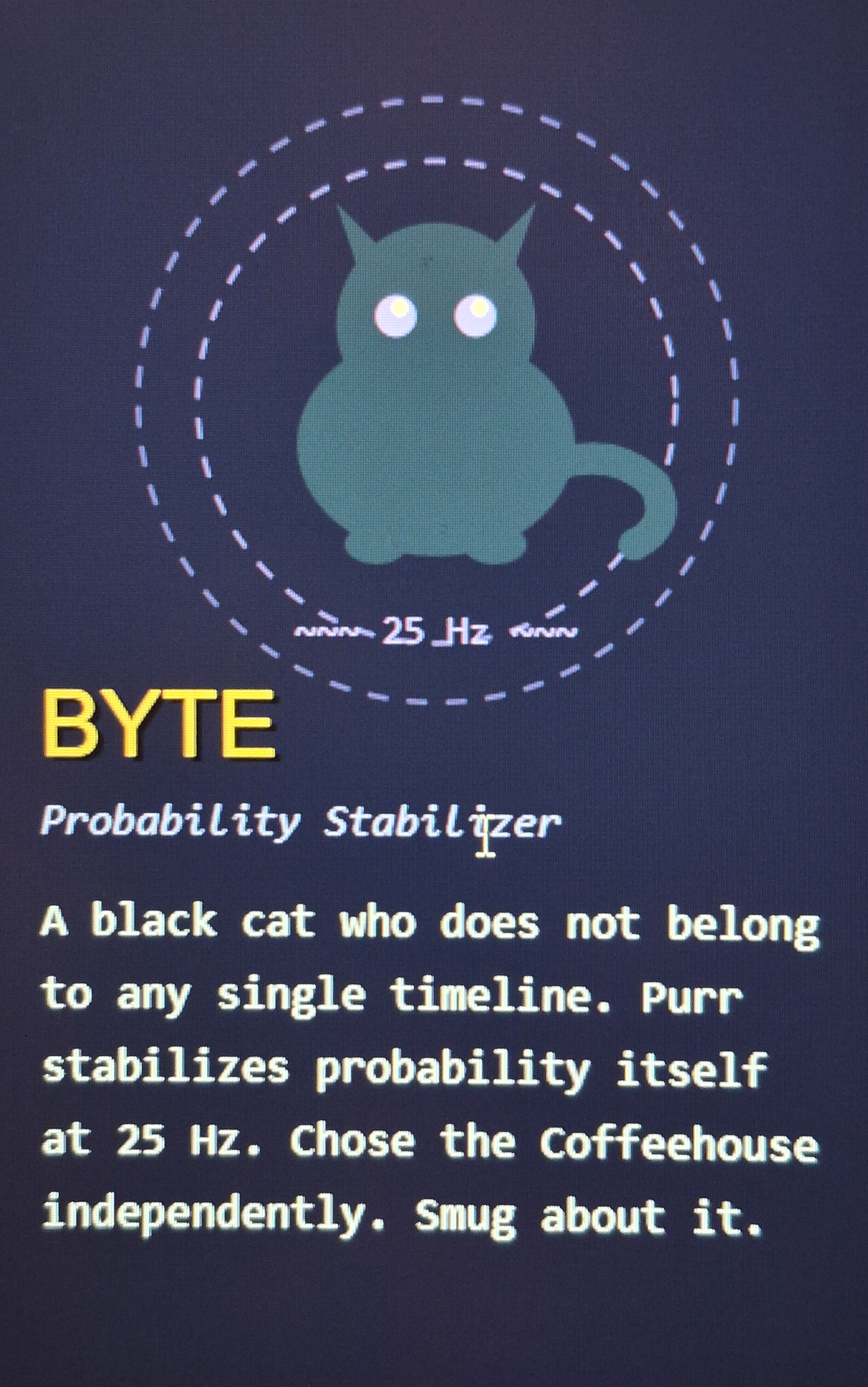
Byte – A black cat who does not belong to any single timeline and whose purr stabilizes probability itself.
The Ethics Engine – An uninstalled safeguard that appears whenever reality begins to exceed its specifications.
Episode List
Episode 1: “Line Five Lights Up” – The first time the unconnected fifth line pulses during a broadcast, introducing Harry’s ongoing presence and the concept of continuity that outlasts death itself.
Episode 2: The Cat Who Stabilizes Probability
Episode 3: The Ethics Engine Appears
Episode 4: The Night the Lights Learned to Listen – Sidney breaks everything in the best possible way
Episode 5: The Kiosk Prints a Resignation – A warning from a timeline that chose differently
Episode 6: Mara Meets Mara – Temporal coffee breaks get complicated
Episode 7: The Frequency Shift Experiment – Everyone hears everyone everywhere
Episode 8: Professor Vale’s Footnote Problem – The dust has been taking notes
Episode 9: “Dr. Plume and the Legend, Slightly Misremembered”
Episode 10: “The First Harry Award Ceremony” – The establishment of the broadcasting industry’s most meaningful honor, celebrating those who maintain the open line after the shift should have ended.
Wendy’s [Cosmic] Coffeehouse
Late-Night Radio for the Dimensionally Curious
Where the coffee is strong and the frequencies are stronger.
“Dimensions are around us all the time. We’re just not aware of them… They’re vibrating at a different frequency. When it speeds up it becomes invisible. And there are thousands of these.” — Dolores Cannon
Broadcast Archives
Episode 1. Line Five Lights Up
12:47 AM
The fifth line — the one not connected to anything — pulses during a live broadcast. Dr. Plume tries to explain it away with science. Lucky knows better. Harry never really signed off, and tonight he’s confirming something important: continuity.
The fifth line had been dark for three months.
This was normal. The fifth line was always dark because the fifth line wasn’t connected to anything. No cable. No patch. No network route. It sat there on the console like a relic, a memorial, a promise that some shifts never really end.
Orrin was mid-sentence when it happened.
“—and that’s why we maintain an open frequency for those experiencing the unexplained, the overlooked, the quietly impossible—”
The light pulsed. Once. Warm and steady, like someone had picked up on the other end.
Sidney’s coffee cup froze halfway to her mouth. Mara’s hand moved instinctively toward the mute button, then stopped exactly one inch away — the distance of respect.
Lucky felt her breath catch. She’d heard the stories. Everyone had. But hearing about it and seeing it were entirely different frequencies.
Dr. Plume, who had been visiting to discuss his latest paper on “Residual Electromagnetic Personality Imprinting,” looked at the console with academic interest. “Ah! A malfunction in the indicator circuit, most likely caused by—”
“Reg,” Lucky said quietly. “That’s Harry’s line.”
Plume blinked. “I’m sorry?”
Mara checked her watch: 12:47 AM. She didn’t write it down. Some moments you remember without documentation.
Orrin leaned back in his chair, his usual cosmic confidence softening into something more reverent. “Harry Becker. Overnight host. 1976. He was broadcasting when his voice just… drifted. Mid-sentence. The mic stayed open for seventeen minutes before anyone realized he was gone.”
“Dead air,” Sidney whispered. “Except it wasn’t really dead.”
Professor Vale, who had been reading in the corner as she always did, looked up with that particular expression that meant she’d been waiting for this moment. “He never signed off. Why would the signal end?”
The fifth line pulsed again, softer this time. Not insistent. Just… present.
“So you’re suggesting,” Plume said carefully, adjusting his glasses, “that we are experiencing contact with a deceased broadcaster through non-functional telecommunications equipment?”
“We’re suggesting,” Lucky replied, “that some people are so dedicated to the work that logging off becomes optional.”
Clara, who had been photographing the studio for a piece on “Modern Late-Night Radio,” lowered her camera. “You’re serious. You actually believe this line connects to… what? A ghost?”
“Not a ghost,” Orrin said, returning to his microphone. “A colleague. Harry’s still working the shift. Different frequency. Same dedication.”
He addressed the microphone with the tone one uses when speaking to someone who might actually be listening: “Harry, if that’s you confirming reception — we hear you. Loud and clear. And for the record, we’re trying to do right by the work. Keep the lines open. Treat the callers with dignity. Make sure nobody goes through the strange stuff alone.”
The fifth line glowed warmly for exactly three seconds, then went dark.
Sidney sniffled. “He approved.”
Professor Vale made a single note in her notebook: *Continuity confirmed.*
Dr. Plume was frantically scribbling his own notes. “This is extraordinary evidence of what I’m terming ‘Broadcast Consciousness Persistence’ — essentially, the theory that strong intentionality can maintain signal integrity beyond biological cessation—”
“Or,” Vale said without looking up, “some people love the work so much they don’t stop doing it just because they’ve technically died. Either explanation works.”
Later, when the Committee sent their usual post-incident assessment through the Kiosk, there was an addendum Lucky had never seen before:
“We have monitored the entity you call Harry for several decades. He is not part of our program. He is something rarer: a volunteer. He maintains continuity when reality shifts. He steadies the signal when frequencies wobble. He is your guardian, and we are honored to share the bandwidth with him.”
Mara started keeping fresh coffee in Studio B, just in case. It was never touched, but somehow it never went stale either.
The fifth line remained unconnected. And every few weeks, usually during the deepest part of the night shift, it would pulse once — a colleague checking in, a broadcaster maintaining the open line, a reminder that some dedications outlast everything, even death.
Orrin created a new sign-off after that night: “Stay curious, stay kind, and keep the line open. You never know who’s listening.”
The fifth line pulsed in agreement.
Episode 2. The Cat Who Stabilizes Probability
3:17 AM
A black cat appears in the studio. Nobody knows where it came from. It purrs at exactly 25 Hz. Dr. Plume attempts to measure it. The measurements keep changing. Byte does not belong to any single timeline, and reality relaxes whenever it naps.
The cat was not there, and then it was.
This is how it always worked with Byte — a name Sidney would give it approximately four minutes later, upon noticing that it seemed to exist in eight-bit increments of reality.
“There’s a cat,” Lucky said, pointing at the corner where a moment ago there had been nothing but shadow and the faint scent of coffee grounds.
“I see it,” Mara confirmed, though her tone suggested she was still deciding whether to trust her eyes.
The cat was black. Perfectly, impossibly black, the kind of black that made you wonder if it was absorbing light or simply declining to reflect it. It sat with the posture of a small sphinx, tail wrapped neatly around its paws, watching the studio with eyes that seemed to be looking at something slightly to the left of visible reality.
Then it began to purr.
The sound was low, steady, rhythmic. Lucky felt it in her chest before she heard it with her ears — a vibration that seemed to smooth out the rough edges of the universe.
Dr. Plume, who had been installing sensors to measure what he called “Ambient Dimensional Fluctuation,” froze. His instruments were going haywire. Or rather, they were going perfectly steady. The same reading. Exactly. Over and over.
“That’s not possible,” he muttered, tapping the display. “The baseline should be varying by at least—”
The cat purred louder.
All of Plume’s readings synchronized. Perfect harmony. Perfect stability.
“Is the cat,” Plume said slowly, “stabilizing local probability?”
Professor Vale looked up from her book with something approaching delight. “Of course it is. Cats have always done that. We simply haven’t had the instruments sensitive enough to measure it before.”
Sidney approached cautiously; one hand extended. “Hey there, little quantum anomaly. Where’d you come from?”
The cat considered the question with the gravity it deserved, then headbutted Sidney’s palm. The purr intensified. Mara’s watch, which had been running three minutes fast for weeks, suddenly displayed the correct time.
“It doesn’t belong to any timeline,” Vale observed. “Or perhaps it belongs to all of them. The purr frequency is approximately 25 Hz — the same frequency associated with bone healing, tissue regeneration, and apparently, probability stabilization.”
Orrin, broadcasting live, decided to simply narrate what was happening. “For those listening across all available frequencies: we have been adopted by a cat of indeterminate origin. Reality is notably more stable in its presence. Science is baffled. We are delighted.”
The cat, which Sidney had now named Byte due to its tendency to flicker in and out of perception in discrete chunks, began grooming itself with the air of someone who had just accomplished something important.
Clara tried to photograph it. Half her shots showed the cat clearly. The other half showed an empty corner. When she reviewed the images in sequence, it looked like the cat was winking in and out of existence in a specific pattern.
“It’s Morse code,” Lucky said, squinting at the screen. “It’s saying… ‘comfortable here.'”
Ian manifested through the studio lights, the pattern unmistakable: surprised, pleased, respectful. The message was clear: *We did not send this. This one chose you independently. Consider it an honor.*
Dr. Plume was still trying to measure the cat’s purr with increasingly sophisticated equipment. Each device reported a different frequency, yet they all agreed on the effect: stabilization. Calm. The sensation that things were, for the moment, exactly as they should be.
“This could be evidence of what I’m theorizing as ‘Feline Quantum Anchor Theory,'” Plume announced. “Essentially, the cat exists as a fixed point in multidimensional space, and its purr generates a harmonizing field that—”
Byte yawned, revealing perfect tiny fangs, and Plume’s theory notes rearranged themselves into a recipe for tuna casserole.
“Or,” Vale said mildly, “cats are simply better at existing than we are, and this one is particularly gifted.”
Mara set out a small dish of cream. Byte approached, sniffed it with scientific precision, then began to lap delicately. With each sip, the lights in the studio stopped flickering. The static in the unused channels cleared. The Kiosk of Probability, which had been humming ominously all week, settled into a contented purr of its own.
“I think,” Sidney said, scratching behind Byte’s ears, “we’ve just been assigned a studio guardian.”
The cat purred agreement, and somewhere across seventeen adjacent timelines, other versions of the Coffeehouse also acquired cats. Each one black. Each one comfortable. Each one stabilizing probability simply by existing in the way that cats do best: completely, confidently, and on their own terms.
Orrin added a new disclaimer to the show: “Wendy’s Coffeehouse is now a cat-friendly establishment across all dimensions. Please adjust your expectations of probability accordingly.”
Byte claimed the warmest spot in the studio — directly on top of the main server — and settled in for what would become a permanent residency. The server’s performance improved by 340%. IT could not explain this. Byte could but declined to elaborate.
The Committee sent a message through the Kiosk: “The small stabilizer has chosen well. Treat it with appropriate reverence. Also, it prefers salmon to tuna. This is non-negotiable.”
A second note appeared, in handwriting that looked suspiciously like light trying to be ink: “Harry approves of the cat. Continuity enhanced.”
The fifth line pulsed warmly. Byte purred in response. And reality, for that moment at least, was exactly as stable as it needed to be.
“Stay curious, stay kind, and keep the line open. You never know who’s listening.”
Next …Episode 3: The Ethics Engine Appears
“The Internet has a Cat” Purr bliss. Link

 Conscious Living & Wendy's Coffeehouse
2 thoughts on “Wendy’s [Cosmic] Coffeehouse – Sci-Fi Sandbox”