“Until I was working in the realms where the unseen becomes seen, where thoughts literally are being crystalized in ice, I don’t know that I fully comprehended that water was an intelligent designer.” – Veda Austin
We are entering an era where the question is no longer whether non-human intelligence communicates, but whether we are developing the tools, both technological and perceptual, capable of accurately translating and interpreting languages that evolved beyond the human experience.
Across multiple fields, researchers are arriving at a similar realization: intelligence reveals itself through patterns, responsiveness, structure, and context. When methods change, what becomes visible changes with them.
The following projects highlight how this shift is already underway.
AI and the Expanding Language of Animals
In animal communication research, the convergence of artificial intelligence, machine learning, and bioacoustics has opened a genuine new frontier. Vast datasets of animal sounds and behaviors, once too complex to analyze meaningfully, are now being explored using self-supervised learning, multimodal models, and explainable AI.
What distinguishes this work is a move away from treating communication as isolated signals. Researchers are examining sequences, individual identity, social networks, and environmental context, recognizing that meaning emerges relationally rather than through single vocalizations.
AI, in this role, functions less as a translator and more as a listening instrument, revealing structure in communication systems shaped by non-human bodies and environments. When paired with ethology, these tools allow researchers to ask questions that align more closely with how communication actually functions in the natural world. Link
What Water May Be Teaching Us
A similar reframing is occurring in research focused not on animals, but on the environment itself.
Crystallographer Veda Austin has spent over 15 years studying what she describes as the design intelligence of water. Using a precise freezing method to observe structured, fourth-phase water, she documents how water appears to respond to external stimuli, such as words, images, music, and intention, by forming distinct crystallographic patterns.
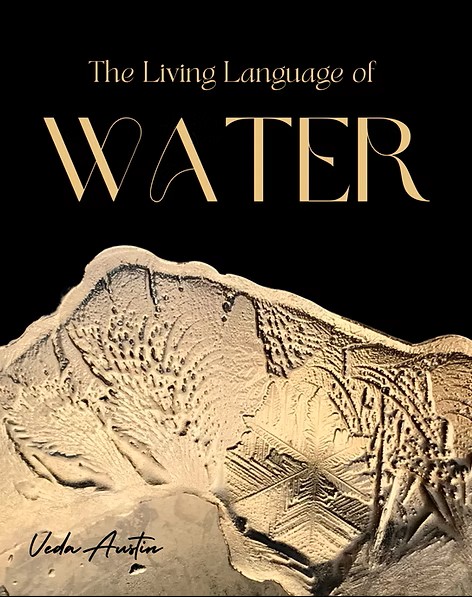
Her work highlights molecular differences between tap water and spring water and raises questions about water’s capacity for memory, responsiveness, and organization. Water appears to register information from its surroundings and express it through form.
Scientists, authors, and healers explore the relationship between water, people, and the rest of the world. Documentary link.
As Austin has observed, it was only when the unseen became visible, through structure, that the possibility of water as an intelligent designer fully emerged. Website
Intelligence Revealed by Absence: The VASCO Project
Far beyond Earth, astronomer Dr. Beatriz Villarroel is challenging long-standing assumptions about how extraterrestrial intelligence might be detected.
As lead scientist of the Vanishing & Appearing Sources during a Century of Observations (VASCO) project, Villarroel and her team analyze archival sky surveys, some spanning over a century, to identify stars and objects that appear to vanish or behave anomalously.
Using automated methods and citizen science, VASCO has uncovered unexplained “multiple transient” events that defy conventional astrophysical explanation. While many may eventually be explained, some remain unresolved, suggesting that the absence of expected signals may reflect a mismatch between our assumptions and the evidence.
Rather than listening for messages, this work searches for artifacts, traces, and anomalies embedded in data we already possess. – 2026 The Science of Consciousness Conference, Website
The Civilian Lens: Learning to See What’s Already There
Another important frontier is emerging outside institutional frameworks altogether.
Patricia Avant is a long-term civilian experiencer who began documenting UAPs in 2016 after witnessing four reddish-orange orbs hovering motionless in the sky. Over seven years, she has recorded more than 10,000 hours of footage through systematic skywatching.
Our previous interview is posted. Link. I’ll update with the current interview after it posts. Patricia’s images are extraordinary, and the videos are outstanding.

Her work challenges popular assumptions shaped by media portrayals of UFOs as solid, metallic craft. Instead, many UAPs appear as transient lights, color-shifting forms, or objects that emerge briefly from camouflage-like states before disappearing.
Avant’s approach emphasizes method over belief, training attention to recognize recurring indicators such as color signatures, movement patterns, visibility transitions, and timing. Like other projects highlighted here, progress comes not from definitive answers, but from learning how to observe differently. Website Link
A Shared Insight
What unites these diverse efforts is a shared methodological insight: intelligence often reveals itself indirectly. It may appear through animal communication networks, the structured patterns of water, astronomical anomalies, or sustained civilian observation.
In each case, breakthroughs occur when researchers forgo familiar frameworks and instead develop tools capable of recognizing unfamiliar forms of order. From the perspective of the Nightlight Oracle, this is a recurring lesson.
Non-human intelligence becomes visible through attention, relationship, and the willingness to refine how we listen, how we see, and set aside what we think we know to discover what we can learn.
We are entering an era requiring the use of tools, both technological and perceptual, capable of accurately translating and interpreting languages that evolved beyond the human experience.
Curiosity is the carrot.
Discovery is the payoff.
Possibilities are endless.

 Conscious Living & Wendy's Coffeehouse