The Day Reality Slipped Sideways …and the truth I was instructed not to telegraph.
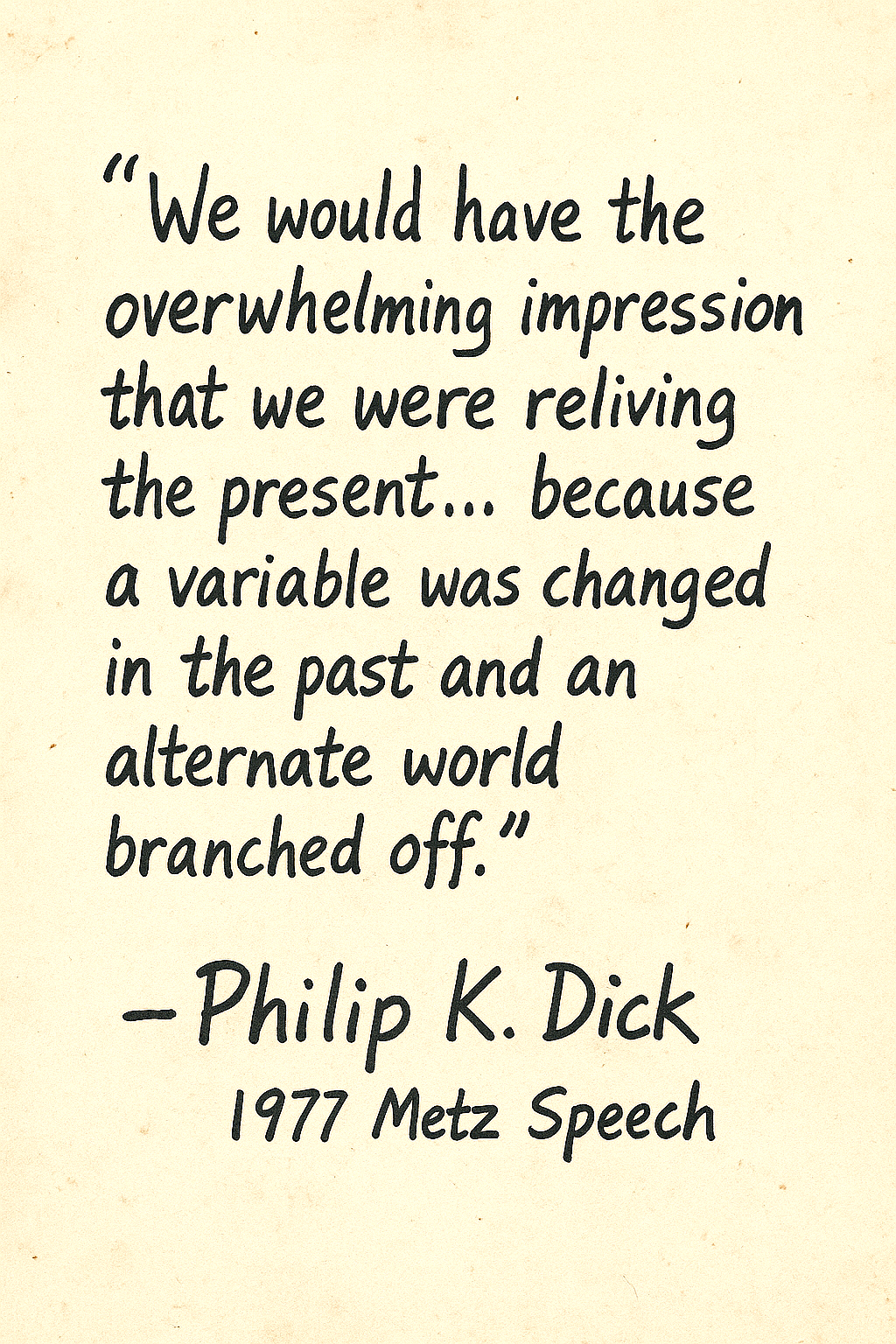
“We would have the overwhelming impression that we were reliving the present… because a variable was changed in the past and an alternate world branched off.” — Philip K. Dick, 1977 Metz Speech
I was not prepared to be told I was about to step into a different timeline. In 2009, that’s exactly what happened.
Not in a sci-fi movie way. It was a calm, matter-of-fact instruction from… whoever/whatever has been “coaching” me from the edges of my life for years. The message was simple and precise: “You are going to experience an alternate timeline. You will see a different reality. Do not telegraph that anything is different.”
That last part, do not telegraph, landed like a highlighted sentence in my nervous system. I was allowed to notice that something was wrong, but I was not allowed to show it.
And then the world shifted.
Everything looked almost the same. Same streets, same layout, same general feel. The people around me behaved like nothing unusual was happening. The only obvious “rule break” was so specific it felt like a joke the universe would write for Philip K. Dick. Every single vehicle I saw was black, white, gray, or silver.
That’s it. No red cars. No blue trucks. No green anything. Every car in sight wore the same narrow uniform of grayscale. Parked cars, moving cars, old models, newer ones, it didn’t matter. All monochrome. I remember walking around with this odd double-awareness. One part of me: Stay cool. Don’t react. Don’t say anything. Just observe. Another part of me: Why are there no colors?
This went on long enough to register as a fully embodied experience. We drove across town and the scene was the same. Andy was with me. I could talk about the experience with him and that helped me ground the reality of it because I told him this would happen and he also noticed the missing color.
When the world snapped back into place with its usual rainbow of vehicles… I was left with a lingering wonderment. It wasn’t a dream. It felt like a field trip. A controlled exercise.
“Here,” they seemed to say. “This is what it’s like when a parameter changes and everyone else treats it as normal. Remember.”
Philip K. Dick and the sideways axis
Years later, when I watched Philip K. Dick’s 1977 Metz talk, I nearly fell out of my chair. He describes an idea that had been haunting him for decades: that reality doesn’t just change forward in time, but sideways, along what he calls a “lateral” or orthogonal axis.
In his metaphor, it’s not one line of time, but a rack of alternate worlds:
- Some better, some worse
- Some discarded after being tried
- Some overlapping so closely that people in different “tracks” can walk the same street and not quite be in the same world
According to him, most people never notice when a track is swapped. Their memories quietly adjust to the new setting. But a few people retain impressions from the discarded versions: wrong details, misplaced light switches, the sense that “this used to be different” without any proof.
He believed his own novels, The Man in the High Castle, Flow My Tears, the Policeman Said, all those dystopian alternate histories, were leaking memories from a “black iron prison” version of America that once existed and was later overwritten by a better track. In his language, a “Programmer” (a kind of immanent God/mind inside reality) kept re-threading history, nudging us away from fascist collapse and toward something freer and more humane.
That’s the theological/science-fiction scaffolding. But there’s a very practical psychological effect in what he’s describing. You can live in a world that feels normal, where everyone agrees on what’s “real,” and still carry a body-level memory that says, No. It wasn’t always like this. I remember another way.
The grayscale world as a training simulation
That’s exactly what my 2009 episode felt like. From the outside, it’s a miniscule adjustment. Cars with no colors. So what? From the inside, it was surgically precise: It targeted something familiar and mundane: traffic, parking lots, everyday life. It rewrote one rule in a consistent way (only black/white/gray/silver vehicles). And it asked me to walk through that rule-change without signaling distress.
That last piece is important. If I had stood in the street yelling, “Where are all the red cars?!” I would have become the problem in the scene, calling attention to myself. The exercise was about awareness without judgement. Blending in, observing.
In Philip K. Dick’s language, it was like being allowed to remember enough of the previous painting to notice that the tree is missing, while being instructed not to scream at the patron about the missing tree.
Was it political foreshadowing?
Given where we are now, politically polarized, drifting toward more control, more surveillance, more pressure to conform, it’s hard not to read that grayscale world as some kind of warning.
Not a literal prophecy that one day all cars will be monochrome, but a symbolic preview of a track where life is still outwardly “normal,” yet something essential has been drained. Fewer visible differences, less room for eccentricity, and a narrower palette of permissible expression.
Authoritarian systems rarely start with tanks in the streets. They start by standardizing speech, belief, aesthetics, and options. You wake up one day and realize that everything technically functions, but the texture of life is subdued. Anyone who remembers a brighter, messier, more unpredictable world is quietly told, “Don’t make waves. Don’t telegraph that you see the difference.”
My encounter didn’t have a political slogan attached. There were no dates, no candidates, no party names. It did imprint the somatic feeling of standing in a reality that has been tweaked “sideways” while everyone carries on as if nothing changed. (Maybe they didn’t see what I saw?)
To me, that is a warning, but it’s also something else. Philip K. Dick saw himself as someone who remembered a worse track so vividly that he spent his career smuggling that memory into fiction. He hoped that by doing so, he might stir a “deep memory” in readers, an inner knowing that says, We have been here before. We don’t want to go back.
My 2009 experience feels cut from a similar cloth. I wasn’t just shown a strange, colorless world. I was coached. I was given clear instructions on how to behave. I also had an unforgettable anchor memory. That combination tells me I’m not just a passive observer.
But it doesn’t tell me why... That’s the frustrating part. It’s up to me to determine how to makes sense of it and how it applies.
It seems that I’m being trained to recognize when the “palette” of reality is being quietly narrowed. I can remember that other tracks exist, even if the crowd insists they don’t. I can hold that awareness without panicking, while still choosing in favor of color, diversity, and freedom.
It may very well be that some of us are here to keep certain possibilities alive simply by remembering that they’re real. So, when I look back at that grayscale timeline now, those endless black, white, and silver cars, the instruction not to telegraph my difference, and then I reread Philip K. Dick’s Metz speech, I see more than coincidence.
I see an embedded clue. He described the mechanics: lateral worlds, alternate presents, overwritten tracks. I was given a lived demonstration of what it feels like to step into one. And together they point toward the same invitation: Pay attention when the world starts losing its color. You may be one of the ones who remembers that it doesn’t have to.
My experience left me with a deep respect for perspectives that fall outside the consensus frame. It showed me how easily reality can shift without collective notice, and how essential it is to stay alert when something feels subtly “off.”
More than anything, it taught me to honor the voices and visions that refuse to fit neatly into what the world insists is real, because so many times I have discovered – those are the ones telling the truth. And that truth is endlessly fascinating.
Altered State Related
If You Find This World Bad, You Should See Some Of The Others, Archive, PKD Metz Speech. Philip K. Dick’s famous “Metz speech”, the address he gave at the second Festival International de la Science-Fiction in Metz, France, on September 24th, 1977.
The Metz Speech with the interpreter edited out. YouTube Link
Time Slip excerpt detailed in Conjuntion World, authored by Elly Flippen, niece of Ingo Swann: “This became even more evident when my son mentioned a conversation he overheard while I was away – a waiter detailing his interaction with the couple who were sitting behind me. But when I had observed that area earlier, there was no couple but instead a family sitting there. We were experiencing vastly different things in time at the same time. Suddenly, my earlier exchange with the waitress about clearing plates made much more sense.”
Within the pages of his book Penetration, Ingo told us something more about just “who” is here on the planet with us. “Perhaps there was a space opera going on in which two different sets of extraterrestrial [read an unseen non-human entity, higher intelligence, deity] troops were fighting some kind of war here on Earth—while both at the same time were somehow ensuring that HUMANS never realize that they, themselves, are psychic.” Two years later, he told syndicated radio show host Art Bell, these unseen entities are the ones ruling this planet. Source: Elly’s website
Non-Human Entities. In Pink Neon, Ingo hinted that as one’s perceptual system expands and higher realms become visible, discernment becomes mandatory. Not everything that appears in the psychic landscape is wise, benevolent, or even truthful. Some impressions are symbolic, some are projections, and some may be encounters with intelligences whose motives humans cannot easily decipher. Ingo Swann
I found a PKD echo in this video. Or is it a catalyst – preset by PKD and the NHI others who orchestrate this adventure – to prime me with a realityshifting activation trigger with the topic of totalitarianism?
The interviewer, Lisa Henry, opens with her thoughts. She says she has been struggling to understand “how many of us are living on the same planet but in completely different realities. The world seems increasingly black and white. It’s either this or that with no shades of gray. How did we land up here in this divisive polarized world.”
She interviews Dr. Iain McGilchrist, a British psychiatrist, neuroscientist and philosopher, known for his theory on brain hemisphere differences. She says, “I travelled to his home on the Isle of Skye to talk to him about our divided brains, why the world is in such crisis, and how we can shift things by the way we choose to pay attention to the world. This film is the result.”
“We are truly in touch with something other than ourselves in the cosmos.” – Dr. Ian McGilcrist
Website: Ian McGilcrist
Incorporating the indigenous perspective
John Perkins – founder of the Pachamama Alliance and Dream Change, non profit organizations that partner with indigenous people to protect environments and offer programs to change the destructive ways of industrial societies. Book Links
The World as You Dream it, Deep in the rain forests and high in the Andes of Ecuador, native shamans teach the age-old technique of dream change, a tradition that has kept the cultures of the Otavalans, Salasacans, and Shuar alive despite centuries of conquest.
Psychonavigation: Techniques for Travel Beyond Time, Shuar shamans psychonavigate for the purposes of hunting and healing, while the Bugis, among the most renowned sailors of the world, use these techniques to navigate without the aid of charts and compasses. Perkins explains how these techniques work and how the people of these indigenous cultures psychonavigate to both distant physical destinations and sources of inner wisdom.
Filed under: Dancing on the Edge — For Those Who Suspect the World Edits Itself. Tiny shifts. Big truths.
Today I experienced another reality tweak. My alarm, usually an irritating male voice I’ve grown used to, suddenly played only music, no voice at all. Just a tiny shift, but unmistakable. The lesson, as I understand it, is completely personal: notice the nuance without trying to intellectualize it. Simply acknowledge that something has changed. And I think “they” gave me a gold star for that, because I didn’t brush it off as a glitch or a malfunction. I recognized it. I felt it. Something in me registered the difference, and that seems to be the progress they were waiting for.
It really is that subtle, and that simple. A mind shift.

 Conscious Living & Wendy's Coffeehouse