“If God gives you something you can do, why in God’s name wouldn’t you do it?”
― Stephen King
The Jackson Earth Restoration & Research Center
Travis Dean is a cancer survivor, engineer, and data scientist specializing in disaster communications recovery. Coming out of chemotherapy in 2018, he began seeing the world, and its data, differently. Years of modeling hurricanes, pandemics, and large-scale crises while watching warnings go ignored pushed him toward something more tangible than analysis.
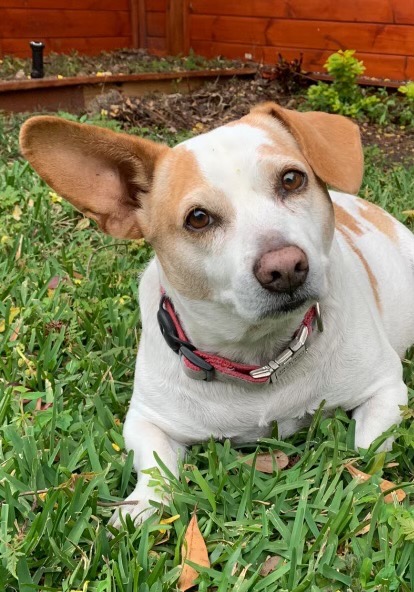
That conviction led Travis to 160 acres of remote Arizona desert and the founding of the Jackson Earth Restoration & Research Center, a 501(c)(3) named for his dog and rooted in a simple belief: science and stewardship belong together. The Center advances climate adaptation through biocrust cultivation, pollinator monitoring, and disaster modeling, while creating living memorials through ceremonial plantings, dedicated groves, and community-driven acts of legacy.
I interviewed Travis about his experiences and the project.
There are some fascinating elements with this story. Travis has allowed me to share – in his words – how all of this came about.
A Follow-Up from Our Interview Guest
Before I tell you about the Golden-Eye People, you need to understand the path that led me to this place — and why it had to be found in silence.
I had cancer in 2018. When the chemo was finally behind me, it felt like I’d been handed a second life. I wanted to do something meaningful with it, but I was still stuck behind a desk, analyzing data as my day job. I’m an engineer and data scientist; I restore communications after disasters.
During one of the major events — right in the middle of my chemo treatments, on my birthday — my boss tried to send me out to a ground-zero site with satellite equipment. Not because I was the right person for the job, but because he wasn’t, and didn’t want anyone to know. After years of boasting about his expertise and passing off my work as his own, I was the only one who actually knew how to operate the system. He was willing to sacrifice my health and safety to protect his reputation.
When chemo was finally behind me and I started to feel like myself again, I saw the world differently — but I still had the same job and the same boss. He had a habit of brushing off anything that sounded like “doom and gloom,” whether it was climate projections or disaster-spread models.
In 2019, I was already tracking COVID long before it became headline news. I shared my data, but he wouldn’t hear it. When I offered to build spread-mapping models, he waved it off as unnecessary. I kept sounding the alarm, but it fell on deaf ears. By early 2020, he was convinced it would simply “go away” — you can imagine whose voices he was echoing.
When the pandemic was officially declared, my maps were ready. Johns Hopkins ended up using the same style of mapping — not because of me, but because it was a standard, effective tool in our field. My boss, meanwhile, stood in front of leadership and presented my work as proof that we were “prepared,” all while insisting the pandemic wouldn’t amount to much.
After that, I was tasked with writing technical papers on N95 masks, viral spread through HVAC systems, and surface transmission — the very things I’d been warning about months earlier. During lockdown, I had a chance to rethink a lot of things, and I stayed focused on my purpose: what would I do with this second life?
I model all kinds of ground-zero events, and hurricanes are the biggest part of my job because we have to restore communications for rescue efforts and coordination. As I was modeling the 2024 season, I went back to data from the 1800s. That changed me.
I could see the climate changing much faster than is being represented in public discourse. I could see very few people doing anything about it. And I knew I had to do something — if only to keep my sanity after years of working for people who have the power to act but choose not to, until it personally affects them.
Finding the Land
I started searching for land — not just any land, but a place that felt like it was speaking directly to me. It had to feel right. And when I finally found it, I knew. It’s somewhere near Kingman, Arizona — that much I can say.
I hunted for weeks, then months, combing through listings and wandering through possibilities. I found several properties, but one of them felt different, almost as if it was calling me by name. When I phoned the number on the listing, the realtor brushed me off. “Don’t waste your time,” she said. “Someone from California is coming to see it.”
I was crushed. I couldn’t shake the feeling that this was the place. I dreamed about it. I stared at the photos until I practically memorized every ridge and shadow.
But something didn’t add up. If it was already spoken for, why was it still listed? I called again, and again she tried to turn me away. So I decided to go out there myself — if not to see that property, then at least to understand the land around it. This time, I called the actual owner.
I had already planned a trip around the entire state when he finally called me back. He said he could tell I was genuinely interested, and that I was welcome to look at it. His realtor would give me directions, he said. She never did.
Right before my flight, I called him again to explain the situation. He sent me a map himself and asked me to try once more. When I did, the realtor told me the price would be higher than advertised because, according to her, the survey team “didn’t know what they were doing.” The owner, meanwhile, told me another man was driving in from California — but he would still give me a chance to see the land and make an offer.
I called the owner as soon as I landed in Phoenix. For reasons I still can’t fully explain, I decided to start my journey in Kingman and circle the state eastward, returning to Phoenix for my flight home. One by one, the realtors I contacted along the way fell through — other obligations, sudden illnesses, properties going under contract before I arrived. With each setback, my hope faded a little more.
I woke at 3 a.m., determined to reach the property before sunrise. I left the hotel around 4:45 a.m., following my GPS through the dark desert. By the time I arrived, it was barely 5:45, and the land was still wrapped in darkness.
I’d brought everything I needed to evaluate the site: soil and wind instruments, temperature gauges, sample containers, and a drone to capture footage. Even with all that preparation, finding the place was a challenge. I relied on satellite images, old videos from previous owners, and an app called OnX just to trace the property lines.
Around 6:30, the sunrise finally revealed the land to me. After taking some drone footage, I turned to put the drone back in my Jeep — and nearly stepped on a Mojave Green rattlesnake. For a moment, I froze. Out there in the middle of nowhere, a single misstep could have ended everything. I was four to six inches away from stepping on it, and no one would have known where I’d gone. I backed away carefully, circled to the passenger side, and climbed in — probably looking, from a distance, like a bear trying to break into a camper. Jeeps aren’t easy to get into on a good day, let alone from the wrong side.
(There’s a video of the snake on my YouTube channel.)
I went back to the property every day for several days. It was unlike anything I had ever seen. I would map and refine my route each day using Google Maps and Google Earth. On the final day before I had to leave, I had to negotiate with myself. I had no idea how I was going to buy this property — or whether the mystery driver from California had already claimed it.
I drove into Phoenix and stayed overnight, since my return flight left early the next morning. From the hotel, I called the owner and made an offer. I negotiated the price down by fifteen thousand dollars and told him I’d pay the deposit as soon as I got back home to Florida. He agreed, asking only for a few small things — nothing difficult. I borrowed part of the money from my 401(k), used my savings for the rest, and we set a thirty-day closing. On January 5th, 2024, the property officially became mine.
A Phone Call in the Wash
It should have been a day of celebration. I flew back out in July, eager to stand on the land knowing it was finally real. I drove a 4×4 Jeep toward the property, but about a mile out, I got stuck in a wash. No matter what I tried, the Jeep wouldn’t budge.
Then my phone rang — the signal is never great in a wash. I answered, thinking I might need help getting out. Instead, it was a surgeon. My son was with him. They had found a large tumor in his colon and needed to operate immediately. My son is an adult, but he also lives with schizophrenia, and for a moment I wondered if this was another confused call, as we’d had before. But this one was real. Very serious.
I gave my permission for the surgery. The moment I hung up, the Jeep rolled out of the wash as if the ground had turned to pavement. No struggle, no hesitation — as if something had held me there until I took that call.
My son is still undergoing chemotherapy. He’s stage four now. We know our time together is limited, so we’re making the most of it. We’re planting trees on the property for my research — and now also as living memorials for the people we love. We recently discussed his own tree. It was a hard conversation, but we had it.
The Golden-Eye People
I’ve placed cameras around the property. There’s one area in particular I call the Golden-Eye People.
For weeks after closing, I kept having the same dream: I’m climbing a specific hill, moving a stone at the top, and revealing a hidden cave. Inside are three small beings that look like children. They have grayish, mushroom-colored skin and very fine, sandy-colored hair. Their eyes are gold — or hazel, close to a yellowish color. They always smile at me, as if they’ve been expecting me. Each time I visit the property, I feel invited, called, and somehow protected.
Recreation of the Golden-Eye Children

160 acres is a lot of land. From one corner to the next, you walk half a mile. On my largest wash, I was walking from that hill when I noticed birds — or bats — appearing and disappearing into the side of the mountain. I’ve tried to find where they go. I believe there’s a cavern I simply haven’t located yet. To be fair, I can’t make it to the property for extended periods the way I need to in order to explore it properly. Each visit is already filled with a long list of things to do.
The Camera
On my last visit, something strange happened. The camera I’d placed at Golden-Eye Hill suddenly went offline. It was a new camera — nearly impossible to find without GPS, the kind of device you can stare straight at and still miss because it blends so perfectly into the rock and brush.
Normally, if I can’t locate it, I activate it remotely and follow the signal. But this time: nothing. No response. I assumed it had been damaged.
When I finally reached the site, I found the solar panel unplugged, the media card missing, and the camera switched completely off. This is in the middle of nowhere — no trails, no traffic, no reason for anyone to be out there except a few rogue cattle and wildlife.
I installed a new camera with pan-tilt-zoom and recorded myself inserting the media card, just to establish a baseline. The camera still works; it only triggers occasionally from the wind. But the card has vanished again. I do have one image from the previous camera — just a blur. I posted it to Bluesky and someone jokingly called it the “mighty desert squatch.” Fair enough.
There were times I turned on the mic and called out for the Golden-Eye People, and heard strange, distorted noise — like a radio rapidly scanning through stations.
Since adding the new camera, I haven’t had any issues other than the media card not registering as though it’s even inside the camera. Everything I capture now goes to the cloud, but the card is still set to record motion locally — it’s simply not being recognized. I won’t know more until I return to the property. If I find the card has been removed again, I have video of myself putting it in, formatting it, and testing it. So where does it go? Who — or what — is out there, and why can’t I ever see them, especially if they know the footage is going to the cloud anyway? I genuinely don’t know.
One other thing: while I was actively using the camera one day, I captured a golden light disk appear in frame. Because I was using the camera in live mode rather than motion-record mode, it wasn’t recording. Before I could finish saying “what is that?” and hit record, it blinked off the screen — as if it knew I was about to capture it.
Recreation of the golden light disc/disk.
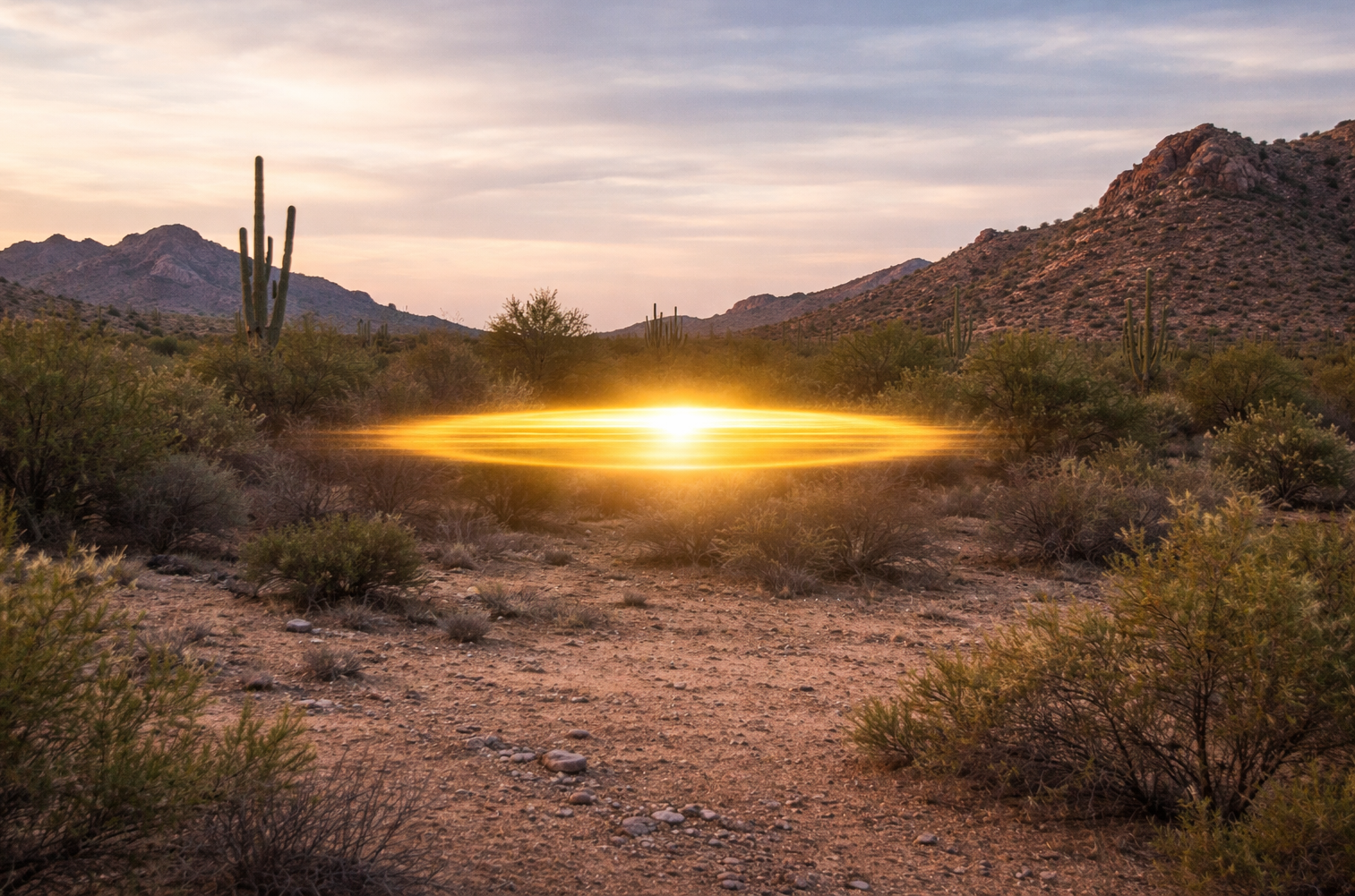
I’m going to continue the work. There are trees to plant, land to explore, and more questions than answers — for now. I’ll keep you posted.
Travis Dean
The Call of the Land
Some people arrive at their life’s work through planning. Others seem to be guided there through a sequence of improbable events.
When Travis told me about his experiences, one detail stood out immediately: he nearly died twice as a child. He doesn’t remember a classic near-death experience. No tunnel. No beings of light. No vivid return from another realm. But that absence of memory doesn’t mean the experience left no imprint.
Research by near-death expert P. M. H. Atwater suggests something remarkable happens when very young children come close to death. After studying nearly 400 childhood experiencers over more than 40 years of NDE research — involving more than 5,000 people in total — Atwater found that children who pass through early near-death states often develop lasting changes:
- heightened intuition and sensitivity
- strong psi or empathic abilities
- accelerated maturity and “wisdom beyond their years”
- a persistent sense of homesickness for somewhere beyond this world
Many of these individuals grow up feeling slightly out of phase with ordinary reality — more aware of patterns, signals, and connections others miss. That pattern becomes interesting when you look at Travis’s life.
He built a career as a data scientist specializing in disaster communications recovery. His work involves modeling hurricanes, pandemics, and large-scale crises — tracking the fragile systems that determine whether warnings reach people in time. In other words, he spends his life studying signals that appear before catastrophe.
After surviving cancer and emerging from chemotherapy in 2018, something shifted. Years of watching critical warnings go ignored pushed him toward something more tangible than analysis. That shift led him to 160 acres of remote Arizona desert. The property became the Jackson Earth Restoration & Research Center, a nonprofit dedicated to restoring fragile desert ecosystems through biocrust cultivation, pollinator monitoring, and climate adaptation research.
On the surface, this looks like a story about science and conservation. But there are also moments that sit at the edge of explanation.
Travis describes recurring dreams involving Golden-Eye beings who seemed to call him toward the land long before he ever saw it. A snake appeared in the desert but did not strike. A Jeep stalled in a wash at exactly the right moment — holding him there until a critical phone call came through.
And one day while reviewing camera footage, he saw something on screen: a golden disc of light. Before he could finish saying, “What is that?” it vanished. Coincidence? Perhaps.
But when you step back, the pattern begins to look less random. Travis didn’t simply discover a piece of land. If you listen closely to his story, the land may have found him — a man trained to read warning signals in complex systems, who became exactly what this fragile landscape needed: someone willing to listen.
Not just to data. But to the quiet intelligence of the desert itself.
Today, the Jackson Earth Restoration & Research Center operates on a simple idea: science and stewardship belong together. And sometimes the people best suited to that work are those whose lives have already brushed the edge of something larger.
And the Jackson Earth Restoration & Research Center is growing — literally. The next community planting event is November 2026, and Travis is looking for people who feel it too. People who are compassionate, committed, and done waiting for someone else to act.
Connect with Travis and the Project:
- 🌐 jacksonerp.org
- 📺 YouTube
- 🦋 BlueSky
- ☕ Buy Travis a Coffee
- @jacksonearthrp on Instagram
- Tree Dedication Form
A big Thank You from Travis Dean – And Dr. Jackson.
Not to be Left Out – The Cows
Travis says they just showed up. Watching them wander around and engage with the camera, at first he thought he might be able to scare them off – making noise and annoying them. Then he got curious and wondered what they might actually like to hear.
It turns out they do have preferences for certain musical pieces. Woodwinds are good. Horns are NOT. And when they are too annoyed they knock over the cameras. He’s had no luck figuring out what ranch they belong to but there is an upside – the cow videos are popular.
I suggested he lean into that. Here’s your Youtube introduction.
Enjoy a few moments with the Cows and Hugh Sung•Debussy Clair de Lune
Prior to the camera tipping incident….
Thank you for reading!

 Conscious Living & Wendy's Coffeehouse