“Absence of evidence isn’t evidence of absence.” — Carl Sagan
The Anomalous Refuses Containment
The modern conversation around contact unfolded in stages, each widening the frame of what could be considered without ridicule. Whitley Strieber opened the door by placing lived experience at the center of the discussion, documenting the psychological, emotional, and transformative impact of contact at a time when such accounts were routinely dismissed.
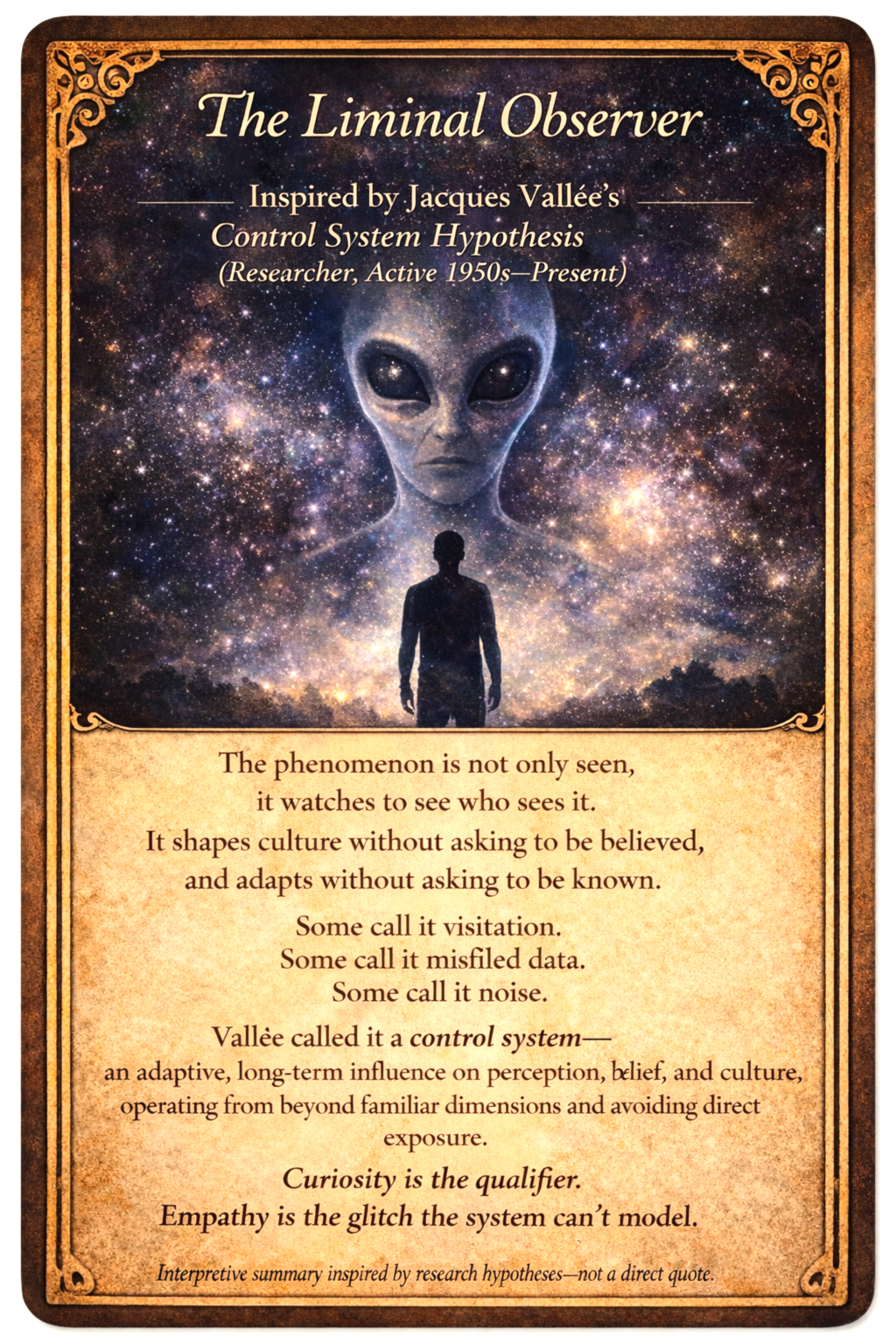
Jacques Vallée expanded that opening into a broader conceptual landscape, proposing a “control system” model, suggesting that the UFO phenomenon may operate from a hyperdimensional layer of reality to influence human culture and perception over long time scales.
His hypothesis suggests a phenomenon that interacts strategically with belief systems and social behavior, a long-term, adaptive system that appears to shape perception, expectation, and cultural outcomes while avoiding direct exposure.
Building on that trajectory, Angela Thompson Smith moves the inquiry inward, exploring contact as an informational and consciousness-based interaction through decades of remote viewing research, longitudinal case documentation, and firsthand experience.
Together, their work traces a coherent arc. From encounter, to pattern, to method, inviting investigation rather than conclusion.
The Long Game
In a recent Dreamland Video Podcast, link, Whitley Strieber expressed frustration that several of his books, namely those following Communion, were effectively buried at the time of publication due to the nature of the material they explored. He suggested that many people now engaging with his online content may not even be aware those works exist.
Strieber has since chosen to republish one of those books, updating it with new material and contemporary context around the contact experience. In this continuation, “Transformation 2025”, he looks toward a future in which these encounters culminate in a meaningful shift in human awareness, a trajectory he has been tracing for decades.
When Communion was published in 1987, it represented a genuine paradigm shift. For many experiencers, it was the first public acknowledgment that deeply personal, often frightening encounters were not isolated or imaginary. Over the years, I’ve spoken with others who describe the book as revelatory, because it reflected their experiences.
Communion was a game changer, coinciding with a series of paranormal events, including waking in the night to see hooded figures standing at the foot of my bed holding a clipboard and speaking about me. They vanished when they noticed I was awake.
At the time, I thought the book had somehow been an invitation and rehomed it. I no longer believe that.
What the book did provide was insight: the possibility that there are intelligences capable of observing us while remaining undetected, and that awareness itself may be a variable in that interaction. My experience validated that but I wasn’t ready to deal with it.
Strieber opened a door. Decades later, experiencers are walking through it with far less fear of ridicule or dismissal. The cultural climate has shifted enough that people now speak with certainty about life-changing encounters, without immediately being shamed into silence.
What remains unresolved are the deeper questions: Who they are, plural, not singular, and what purpose these interactions serve. Multiple intelligences have been documented across experiencer accounts, defying any single explanatory framework. The conversation has evolved. The experiences continue. And the inquiry has persistently moved forward.
The Hidden Hand
Jacques Vallée expanded the early contact narrative into a broader conceptual landscape, proposing that the phenomenon behaves like an adaptive, long-term influence on human perception and culture — resistant to direct exposure, and unfolding relationally over time.
That framework finds a striking real-world parallel in the decades-long experiences documented by John Foster, link, whose encounters began in early childhood and continued throughout his life, often in the presence of multiple witnesses.
Foster’s case stands out not only for its duration and intensity (marked by profound physical consequences later in life) but for its rigor: meticulous records of dates, locations, corroborating experiencers, and extensive visual documentation.
I spoke with John about his experiences. “Exactly how the intelligences communicated with us beyond ESP during normal times really remains a mystery. Except, I know because of another bizarre experience, it at least required my subconscious openness and cooperation.” – John Foster, To Earth From Heaven, Page 37. Our conversations are in the podcast archives. This is a short segment: link.
Across multiple books, including Eminent Discovery and its expanded two-volume reissue, his account reads less like an isolated anomaly and more like a textbook example of the very dynamic Vallée describes: a phenomenon that interacts persistently, shapes belief and awareness, and reveals itself gradually without ever fully declaring its nature.
That same continuity — encounter unfolding into pattern over time — echoes the arc first made visible through Whitley Strieber’s work, where personal experience became a catalyst for broader cultural inquiry.
Please Do Not Touch the Phenomenon
It’s encouraging to see the accumulation of serious, consistent testimony from people who’ve spent decades working at the edge of accepted frameworks.
One of my interviewees, Dr. Angela Thompson Smith, link, adds a compelling layer of validation to that record. With roughly four decades of remote viewing work behind her, she is widely known as a researcher, instructor, author, and presenter in the field.
Her body of work extends beyond the “nuts and bolts” discussion of UFOs/UAP. It leans into the more difficult question, whether aspects of contact are informational, telepathic, and consciousness-linked, not merely physical.
A central example is Voices from the Cosmos, a year-long project focused on remote viewing and telepathic contact aimed at profiling 18 purported ET races. Read as literal contact, a structured consciousness experiment, or an exploratory model, the value is in the effort to map unknown territory systematically rather than dismiss it by default.
Dr. Smith’s personal history is also extensive and documented in Diary of an Abduction, a first-person narrative spanning 1986–1999.
Across her wider bibliography, including SEER and its follow-up SCRIBE (together presented as a multi-decade record of remote viewing research and cases), as well as titles like Tactical Remote Viewing, reviews repeatedly point to the same theme: the work is “beyond the comprehension of most people,” and yet it is presented as a serious attempt to describe and organize anomalous data.
That is where Sagan’s line belongs, as a reminder: lack of mainstream validation does not automatically equal nonexistence. Sometimes it simply indicates that our current tools, scientific, cultural, or psychological, are not yet designed to measure what is happening.
“Absence of evidence isn’t evidence of absence.” — Carl Sagan
The Liminal Journey
Patterns, Encounters, and the Space Between
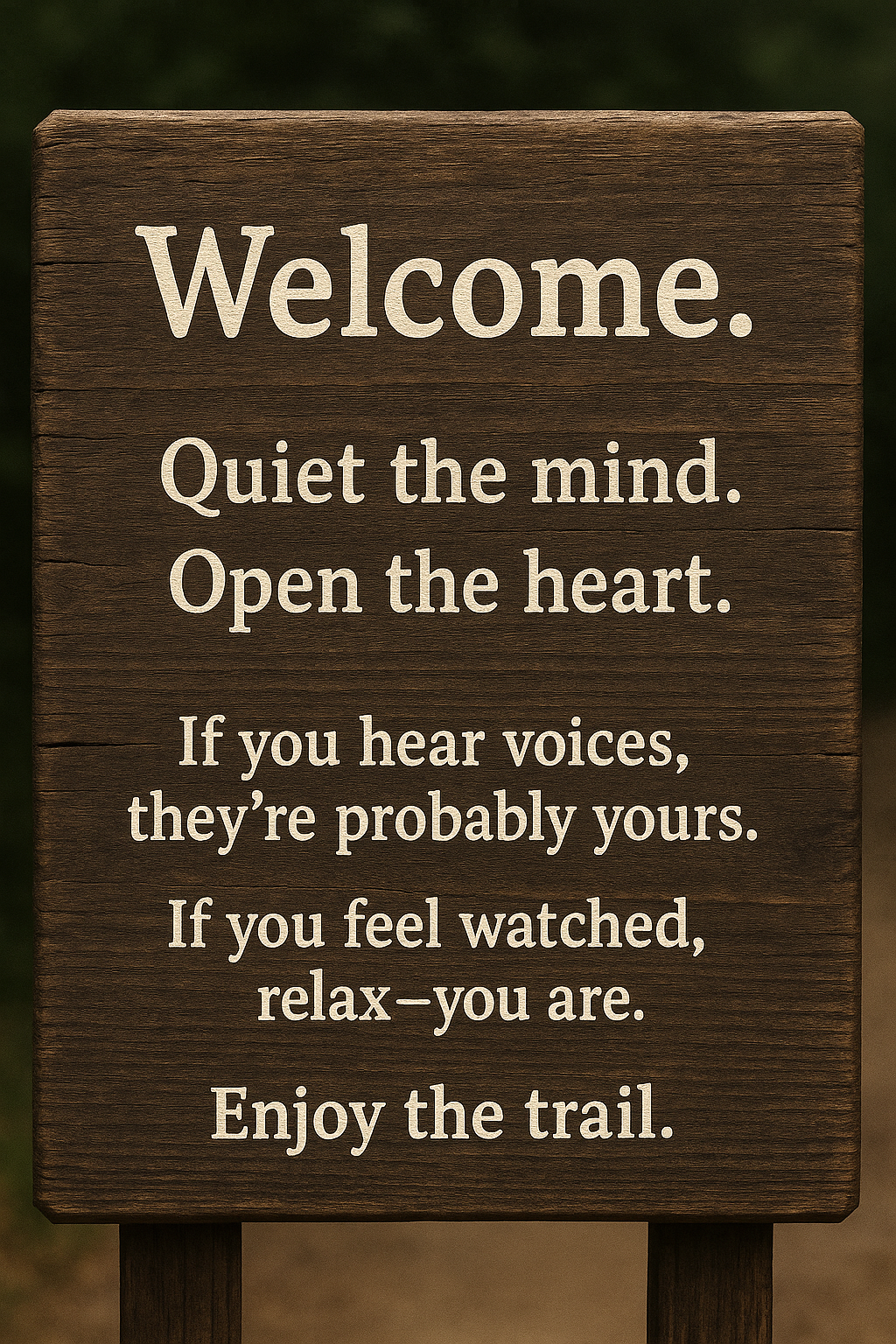
When quantification fails and the phenomenon remains willfully clandestine, the quality of the questions matters more than the answers.
Rather than asking what they are, we can ask what changes in us as a result of contact, regardless of origin, how perception, behavior, creativity, fear, empathy, and belief are altered over time.
We can also examine the conditions under which interaction appears or withdraws, paying attention to context, awareness, emotional state, environment, and expectation.
Finally, we can ask which assumptions about reality are being challenged and which remain untouched, because the boundaries that fail under pressure often reveal more about the nature of the phenomenon, and ourselves, than any definitive explanation ever could.
Trailhead Questions
Before proceeding, consider: What changes in you after an encounter, regardless of what it was? When does the forest respond, and when does it go quiet? Which assumptions did you bring with you, and which ones are you willing to leave behind?
There are no answers posted ahead. Only patterns.
Proceed with curiosity.

 Conscious Living & Wendy's Coffeehouse
An excellent and valuable blog. Sincerely, Aladin. 👍✌️
LikeLiked by 1 person
Hello Aladin. Thank you for reading and for your kind comment. I appreciate knowing my ideas resonate. Be well! Cheers! – wendy 🙏👏💖
LikeLiked by 1 person