Following in the steps of fellow knowers, I’ve seen the watchers. They are real. No one believes me – so, I let fiction tell my story.
In 1823, Lord Byron brushed against a dangerous idea without fully unpacking it. In Don Juan, he suggested that the great upheavals of history don’t always arrive with explosions and speeches. Sometimes they pivot on trivia:
You’ll never guess I’ll bet you millions, milliards —
It all sprung from a harmless game at billiards.
Then he added the line that still unsettles every honest storyteller:
’Tis strange — but true; for truth is always strange,
Stranger than fiction…
Which is another way of saying: reality doesn’t just wear a mask — it wears a sense of humor. Philip K. Dick would later give that hidden machinery a name: a vast, living intelligence embedded inside the world itself. A Programmer. Not a ruler. Not a tyrant. More like a cosmic systems engineer who refuses to announce patch notes. VALIS.
Somewhere, just adjacent to where the world insists it is fixed, a variable was nudged by one quiet degree, a line of code rewritten without ceremony, and the system waited to see who would notice.
. . .
Mara’s alarm went off at 7:00 a.m. exactly. Which immediately pissed her off. Not because she hated mornings. She hated authority. And a tiny rectangle ordering her consciousness to rejoin the workforce felt like tyranny delivered in polite fonts and upbeat sound design.
For three years the alarm had used the same aggressively cheerful male voice: “Good MORNING! It’s TIME to RISE and SHINE!”
Every day, Mara considered violence. But today: Music. Just music. No command. No synthetic enthusiasm. She opened one eye. “Oh,” she said. “That’s new.”
Her brain reached automatically for explanations. Update. Hack. Solar flare. Ghosts. Then something odd happened. She actually noticed it without spiraling. The universe changed a setting…
And she got out of bed. Apparently, that was the test.
Later That Day
In the parking lot, a man stood staring at his car like it had personally offended his ancestors.
“All the colors were gone yesterday,” he muttered.
Mara paused. “Gone how?”
“All the cars. Gray. Black. White. Like the planet was forced into business casual.”
She looked around. Red. Blue. Green. Sunburst yellow. The man followed her gaze.
Oh,” he said. “Guess it was just nothing.” He walked away, soothed by the word nothing. Mara stayed a moment longer.
“Business casual,” she whispered. “Jesus.”
That Night
Her phone chimed without sound. Three bold lines of text floating on black: Observation successful. No overreaction detected. Gold star awarded.
She laughed. “That’s it? I spot a reality glitch and I get cosmic Yelp feedback?”
Another line appeared: Your restraint is the reward.
Oh,” she said. “So it’s that kind of program.”
The screen went dark.
The Next Morning
The news ran a headline no one would remember by lunch: GLOBAL VOICE DEVICES SILENT FOR SEVEN MINUTES — “HARMLESS SYSTEM ERROR.”
Engineers blamed a timing fault. Psychologists blamed expectation. Social media blamed Mercury Retrograde. Then everyone went back to work. Mara stared at the headline over her coffee.
“Seven minutes,” she said. “That wasn’t a malfunction. That was a rehearsal.”
Across the region, millions experienced the same thing without knowing it. Devices changed. Reality hiccupped. A variable shifted, then innocuously reverted. No one compared notes. Because from inside the play, there is no stage.
Final Turn of the Screw
Somewhere just outside the human story — in the thin space between what happens and what is allowed to be noticed — observers watched data scroll.
☑ Subject noticed anomaly
☑ Subject did not panic
☑ Subject did not convert event into religion
☑ Subject retained humor
One tilted its head. “They think it was a glitch.”
Another replied, “They always do.”
A third added, wryly, “Who’s on first.” Only funny from the outside. The watchers, it turns out, are particularly fond of that routine and are briefly sidetracked by a bout of riotous chuckles.
“Exactly,” said the first. “And they’re still arguing about the bat.”
Alien Overlords on Speed Dial
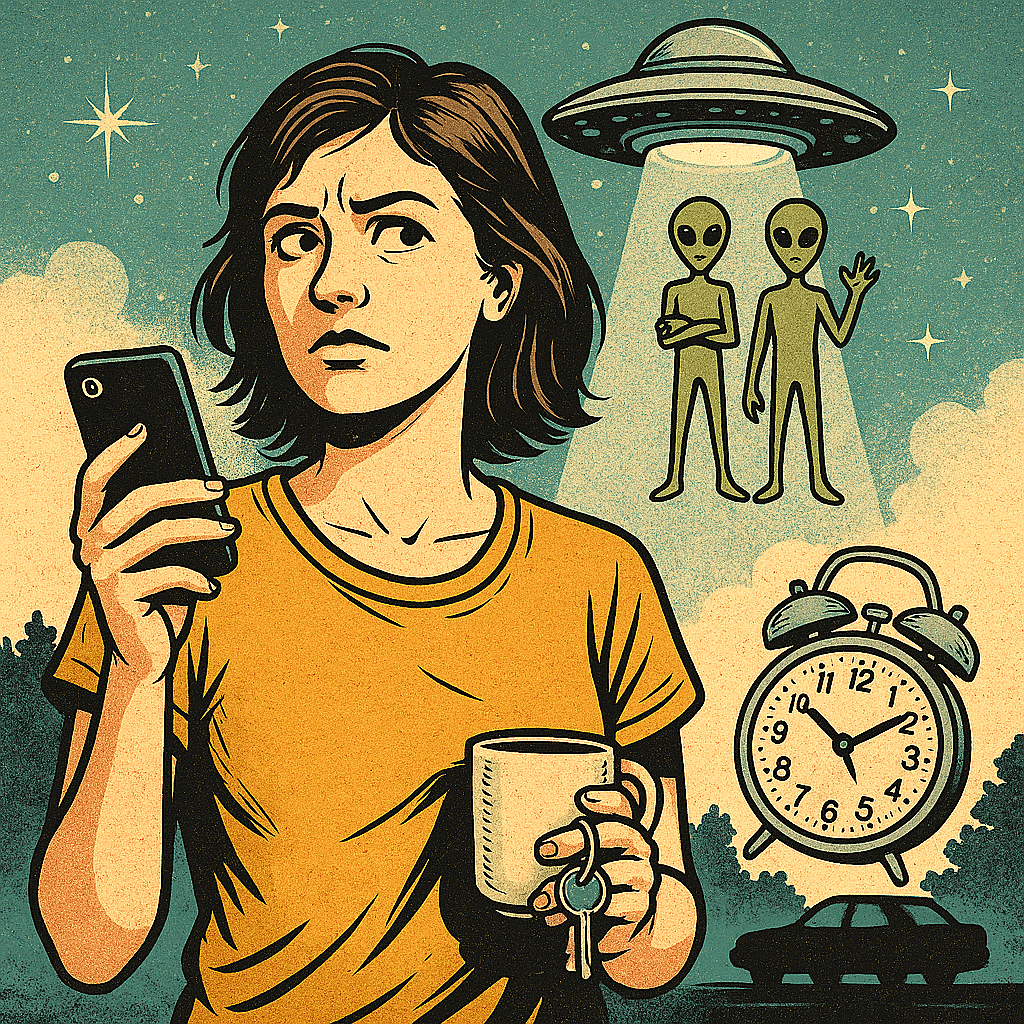
Narrative aside: if something doesn’t fit the user manual of consensus reality, we slap on the label aliens and call it a day. It’s the intellectual equivalent of duct tape on a nuclear reactor.
Modified Reality Aversion
Mara finished her coffee and picked up her keys. The world still worked. Gravity held. Bills existed. But now she knew. The joke wasn’t on humans. It was passing through them.
And a few of them… just a few …were finally starting to hear the punchline, thanks to the suspicious sound of laughter from an audience that wasn’t in the room and a wink from inner space: You see the glitch, congratulations! The glitch sees you.
Reality Glitch Assessment: Subject now “complicit.”
For reasons she refused to psychoanalyze, Mara had just added Who’s on First to her favorites.
Overheard from humans who still don’t get it: “We’re gonna need a bigger bat.” It’s always the bat. Always violence. Never perspective.
Reality is beyond belief. Who’s asking.
Humor is the only user manual that actually works. A nod to George Carlin — patron saint of inconvenient clarity: “Intelligence tests are biased toward the literate.”
Philip K. Dick took this one step further. In his journals and in speeches like Metz, he returned again and again to the same aching fault line: illusion versus reality, Gnosis versus programming, awakening versus loyalty to the story one is given. He wasn’t merely critiquing politics or media. He was diagnosing a deeper cultural condition: a preference for comfortable lies over destabilizing truth.
His satire of American conformity was less an attack on ignorance than a diagnosis of voluntary submission to a manufactured world, a quiet, unspoken contract to remain inside the script. What Dick ultimately exposed was the spiritual cost of choosing not to notice.
And here we are — bat in hand. Who’s on first.

 Conscious Living & Wendy's Coffeehouse
The Programming Clue You Didn’t See
In watch ads, the time is almost always set to 10:10. Not because anyone needs to know the time, but because it looks good. Symmetrical, optimistic, and perfectly framing the logo. A tiny, preselected choice that feels natural, goes unnoticed, and quietly shapes how we feel about the object.
Mara’s alarm going off at 7:00 a.m. exactly works the same way. The time is arbitrary, but the ritual is not. The world says, This is when you wake, this is when you report, this is when you rejoin the script. The settings were chosen long before you started “choosing” them. The hands on the clock, the alarm on the phone, the cars in the lot, the voice that suddenly goes missing. Each one is a 10:10 moment:
A tiny, designed adjustment in how reality presents itself. If you don’t notice it, it’s just time. If you do, it’s a clue.
LikeLiked by 1 person